
Celebrating the gift of life
First-time event at Trinity honors heroes of organ, eye and tissue donation
Trending
STEUBENVILLE -- Kathy Warhola sat Wednesday evening in the lobby of Trinity Medical Center West, not knowing for certain who she'd see.
The regional hospital development coordinator for Lifeline of Ohio, a nonprofit organization that promotes and coordinates the donation of human organs and tissue for transplantation, expected to see several area residents she knew were transplant recipients.
But whether any donor families themselves would actually make their way through the revolving door, despite an invitation, was anybody's guess.
Even so, Lifeline of Ohio and Trinity Healthy System united to honor "the heroes of organ, eye and tissue donation" during a Gift of Life informal event that included camaraderie, celebration and an underlying sense of gratitude beyond measure.
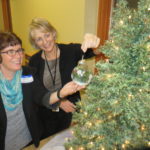
Those attending were invited to decorate an ornament, in this case in honor of the donor and family who made the transplant -- the gift of life -- possible. Trinity will display the ornaments on a tree throughout the holiday season, a difficult time for those who have lost a loved one, Warhola said.
The first-time event at the local hospital was coordinated by Warhola and Barb Banfield, director of nursing, in conjunction with Lisa Snodgrass, clinical manager, critical care. Also on hand was Darrell Maze, pastoral care coordinator, there to listen, be supportive and offer helpful ways to cope to those grieving during the holidays.
Lifeline of Ohio is the organ and tissue recovery agency that works with Trinity Health System, according to Warhola, who has been with Lifeline of Ohio for 15 years.
"I have been the representative that comes here. We have a liaison at each hospital, so Barb Banfield and Lisa Snodgrass are the two nurses I work with," Warhola said. "We do education in the OR and ICU and ED and with physicians, kind of preparing the way so if someone dies who wanted to be an organ, tissue and eye donor, they know what to do, so that's my role."
Warhola said Trinity is participating in a national challenge by the Health Resources and Services Administration. "They encourage hospitals to participate in a challenge to get the word out to educate people about the urgent need for donation and also to sign people up," she said, noting she works with 26 hospitals from Zanesville to Steubenville, from Coshocton to Athens.
Lifeline of Ohio serves 72 hospitals in 37 counties in Ohio and two in West Virginia and is designated as an organ procurement organization through the Centers for Medicare and Medicaid Services.
Warhola said she has done five Gift of Life events this year at hospitals that have potential for organ donations, which Trinity does. "They have had organ donors here before. I suggest they (hospitals) do this because it's a way to kind of take care of those families, and so we sent out invitations to all the donor families we were aware of in this region, if they'd like to come to this," Warhola said, explaining that ones were held in Cambridge, Marietta and closer to home, in Martins Ferry recently. "We had 15 people come last week down there," she said.
"The goal is just to support the families and thank them for their part in it, and we always tell them we'll honor their loved ones as heroes, and that's what we're here to do," she said. "It really does make a difference because it's so hard to lose a loved one, so that's what we're going to do tonight," she said in explaining the goal of the Gift of Life event.
Warhola said it's not easy for donor families to accept such an invitation.
"It's hard for them to come -- it's tough," she said. "It takes a lot of courage to come because they're not sure what will happen. They do know we have two full-time bereavement people in Columbus who work with families and send them information, so they know their names, and the letters came from them to invite them here, so we'll see," said a moderately optimistic Warhola.
The first Gift of Life ceremony Warhola said she ever had was in Cambridge. "I invited people from my region. A few people came, and one woman drove an hour from Belpre. She came to the door and didn't want to come in, because she was too emotional. She handed me her ornament and said, 'Please hang it on the tree to honor my dad.' I swore after that I would do this whenever I could, because if you can help one person get through the holidays, it's worth it," Warhola said.
Those attending the Wednesday evening gathering in the private dining hall at Trinity West were able to create an ornament, a clear plastic globe with items to put inside it. A tag also was provided to acknowledge a donor's name if it was known.
Not everyone has met a donor's family, but Carl Cook of Wintersville has.
He and his wife, Connie, served as greeters at the event, standing in the lobby and wearing nametags to distinguish themselves in the event any donor families invited would attend.
"I came here tonight to honor my organ donor," Carl said. "This night is special because he was a pediatric, only 22-month-old boy that passed away of child abuse, but I am here to honor him and his memory. I carry that memory every day. Every day when I get up, I carry his memory with me, and we do have good contact with his family," Carl explained.
"We speak with his great-grandmother almost every month or so," he said, noting a relationship took root with the donor family a couple of months after his kidney transplant in 2004.
Donor family members attended the wedding of the Cooks' daughter, Carissa, in 2010.
"We have a very good relationship," Carl said, explaining he had a hereditary kidney disease and found out he needed a kidney transplant. Carl did dialysis for 30 months, and after 49 months of waiting for a kidney, "I was blessed to have a transplant up at Cleveland Clinic."
"Donor families need to see the recipients thriving, because it gives them hope that their family is still doing something good, and they see somebody living even though they have lost someone so it is part of their healing process," Connie Cook said of the value of transplant recipients and donor families connecting at an event such as Gift of Life.
"I know with our donor family and because a lot of the donors have passed from a tragic thing, it gives them hope that they're carrying on," Connie said. "The first time when we met his donor family, because the kidney sits closer to the skin after the transplant, he (Carl) let her (the great-grandmother) feel that, so it was like feeling part of your family," Connie said.
"And one of our other fellows not here tonight, he got a heart, and so that's the first thing they (the donor family) wanted to do was lay their head against his chest and hear that heart, so it's an emotional process," she continued. "A lot of people after getting organ donations, they go through that recipient guilt even though they knew they needed it for life, they go through that guilt so not only is it good for the donor's family, it's good for us to see the donor families, because we're so thankful for what they gave," Connie said.
Former Steubenville resident Bill Padden made the trip in from Cambridge to attend the Trinity event.
"It's a pretty phenomenal thing, that somebody can give me an opportunity to stay alive this long," said the 1974 graduate of Catholic Central High School.
Padden explained the scenario of his need for a liver transplant.
"I was working in Cambridge city schools and over a period of years kept getting sick and then I would get better and then I'd have the flu, and they didn't know what it was, and one night I got really sick and had end-stage liver failure," Padden said. "So I went to Ohio State and was there for several weeks, and they sent me back to square one. Ohio State was not doing that many transplants then, and the doctor got me listed at the University of Pittsburgh Medical Center," Padden continued.
"On Jan. 3, 1992, I got a call that they needed a backup, because they always bring extra people in in case it's too big, too small, they're not going to waste an organ, so I came in, and they said, 'Get dressed to go home -- it's not going to happen,' so I kind of expected that, and I got dressed, and she comes back in and says. 'It's too big for the guy ahead of you, you're up,' and so I got it, and almost 26 years later, I'm still here," he said.
Padden has never met the donor family.
"Unfortunately back then, that was like the stone age, it was really not encouraged. It was kind of new," he said. "I knew it was a 19-year-old young man in a motorcycle accident, because my wife overheard people talking in ICU, and that's the only thing we ever really knew, and it was intended for someone else, and when he got there, it was too big for him, so I was just at the right place, right time with the right people," he said.
"You just try never take it for granted, and that's why I volunteer with Lifeline of Ohio. I have been doing that for years," Padden said.
As the years brought an overall increased receptiveness to the idea of transplant recipients and donor families at least having the opportunity to connect or meet, Padden made the effort.
"That's my biggest regret -- that I didn't get to meet any of my donor's family. I wrote letters," he said, noting a compounding issue in the process was that the donor was from New Orleans. "When the hurricanes came through and the hospitals lost a lot of their records, they told me it's not going to happen," he said.
"Every day you think about that person," Padden said. "What could he have done with 26 years, and so you hope at the end of the day, you've done the best you can, and I have a belief system that I someday will meet him and thank him for that opportunity, because if not I would have missed so much. You just think about the little things that go on daily and then the lifetime highlights, all made possible because someone was willing to be an organ donor. Someone's family in the worst time of their life said 'yes,'" he said.
"With us (transplant recipients), the saying is our best day is somebody else's worst day. My best day was when I got my liver. Somebody else's worst day is when they lost that person and they're not coming home, they're not going to be at Christmas dinner, they're not going to be anywhere but I'm still here, and so you promote organ and tissue donation if you can," Padden added.
Transplant recipient Vito Suppa of Toronto attended the event with his wife, Cora.
Vito had a liver transplant Nov. 19, 2014, after having been sick for a couple of years.
He has not met his donor family but has reached out in an attempt to do sot.
"We wrote them a letter," he said, noting it was one of the hardest letters ever to write.
"It took me days -- I'd write something, throw it away, just thank them for being a donor."
He still holds out hope of a meeting some day.
"They say sometimes it takes a donor family a while to get used to it (the idea of meeting)," Suppa said.
Jim and Anita Albert of Martins Ferry also attended. The two are involved in a support group in Cambridge called Buckeye Gift East, as were others in attendance, and they are volunteers with Lifeline of Ohio.
Jim had a kidney and pancreas transplant in 2000 and five months ago had another kidney transplant.
Asked what it meant for him to attend the Gift for Life gathering, he said, "To honor your donor, what they did for you. You do everything you can for what they do for you. I know them but never have met them," he said of the donor's family. "I have written a few times," he said.
"We're hoping for tonight just to celebrate the life of the donors and the recipients," Banfield said of the evening's purpose. "It's a little special to me because my sister is a liver transplant recipient so from the family's side, I know how very, very difficult it is, so we thought this was a good time of year to honor the families, the patients and the donors.
"What we're trying to do is get people involved in grief share groups," Maze said of his presence at the event. "That's a community of people who have lost somebody for various reasons. When you get isolated as somebody who's grieving, it's hard to heal, so we're encouraging if they can find a community of people they can share those experiences with, there's been a lot to come out of that," he said.
"The bottom line is it's a relationship lost with somebody, and that needs its own special space to be honored," Maze said.
For information on Lifeline of Ohio, 770 Kinnear Road, Columbus, Ohio, call (800) 525-5667 or visit www.lifelineofohio.org.
(Kiaski can be contacted at jkiaski@heraldstaroline.com.)