Breaking News
Local News

Franciscan University professor discusses child advocacy work at Kiwanis Club

By ROSS GALLABRESE 5 min read
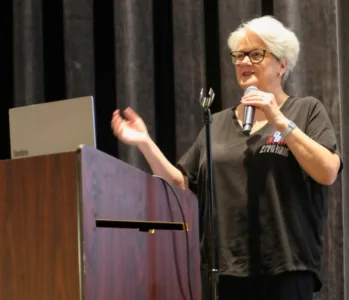
Ross Gallabrese DISCUSSES WORK — Paul Boyles, interim director of A Caring Place Child Advocacy Center, speaks during Tuesday's meeting of the Steubenville Kiwanis Club.

STEUBENVILLE -- Since work brought Paul Boyles and his family from Lexington, Ky., to Steubenville a couple of years ago, he’s been busy teaching and directing programs at the Franciscan University of Steubenville.

And, for the past several months, he’s been serving as the interim director of A Caring Place Child Advocacy Center.

“A number of the things child advocacy centers do involve connecting children with services,” Boyles said while speaking during Tuesday’s meeting of the Steubenville Kiwanis Club at the Sycamore Youth Center. “This is not just a Jefferson County thing or an Ohio thing. This is a nationwide model to improve the identification and, ultimately, the prosecution of people who hurt children.”

The Wintersville-based agency helps to facilitate a multi-disciplinary team that works to ensure children who are victims of child abuse get the care they need and access to the justice system to ensure they are protected.

National numbers paint a disturbing picture. According to information from A Caring Place, 1 in 10 children will be sexually abused before their 18th birthday and between 25 percent and 30 percent of children will be abused by someone a caretaker brings home. Almost 90 percent of children who are sexually abused are hurt by someone they know.

Child advocacy centers sprang from a model created in Alabama in the 1980s after officials found they were having trouble getting successful prosecutions in child abuse cases. The idea was to build a multidisciplinary team through which law enforcement officials, prosecutors, social workers, the medical field and others could work together.

“Currently, we have 24 active cases that we are working with all of these folks,” said Boyles, who is an adjunct professor and the program manager for theology and philosophy at the university. “There are currently three that are in various stages of prosecution and two trials coming up for prosecution of sexual assault on a child and one where we just got a successful prosecution that led to a sentence of 15 years for a child abuse case.

“To me, those are the numbers that really matter, because, at the end of the day, medical exams -- which we have done seven -- those can be done almost anywhere,” Boyles added. “Getting children in touch with social services or with resources -- plenty of agencies do that. No other agency in the county brings all of these people together to bring justice for those kids, their families and everyone else.”

Fifty children have been forensically interviewed this year, he said.

Before retiring after a 20-year career in law enforcement, Boyles spent two years supervising the crimes against children unit in Lexington. He said that since then, he has been involved in one way or another with child advocacy centers for going on 14 years. There’s another reason for his interest in making sure children get justice.

“I myself have a family member who was a victim of sexual assault,” he explained. “The perpetrator was never identified, and no one was brought to justice, and that’s kind of what motivates me in this -- helping the next kid.”

Child advocacy centers streamline the initial phases of the investigation process, Boyles said. While at one time a child might have had to talk with 15 different people, that can be reduced to around three.

“If you know anything about how the brains of children work, telling the story and reliving it are not two different things for them,” he said. “So, when the child has to tell their story to a social worker, and tell the story to a police officer, tell the story to a doctor and tell he story to a teacher, that’s reliving that over and over again. That’s a terrible thing to have a child do.”

He added that asking children to tell a story over and over again can lead details to change, not because the children are lying, but because they are kids.

The goal, Boyles said, is to have children interviewed just one time, adding Jefferson County is fortunate to have a forensic interviewer, Taylor Norman, who’s been trained in interview techniques that will be legally admissible in court.

Child advocacy centers are, for the most part, located in houses, like the one A Caring Place occupies in Wintersville. That helps to provide an atmosphere that is less tense.

“They’re going to a house, not a clinical setting, not a scary hospital with beeps and buzzers. It’s just a house, right? But it is a house that is outfitted with all of the technical means of interviewing these kids. It’s a house that has a full pediatric sexual assault examination room. It’s terrible to think those kinds of things have to exist. But, I’d rather have them exist as a child advocacy center, where a kid can come and be comforted than in a hospital.”

Boyles said it is unlikely that he will remove the interim from his title. He said he had considered applying for the position but decided there were some aspects of the job that he felt uncomfortable with, such as writing grants. Grants, like the support received from the United Way of Jefferson County, and donations provide funding for the agency. He will continue to work as a member of the agency’s board.

That said, he will be looking at implementing training work for medical professionals that would help them to be better able to look for and recognize signs of abuse and how to be good witnesses. Building awareness for children is important, too, Boyles explained, adding that the best way to prevent or to address cases is to keep them from happening.

“The kind of work we do, historically, multiple studies have shown, has increased prosecution rates, or increased acceptance rates for prosecution,” he said. “It means that all of the boxes have been checked and where a prosecutor thinks that he is willing to fight for by between 60 percent and 80 percent.”

Starting at /week.