
Union Cemetery history topic for Kiwanis club
Trending
STEUBENVILLE -- The superintendent of Union Cemetery in Steubenville gave members of the Steubenville Kiwanis Club some insight on its past and present.
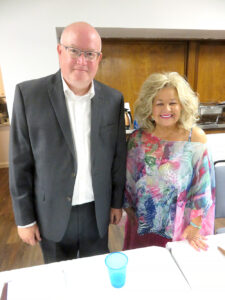
The guest speaker was Joe Benline Jr., who became superintendent of Union Cemetery at 1720 Sunset Blvd., Steubenville, in 2016 after the retirement of his father, Joe Benline Sr., who had served in that capacity since 2004.
Union Cemetery today is 199 acres and was established in 1854. It's listed on the National Register of Historic Places and is privately owned and run by the Union Cemetery Association.
The cemetery originally was in downtown Steubenville where Grant School once was but the town's growth in 1850 created a need for more land, prompting five churches to unite to purchase 50 acres of the Huscroft farm to start the cemetery.
"By July 4 of 1855, the grounds were consecrated by the churches, and they started to develop what you now know when you first go into the cemetery, the bottom part of the cemetery is the first areas that they developed," Benline explained, noting the first burial occurred Oct. 10, 1855, and was for Clayton Donaldson. By 1856, there were burial transfers from the downtown site, according to Benline.
"One of the interesting things that happened during the Civil War, they didn't have enough manpower to help take care of the cemetery, so they decided that sheep would do the job," he said. "They brought 2,000 sheep in and let them run throughout the cemetery, and I actually found when I was researching this that we were one of the first places in the country to even think about doing something like that during that time, but it started to spread that Union Cemetery was doing this, and other cemeteries started doing that to take care of their cemetery," he added.
By 1877, the 48 original acres increased to 143 acres after some other purchases had been made. "Today, we have 199 acres that we take care of," Benline said. The cemetery has around 42,000 burial sites with enough space to accommodate another 100 years' worth.
"In 1909 they discovered oil on cemetery land, not on areas where burials were, but a little bit further up, so they got money from the sale of the oil that they found," he continued. "And two thirds of the money that they put in for that was for redevelopment of some new areas, fixing some of the roads on the current areas that they had. The other third was put into an endowment care account," he said. "Endowment care that we have nowadays, 10 percent of every sale that we have goes into an endowment care account, then we reinvest that money. That money is to be used when we can no longer sell lots, when we can no longer have burials, so that Union Cemetery can be taken care of way after we're done being able to have any burials," he said.
"By 1918 to 1920, the Spanish flu came through, and I don't know if you are aware of or familiar with the cemetery, but where the visitors side of the Harding parking stadium is, if you look back behind there, you'll see stones everywhere, and then you'll see an area where it's nothing but grass. They had to do mass burials there," he said. "That is the only area of the cemetery that we don't have a record of who was buried because the health department made it a mandate to where if somebody had passed at that time, they had to be buried as soon as possible. So they had a mass grave ready, and they buried them in there. There's no record of who's in that area," he said. There is no monument or stone to acknowledge that either.
"In 1930, our land used to go all the way down to Beatty Park," Benline said. "We had two original entrances -- one was down off Lincoln Avenue where Beatty Park's entrance is and one was up on then Market Street, now Sunset Boulevard," he said, noting funeral processions came up through Beatty Park as a way to avoid toll-road fees on Market Street.
The current administrative building was constructed in 1931, according to Benline, who pointed out that there used to be a house opposite that where the board of trustees would meet, and rooms would accommodate people coming from afar, enabling them to actually stay there in the cemetery.
The veterans section was developed in 1939. "We have our soldiers and sailors monument, and that's up in our section right above our GAR section, and that was to commemorate all the Civil War veterans.
Another point of interest, he said, is the old stone bridge. "Anybody that's been through the cemetery, you've crossed that bridge, because that's the only way you get to the upper part of the cemetery," he said.
The receiving vault, refurbished by a Questers group, harkens to a time in history when there wasn't equipment to make winter burials possible. Caskets would be placed there until weather conditions were favorable.
The original office, which was built in 1892, houses the original bell from the Jefferson County Courthouse.
A grave with a collie dog marker has a special story behind it, according to Benline.
"There was a man named John Boylan, and he was a molder in the Means Foundry, and there was an accident. He became blind," Benline said, noting a stray dog ultimately ended up serving as a seeing eye dog for him. When Boylan died in 1924, some of his co-workers decided to make a mold of the dog, using it as his grave marker. "It's been there ever since."
The office building doubles as the residency for Benline. "I'm on the premises at all times. That way, if anything ever happens, I can take care of it, because the Union Cemetery is kind of like a small city. We have water treatment plants. We have a whole water system going through."
He cited some of the prominent burials in Union Cemetery include James and Anna Wilson, the grandparents of President Woodrow Wilson; the fighting McCook section with Col. George McCook having been a colonel in the Civil War and attorney general for the state of Ohio; Bezaleel Wells, founder of Steubenville; Col. James Collier, a veteran of the War of 1812 and the first volunteer from Jefferson County for the Civil War; Moses Fleetwood Walker, the first African American professional baseball player; Tuskegee Airmen Jerome and John "Ellis" Edwards; and Eliphalet Frazer Andrews, who painted a portrait of Martha Washington that hangs in the White House still.
"We have Chief Red Cloud who lived to be 120 years old, and he was best known for traveling with Buffalo Bill's Wild West show, and he ended up moving here in the area. He left the Wild West show and he started practicing his form of medicine," Benline said. "They said he used to drive around in a car with an eight-foot black snake, across the hood of the car."
The cemetery is the final resting place for 10 Revolutionary War soldiers, Benline noted.
Ditto for Jimmy the Greek.
The maintenance building was constructed in 1975. "It holds all of our equipment. There are two public restrooms in there. And there's also a two-bedroom apartment in the maintenance building for the nightwatchman, who lives there, so we actually have somebody who lives out in that outer part of the cemetery and then myself who lives right where you first come in at the cemetery," Benline told the group.
In 1987, the cemetery was named to the National Registry of Historic Places. "The reason for that is we were the second cemetery in the United States that was considered a garden style cemetery. The first one was in Cincinnati -- Spring Grove Cemetery -- and we're both still operating cemeteries at this time," he said, noting Spring Grove was probably about two times the size of Union Cemetery.
In 1995, the current chapel and mausoleum were built, and in 2016, the cemetery fence and gate were redone
"We also created a website that we currently have union cemetery.com in the website, you can actually search burials so if you're looking for somebody, you can actually put down the name of the deceased and it'll tell you what section and lot," he said.
"In putting the website together, we put all the records onto the cloud. Before that, records are basically all handwritten or we had them on the computer, but if we would have had a fire in the building, every burial record could have been gone, so now it's actually protected up in the cloud. We do have all the original records in the office," Benline said.
"We have books that are about this big and about this thick from the very first burial all the way up through, and they're all handwritten. There they are in fireproof safes," he continued.
In 2018, Union Cemetery became the first location sponsor in Jefferson County for Wreaths Across America, "and we've been doing that ever since," Benline said.