
Steubenville Woman’s Club learns about 911
Trending
STEUBENVILLE -- The GFWC Woman's Club of Steubenville got an in-depth understanding of what Jefferson County 911 entails from its director during the group's April 4 luncheon meeting held at Froehlich's Classic Corner.
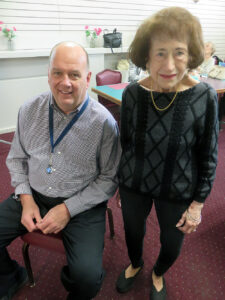
President Carlotta Jordan presided at the meeting where Charlotte Christian introduced Rob Herrington, who has served as Wintersville's fire chief for 40 years and logs three decades with 911.
"Thirty years ago I went to the county commissioners about establishing 911 and they asked me about a year later to take a professional leave from the fire department to build the 911 system -- we had no addressing, no radio system, no 911 center, nothing," Herrington began.
It opened as of May 1997 and has been in the current building at the Jefferson County Airpark since 2006. In a year, there are an average of 40,000 calls handled or as many as 100 per day.
"Radio-wise we have about a million radio transmissions a year back and forth with police and fire and EMS," Herrington said. "We dispatch 52 agencies so we take all 911 calls for the entire county," he said noting those agencies provide police, fire and EMS service in the county.
"All 911 calls ring into a central answering point -- our building in Wintersville at the airpark," he noted., explaining the call data is routed through Boulder, Colo., which "believe it or not takes about 1.7 seconds to go there and back." Boulder is the national center for 911 system management.
The local center has 13 full-time and seven part-time employees and a language interpretation service in Dallas.
Cellular calls account for a large percentage of 911 calls received daily with it being 78 percent last month. The X and Y coordinates of a caller appear on a map with normal accuracy being 25 to 40 feet -- "that's close enough to send you help," he noted.
"We do text messaging," he said, explaining that 28 of Ohio's 88 counties accept text messages to 911. "We have been doing it four years and were one of the first in Ohio to do it," he said. Text messages is done with people who can't speak for any number of reasons -- for medical reasons or domestic violence situations, for example. He shared a story of how a local woman was rescued from a would-be abduction situation thanks to texting 911.
"In about two years we will start video and pictures -- enhanced 911 will give us more capabilities," he said.
Herrington said he has been involved in testifying the past two years in Columbus for the 25 cent surcharge for 911 on a cell phone bill to be raised to 70 cents. It would generate money needed because the NextGen 911 will involve more technology and with it expense.
What Metadata is and what it means was something Herrington shared with the club members, noting Metadata can help cell phone users find relevant information and discover resources but it also can help organize electronic resources, provide digital identification and archive and preserve resources.
Metadata of telecommunication activities, including Internet trafficking, is very widely collected by various national governmental and private organizations, he explained. Such data is used for traffic analysis, marketing and mass surveillance.
The 911 center uses RapidSOS technology, which is a data platform that integrates with emergency response centers to help deliver better, faster help to people in need, according to Herrington.
One of very first cases of this being successfully used in the United States involved a local situation when a woman was kidnapped in Pittsburgh and brought to New Cumberland.
Sometimes 911 uses Code Red Reverse Calling, which is the ability to call residents in a geographical area, for example, in which lost or wanted-person information can be distributed. It's also handy for road closings or utility interruptions and proved especially helpful in finding the suspect connected to a bank robbery in Brilliant, Herrington noted.
A present-day project is a school safety one, according to Herrington, who unveiled it recently at a Jefferson County commissioners' meeting. The program is built around the SaferWatch App -- a communications network that links administrators, teachers, students, parents and first responders, as well as a school camera network that 911 dispatchers could tap into in the event of a school emergency.
With the SaferWatch App, emergency notifications go out to administrators and first responders in seconds. Teachers and staff can use a pendant emergency button, desktop buttons or smartphones to sound the alarm, but the system also will broadcast non-emergencies and tips about school-related activities.
The cost per school would be $2,500.
"We have 38 school buildings and almost 10,000 students in the county so this program will be geared at protecting them as much as we possibly can," he said.
September is the goal for its implementation.
The woman's club has two meetings remaining for the 2022-23 club season, including the May 2 meeting at noon at Froehlich's Classic Corner, where Greg Demary of the Harmonium Project will be the guest speaker and the club will present annual scholarships to students from Catholic Central and Steubenville high schools.
The June 6 meeting will involve a program on the Fort Steuben Chapter of the Daughters of the American Revolution led by past Regent Vickie Joseph with Carlotta Jordan and Judy Brancazio conducting a memorial service acknowledging club members who have died since the service last June.