
Remembering Bellaire native Carl C. Johnson
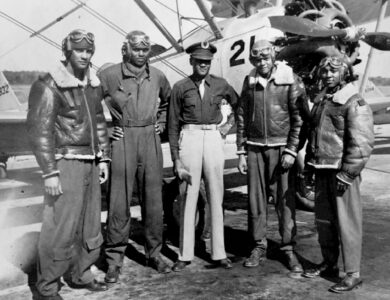
BELLAIRE -- Black History Month is coming to a close. But it would not be complete without a story that remembers a Bellaire resident by the name of Carl C. Johnson.
His friend, Ambrose Bolling of Weirton, supplied some of the information for this story, as noted by Esther McCoy, former lifestyles writer for the Herald-Star.
McCoy previously wrote stories about Johnson when she was employed at the paper.
She, too, contributed a portion of the information for today's article.
Johnson was born April 27, 1926. He grew up during the Jim Crow racial segregation period.
Johnson had been fascinated with aircraft since he was a young boy.
Standing outside his Bellaire home, he would watch as the mail plane would fly overhead, making its way above his Bellaire home toward its destination of Cincinnati.
That love for flying would be reborn within Johnson.
The passion returned while attending high school.
One of his friends was discussing the idea of enlisting in the Army. It was then that Johnson began seeing himself as a pilot.
"My friend, who was white, received a notification, and they didn't call me," Johnson recalled as he spoke to reporters during an interview in 2021.
He said that was the first time he had actually felt discrimination."
The Ohio high school Johnson had attended was racially integrated, as was the campus at Ohio State University, where he enrolled following high school.
His studies at OSU were in preparation to become a dentist.
However, those dreams would have to be placed on hold. Johnson was soon drafted into the Army.
He would be training in what was deemed to be the Tuskegee Experiment. But officials referred to it as the Tuskegee Airmen.
The year was 1945. Johnson was officially inducted into the Army Air Force at Fort Hayes in Columbus.
The Tuskegee Airmen's job to escort bomber pilots (who were mostly white) during combat.
The airmen were made up of approximately 1,000 pilots and several thousand personnel.
The training was so rigorous that Johnson said out of the 119 members in his class, only 12 would make it on to phase four. He was one of those 12.
He completed his training in a special program for pilots from China, and would serve in the military in the capacity of officer.
In early 1946, he and 14 other African-American draftees were admitted into the Army Air Force's Tuskegee Army Air Field aviation cadet program, Class SE-45-I.
Jim Crow segregation was common many places. So, despite possessing a train ticket on one of the more luxurious sleeping train cars, he was placed in a segregated coach seat behind the train's hot engine.
Not being permitted in the dining car either because of his race, Johnson ended his trip to Alabama covered in soot.
When the Tuskegee Airman cadet pilot was prepared to graduate, there soon would become cause for concern.
Appendicitis would strike Johnson, leaving officials to have to conduct his graduation ceremony without him.
And on Jan. 29, 1946, Johnson's classmates graduated Class SE-45-I.
Concerned the Army Air Force would terminate him from the program, along with dozens of other aviation cadets, he continued with his training following a two-week convalescence and a weekend pass to Atlanta.
Following that convalescence and training, Johnson officially graduated.
He was notified by Tuskegee aviation instructors that he had become the final Tuskegee Airman to graduate from the Tuskegee Institute.
In October 1946, Johnson graduated from Tuskegee's Class 46-C Twin Engine Section, earning him his wings as a flight officer.
In addition, he received "Chinese wings for his help in communicating instructions to the Chinese flying B-25 twin -engine planes.
These were given to him from the Chinese President, Chiang Kai-sheik.
He said during his 2021 interview that he was "more or less an instructor for them."
Johnson would now be assigned to Enid Army Air Field in Oklahoma.
He would then be assigned to Lockbourne Air Force Base in Columbus where he served as a member of the 477th Bombardment Group Composite's 617th Bomber Squadron.
In 1947, Johnson was discharged.
Now a student at Ohio State University once again, Johnson joined the Ohio National Guard as a member of its only African American unit.
He returned to active duty as an Army Combat Aviator during the Korean War.
He served as a distinguished aviation cadet.
During the Vietnam War, he served as a lieutenant colonel, commanding the 210th Combat Aviation Battalion in the Republic of South Korea.
Johnson commanded a seven-company aviation battalion while in Vietnam and received the Distinguished Flying Cross award from having served in the war.
This award is presented to any officer or enlisted member of the Armed Forces who distinguishes himself in support of operations by "heroism or extraordinary achievement while participating in an aerial flight," subsequent to Nov. 11, 1918.
For his service in Vietnam, Johnson received 10 air medals, as well.
These medals are awarded to anyone who has distinguished themself by meritorious achievement while participating in aerial flight while serving in or with the Armed Forces.
Having served 31 years in the military, Johnson retired from the Air Force, having achieved the rank of colonel.
Following his retirement from the military, Johnson served at the Federal Aviation Administration and the Department of Defense.
He served in the capacity of commissioner with the Cleveland airport and as a deputy director for Pittsburgh International Airport.
He was married 67 years to his wife, Nancy.
In 2007, Johnson and the collective Tuskegee Airmen received the Congressional Gold Medal.
On Aug. 28, Johnson died at the age of 97. He is survived by his two children, Karen and Michael; his grandchildren, Sancia, Marissa, Jeremy, Matthew and Zachary; and six great grandchildren.
His service was held at his final resting place -- Arlington National Cemetery.