
Doctors take medical care on the road
Trinity physicians undertake missions around the world
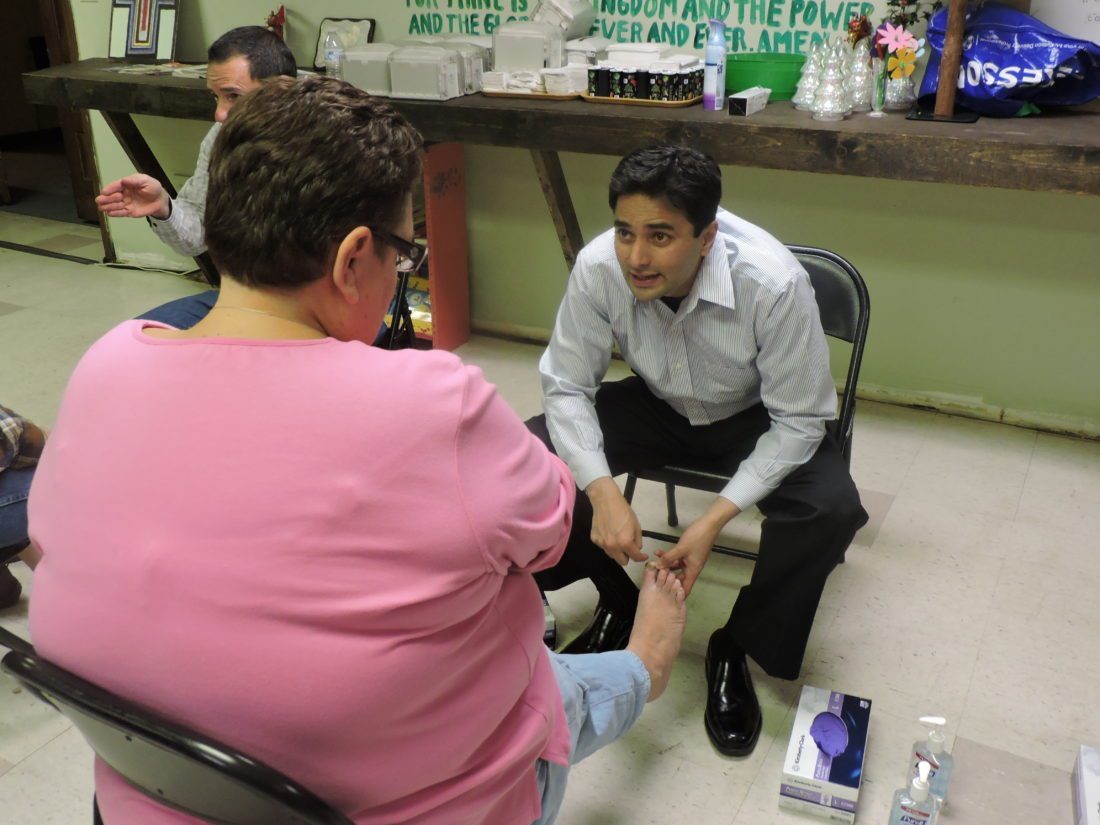
OUTREACH — At left, Dr. Milton Swaby, a physiatrist at Trinity Health System, greets a patient during one of his mission trips. Swaby has worked on mission trips in Honduras and Jamaica, relieving pain and helping patients with mobility and movement issues. At right, Melissa Kegler of Steubenville talked to Dr. Aashish Jog of Trinity Health System about taking care of her feet during the annual Red Wing shoe and boot distribution at Urban Mission Ministries in December. Bottom, longtime Steubenville-area cardiologist Dr. Sathish Magee from Trinity Health System works with patients during a visit to his home village, Dodda Magee, India. Magee made his latest visit to his homeland at the end of February and saw more than 200 patients for free, an effort he began after medical school in 1983 on guidance from his father. His family has formed a trust to help with the medical efforts. -- Contributed
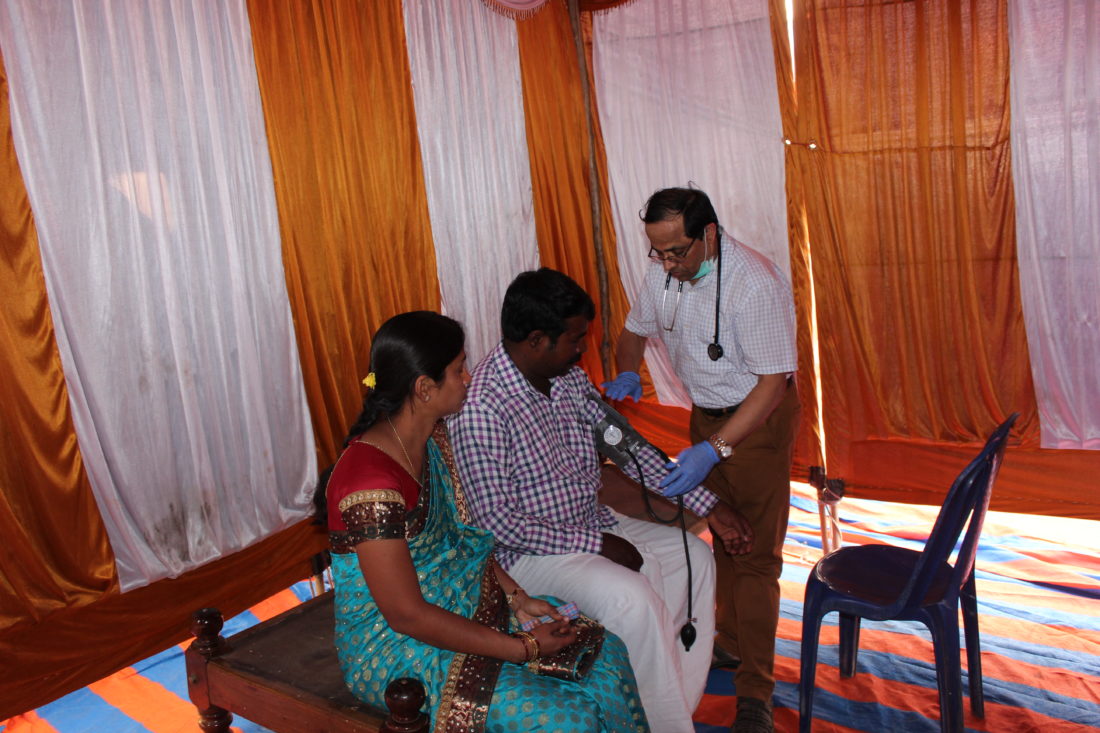
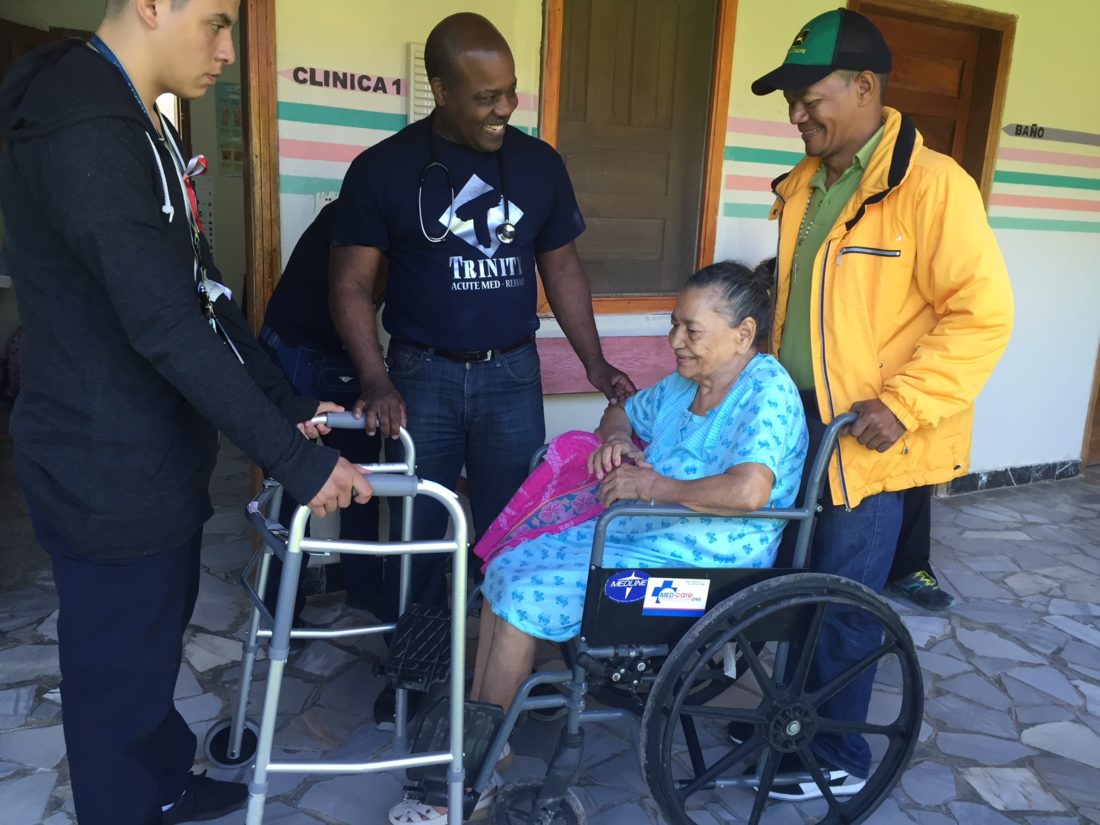
OUTREACH — At left, Dr. Milton Swaby, a physiatrist at Trinity Health System, greets a patient during one of his mission trips. Swaby has worked on mission trips in Honduras and Jamaica, relieving pain and helping patients with mobility and movement issues. At right, Melissa Kegler of Steubenville talked to Dr. Aashish Jog of Trinity Health System about taking care of her feet during the annual Red Wing shoe and boot distribution at Urban Mission Ministries in December. Bottom, longtime Steubenville-area cardiologist Dr. Sathish Magee from Trinity Health System works with patients during a visit to his home village, Dodda Magee, India. Magee made his latest visit to his homeland at the end of February and saw more than 200 patients for free, an effort he began after medical school in 1983 on guidance from his father. His family has formed a trust to help with the medical efforts. -- Contributed
Trending
STEUBENVILLE -- Physicians at Trinity Health System undertake missions to far-flung areas to deliver medical care Americans take for granted in their local doctors' offices and hospitals.
A number of doctors from Trinity take part in missions, volunteering their services to patients in need from India to Central America and the Caribbean islands.
Here are three of their stories:
Dr. Sathish Magee
Cardiologist
Magee comes from Dodda Magee in India, where his father, Lakshminarayam Magee, was a social worker and lived a life of giving to others. He built a school for poor children that became run by the government after his death.
Magee said his father made him practice medicine for a year for the poor, completely free, while the doctor was waiting a year for his visa to come to the United States after he finished medical school in 1983.
"He funded me. I had nothing. We set up in a house in a small room. People have known me since then, and when my parents were alive, once a year or so, I would see patients there who come to the office. After my father died, we created a trust for my mother and father -- she died four years ago here -- and my uncle, Natesh Magee, a general electrician from GE, retired and is president of the trust in India," Magee explained.
"We get no tax benefits out of anything here, that's not the reason for doing it. This is the fourth year I've gone to see patients funded through the trust," he said.
Magee said he saw more than 200 patients between Feb. 27 and March 2, offering services set up in a tent with local help. Magee sees internal medicine and cardiology patients, many older people and some who have nothing. The trust has sponsored major procedures, including for a 25-year-old who was in need of a kidney transplant last year, with the trust picking up the cost of what the government did not.
Magee said 150 patients received three months of medicine, through a pharmacist paid by the trust. He said some who can pay don't take the money through the trust.
"We do a lot of screening and blood work and EKGs. Many didn't know they have hypertension or diabetes," Magee said, becoming a bit emotional. "God has given everything to us and to see those people who have nothing who are so appreciative for what you do."
On the last day this year, 500 people spontaneously came to see him off. A ceremony was held in the local temple for Magee.
"I didn't want it, they arranged it," he said.
"We really have to look at people who have nothing and really appreciate what we have every day," he said.
The lesson has settled in with the next medical generation of Magee's family. He said his daughter recently gave her clothes to a girl at college who had nothing.
Magee's family contributes whatever it can to the trust.
"My father preached to me and to my brothers, both of whom are engineers and who have been here a long time -- they came before me and I came in 1984. He told us I have given you an education. I don't need to give you property. He donated it to the school, which started as a high school and now is a junior college. It didn't even have a picture of him in the school until after his death and now it's known as LSM Junior College. When we see his name, it is amazing what he did," Magee said.
He said his father helped found a hospital, build roads and make the area into a small town.
Dr. Milton Swaby
Physiatrist
Swaby, a physiatrist (a doctor who specializes in physical medicine and rehabilitation) has been going to Honduras for eight years and for the last two years to Jamaica, on medical missions.
He said going through a divorce led him to a calling to do for others. He said he attends an annual meeting of physiatrists and put in his name for international medicine and promptly forgot about it, until about a year later, when he was contacted about making a trip to Honduras.
"I'm originally from Costa Rica and I speak Spanish, so it sounded perfect. It is a physiatrist-driven trip. Usually these kinds of trips are for internal medicine or surgeons or dentists. I was intrigued by how it would work," Swaby said.
The trips typically follow a set schedule. The first day includes meeting with neurologists and physiatrists in the residency program, complete with rounds of their patients. There is a conference the next day and then a six-hour bus ride with third-year physical and occupational therapists out into rural Honduras, to San Esteban. It's their senior trip, Swaby explained, and the students are honored to take part.
They stay at a working ranch with a clinic that the doctors take over for their visit. Also along are physical therapy students from the Mayo Clinic, and there usually is a pediatric physician and a rehabilitation doctor, Swaby explained.
"We are dealing with kids with congenital deformities, who need braces or different beds or wheelchairs," he said. "They identify the children who need something and we get the stuff they need."
Adults recovering from strokes or spinal injuries, or those with neuromuscular diseases come to the clinic, too.
"It's all out in the bush. They come by motorcycle or on horseback, or they walk or come by car," he said. Sometimes, the doctors venture farther into the rural areas to set up clinics in remote communities.
"We see whatever there is to see. We are doctors first and we treat whatever comes before us," he said. Often the work involves teaching families how to deal with therapy and proper care for their loved ones.
Because of political unrest in Honduras, Swaby won't be visiting on a mission this year.
"I can't wait and I hope next year we go back," he said.
Swaby said his sister's church in Florida has a group of doctors who have been going to Jamaica or Haiti for years, setting up daily clinics in different places. He said people who live in Jamaica help set up where the doctors go and the doctors bring donated medicines.
"Trinity has been very helpful and always does well with that, for Honduras and Jamaica," Swaby said. He said he became one of the busiest doctors on the trip when he first went to Jamaica two years ago, giving shots in joints, draining fluid from knees, working with congenital ailments, making diagnoses, offering braces.
"People would hobble in and walk out. And the word spreads," he said. People start coming to the clinics specifically asking for him, he said.
"I come in at 5 or 6 in the morning and stay until 5 or 6 at night. I'm not leaving until I see the patients," he said.
"I was born in Costa Rica and my grandparents are from Jamaica, so I feel a connection. For me, I think God made me to be a doctor," he said, recounting years of finding his way to medical school and then struggling to become a doctor. He had been an information technologist for Zales and a batch data processor for Viacom International in New York, working as a professional trainer, including to some famous clients, on the weekends in the Hamptons.
"I am a strong believer in God. God, the whole time, was preparing me," he said.
Eventually, he did his residency at the University of Pittsburgh. He's been working at Trinity for 10 years.
Dr. Aashish Jog
Orthopedist
Jog began working at Trinity Aug. 1. His outreach includes the local area.
He takes part in the annual From Our Hearts to Your Soles event, a charity founded in 2004 in Pittsburgh by Dr. Stephen Conti and his son, Matthew, who was in high school at the time. He said volunteers go once a year to invite the homeless or those who cannot pay for care, to receive free foot and ankle examinations. Free shoes are distributed. He said in Steubenville there were a record 217 people seen at the most recent event, with more than 200 pairs of shoes distributed.
"I am happy to have done something. It was the beginning of winter, and having winter boots gives a lot of support for their feet," he said. Jog said services include callus removal, treatment of foot and ankle issues and offering minor procedures.
"I offer one free visit," he said.
He offers promotion of healthy practices and gives talks around the area.
"It's not to promote our practice or the hospital. It's just purely to prevent disease so that they don't need medical treatment in the future," he said. For instance, he talks with the elderly about the impact of the loss of bone density as they age, and the need for a good diet to support bone health.
Jog's father was an orthopedic surgeon in Pune, India, and his parents built a Jog Hospital in 1988, a center for deformity correction research. They were able to provide free surgery for hundreds of deprived children.
"At the time, I'm 8 years old and I want to be a graphic game designer. I walked down to talk to my dad one day and he was talking with a family he did surgery on. I tried to get him to spend some time with me," Jog said. "The family's parents told my father, 'God up there sent my kids and they couldn't walk. God down here made them stand and walk.'
"That completely transformed me. If we can do anything more, if we can bring a smile to anyone's face, that is perfect. I changed my career path and told my father I wanted nothing to do with computers anymore," Jog said.
He has worked with Rotary International camps in India to help repair deformation from polio.
"I have been trying to help people since I was 8 years old," said Jog, who turns 36 this month.
"Be grateful for what we have. I consider myself privileged. I am grateful to God for giving me what I have, the ability to take care of myself. In terms of getting happy, there is only so much you can do to fill your own needs. Beyond that, even just giving a smile and telling someone you made my day makes you feel happy. It's from what you see in the eyes of other people that is behind the pursuit of happiness. You do make some difference," Jog said.
"It's not just for us in health care. Just give a cookie to someone. Do anything that makes another person happy. Nothing can match that," he said.
He said it's important to make "the person across from you feel special." Half of all medical problems, he said, are exacerbated by stress levels. "I tell all my physician assistants, residents and medical students that if you talk with a patient, you don't have to look at the X ray. You will know what he wants or needs."
Jog expected to see as many as 100 children in his hometown in India during his spring visit this year.