
Her part of ‘Her Flag’
Weirton artist representing W.Va. in 100th anniversary of 19th Amendment
Trending
WEIRTON -- The 100th anniversary of the 19th Amendment giving women the right to vote comes in 2020, and local artist Savannah Schroll Guz will be part of a unique tribute to that.
The Weirton woman has been selected to represent the state of West Virginia in the Her Flag project -- www.herflag.com -- which celebrates the original 36 states that ratified the amendment.
The nationwide collaborative art and travel project is the brainchild of Oklahoma-based artist Marilyn Artus, and Guz is in the company of 35 other artists involved, each of whom represents their home states. Together they will create a flag with 36 distinctive stripes.
On her Facebook page about the flag project, Artus notes she wanted to create something that was "a powerful, positive educational project to celebrate this very important American anniversary."
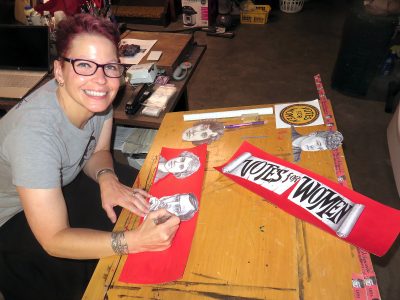
For Guz, her work will be the 34th stripe in the 18-by-26-foot flag and contain portraits of four figures instrumental in the amendment's ratification: Dr. Harriet Brown, Lenna Lowe Yost, the Hon. Jesse A. Bloch and Ada Enid Haldeman Ford. "I meet up with Marilyn on June 11, 2020, in the W.Va. state capital, where she will sew the 312-inch stripe I contribute onto the larger flag. The event will be filmed as an episode in a larger project documentary. We're going to make it a celebration, with music and spoken word poetry by West Virginia-based performance artists."
But Artus already has begun her 14-month journey to 36 states, traveling in the order of ratification. It kicked off June 10 in Wisconsin and will end on Aug. 18, 2020, in Nashville.
Ohio's stripe, designed by illustrator and designer Lindsay Dale-Scott to honor the Ohio women who led the charge for women's suffrage, was added to the flag in Columbus on July 21.
"The completed flag will hang at the Mid-American Arts Alliance in Kansas City, Mo., and then Marilyn is working to have it hang in the U.S. Capitol in Washington, D.C., during the 2020 election season," Guz said. "Additionally, she and her team are creating a documentary film about the flag itself, and each of the 36 sewing ceremonies, so there will be a segment in the film about our meeting in Charleston. The Her Flag project will live on in film that way as well," she said.
From stop to stop, the artists will publicly hand Artus the stripe representing their state, and Artus will sew it onto the flag in their capital city. She will engage with each local community to provide a woman musician or performer the opportunity to participate in this celebration as well. The public, meanwhile, will be invited to witness the performance and take a moment to remember an important anniversary.
Guz learned about the Her Flag project's call for artists through a friend, who urged her to enter.
She did, completing her initial design in March and submitting the final artwork in April. "I submitted examples of my work, my artist statement, an explanation of why I wanted to be involved and waited for the notification," she said. "When the 'congratulations, you've been selected' e-mail came, my husband, Michael, said there was so much joyful squealing coming out of me that I scared our dogs," she said, playfully referring to her "art associates" -- Otto, a schnoodle, and Miss Pepper Potts, a rescue Pomeranian from Paws Here Awhile in Georgetown, Pa.
"I feel incredibly privileged to represent this wonderful state with my art, to honor the state figures that made women's suffrage possible and to be able to tell our state's actually pretty dramatic ratification story," Guz said.
"Marilyn is having each design printed onto a stripe, whose predominant color is either red or pink. Because we are state No. 34 of the 36, my assigned color is red, and its length is 312 inches. Marilyn is traveling to each ratifying state's capital with her Singer sewing machine and attaching each stripe to the growing flag, which will ultimately be 18 feet by 26 feet. Although West Virginia ratified the 19th Amendment on March 10, 1920, I'll be meeting Marilyn in Charleston on June 11, 2020, for the sewing ceremony. We're hoping to achieve this on the capitol grounds. I'm working with her staff to make this happen, as well as have female musical performers present for the event," Guz said.
The artist statement that explains her stripe's iconography and will accompany her contribution as the flag tours notes:
"West Virginia's stripe depicts four figures instrumental to the state's ratification of the 19th Amendment. The first portrait, at left, is of Preston County-raised Dr. Harriet B. Jones, the state's first licensed female physician and the first woman elected to the West Virginia House of Delegates. The second portrait is Marion County-born Lenna Lowe Yost, president of the Equal Suffrage Association and the West Virginia Women's Christian Temperance Union as well as eventual director of the Women's Division of the national Republican Party. The third portrait represents Wheeling-born Sen. Jesse A. Bloch, who raced home from a California trip to break the 14-14 deadlock in the West Virginia Senate, thus compelling ratification. The last portrait depicts Taylor County-raised Ada Enid Haldeman Ford, founder of both the Taylor County Women's Suffrage League and the first Democratic Women's Committee as well as the first woman to be elected to the Democratic State Executive Committee.
"The years indicated on the stripe are watershed points in state suffrage history. The first, 1895, is the year in which the inaugural women's suffrage convention was held in Grafton, W.Va., and the point at which many suffragette groups were founded. In 1913, the West Virginia House of Delegates attempted to pass a statewide women's suffrage amendment, but it failed to receive the two-thirds majority required. The year 1916 saw an unsuccessful public referendum on women's suffrage, which was rejected by the yet all-male electorate. A star appears on the year 1920, when Sen. Bloch cast the deciding vote in favor of 19th Amendment ratification.
"Finally, a rhododendron, West Virginia's state flower, is self-referential but also because the plant flowers in clusters symbolizes the great blossoming of women's rights. It is depicted in ascendance."
Guz describes herself as an area transplant who grew up just outside York, Pa., "often called the nation's 'first capital' because the Articles of Confederation were signed there," she notes. "I went to high school in a little town called Spring Grove, which is still dominated by the paper industry, and from there, I went to a wonderful, small liberal arts college called Juniata, not far from Penn State's main campus. I had so many fantastic professors there. Just before graduation, I was awarded a Fulbright Scholarship, which allowed me to study in Germany," she said.
"Once I settled in Munich, I sought an internship at a museum called the Alte Pinakothek, where I became an assistant to a curator of 17th-century Flemish paintings and actually became a correspondence translator for a Hohenzollern prince, who, in 1998, was the museum's director," Guz said.
"When I came back to America, I attended Pitt, where I got a master's degree in art history, and thereafter, I worked as the public information officer for the Smithsonian Libraries from 2000 to 2002. I stayed through Sept. 11th, the anthrax scares, some local chaos, and I finally left during the sniper attacks," she said. I moved to Weirton in early 2006, a few months after I met my husband, Michael, in Pittsburgh, and we decided we wanted to get married. Michael is my best friend and, often, the brains of my operation: I talk with him about some pie-in-the-sky idea, and he helps me to make it a reality. For example, I recently wanted to build a coffin for an exhibition that ended Friday at the Pittsburgh Glass Center, and he helped me engineer and build it. He also helps me fabricate all the handmade frames for my paintings," Guz added.
For a long time, Guz worked as a freelance writer and copy editor and also taught composition classes at West Virginia Northern Community College. "Primarily, I wrote articles for American Craft, Pittsburgh City Paper, DRAFT Magazine, and I had a monthly review column in Library Journal. I also copy edited college textbooks and encyclopedias for a publishing house in upstate New York," she continued.
"In 2012, I began doing art casually, and when it began to sell, I began to shift my focus to creating more pieces. In late 2017, I decided to pursue art fulltime, although I still take on writing and copy editing projects and helped to revise the Pittsburgh Glass Center's website text and publicity material," she said. "I also work as a teaching assistant at the Pittsburgh Glass Center, a job that grew out of a recent artist residency there. I also have a few collectors who regularly order pieces from me, and I am very grateful for that," she continued.
Art has always been an interest.
"I have created art since I was very little, just capable of holding a pen," Guz said. "My father was a kitchen manufacturer, and as a 4- or 5-year-old, I would sit at his desk and amuse myself by drawing princesses on the little Formica tablets that salesmen left him. My mum tried me in ballet and piano lessons. Nothing stuck but the art. In middle school, I won several art contests, and that seemed to seal it in my mind. I took some creative detours involving writing in my 20s and early 30s, but it has always been the visual arts that have interested me most," Guz said.
"I love to draw -- it really seems as natural as breathing to me. Bic ballpoint pens, which is what I created the Her Flag portraits and rhododendron, are my absolute favorite, but, when not digitized, ink is fugitive and fades quickly if exposed to strong light. So I have shifted my focus to painting and installation, and I love working in color. I recently took a course in Eastern Orthodox icon painting with a wonderful iconographer named Michael Kapeluck in Carnegie, Pa., and I believe I may now be hooked on this art form. I am developing a collection of books on the subject," she said.
In 2000, Guz was part of a group show in New York City at Limner Gallery, which was then on the Avenue of the Americas, not far from Times Square, she explained.
"After 9/11, that gallery moved to Hudson, N.Y., and I had a piece in another Limner group show in 2013. I am grateful to the now defunct GalleriE CHIZ in Pittsburgh because it was the first to take my work on consignment in 2012. I remember driving through a snowstorm on the Parkway to deliver pieces. In 2013, I found a wonderful gallery called HIVE artspace in my hometown of York, Pa., and the owner, Susan Scofield, has been so incredibly supportive. She also works at Creative York, a major arts organization in the city, and thanks to her encouragement, I began submitting work for various shows," Guz said.
"In 2017, I submitted pieces for an exhibition juried by a curator from Allentown, Pa., and my giant -- I had to rent a truck to get it there -- Hildegard von Bingen painting won Best of Show. Afterward, in January of 2018, I had my first full-scale Radium Girls installation at Creative York, and for this installation, I worked with Weirton's amazing Rick Witkowski to create a soundtrack. This played on a reproduction phonograph in the installation's corner, while my drawings illustrated the story. In August 2018, I had my first major solo exhibition, titled "Oracles, Criminals, Mythical Beasts," at the Foundry Art Centre in St. Charles, Mo. Otherwise, my drawings and paintings have illustrated a number of literary journals, including, among others, the University of Houston's Glass Mountain, Youngstown State University's Jenny Mag, and American University's Folio," she said.
"On Friday, I am excited to be exhibiting with the incredibly talented Steubenville-based artist Gerald Van Scyoc in a show called 'Fire & Water' at the Center for Music and Art in Wintersville. Our opening starts at 6:30 p.m. in the downstairs gallery," she said.
Being part of the Her Flag project is another distinction, one bearing even more meaning given it involves a woman's right to vote and a special centennial celebration. "I think contemporary women often take our ability to vote and our political voice for granted, only because we are so many generations removed from the original struggle," she said.
"The story of the fight for women's suffrage has been eclipsed by so many pressing pieces of history and so many more modern and contemporary tragedies," she said. "However, we need to learn about and celebrate what it took to get us, as women, here and about the people -- female and male -- who fought to give women a political voice."
Guz is passionate about the project with good reason.
"When I was a child, my mum, who is a baby boomer, had a pink-and-white scarf that said, 'You've Come a Long Way, Baby.' It was cigarette-related swag, but the message meant so much more than pushing a product. It was a reminder of the era from which she emerged," Guz explained.
"She and my father were entrepreneurs; they both came from humble backgrounds, but together, they forged a tremendously successful business and, ultimately, a larger legacy. She and my father instilled in me a desire for self-empowerment, for getting things done, and I am forever grateful for that because it is a genuine gift. I understand that not every girl receives this message of self-actualization. There are many women throughout the world who don't enjoy the luxury of a political voice, who can't express themselves at the ballot box, who live under tremendous oppression," she said.
"Ultimately, I want the visual narrative Marilyn Artus is piecing together to reach outward to embolden others and, in this approaching election year, to remind women in the United States of how far we have come," she added.
"I am so excited and honored to represent my adopted state in this project," Guz said. "Our state has so many amazing artists and so much potential to be a cultural powerhouse. No one should ever count West Virginia out. I may not have been born here, but I married someone who was, and I know how deeply West Virginia allegiance runs. I love it, and I absolutely honor it."
(Kiaski can be contacted at jkiaski@heraldstaronline.com.)