
‘Keeper of Memories’
Weirton museum has change in leadership
Trending
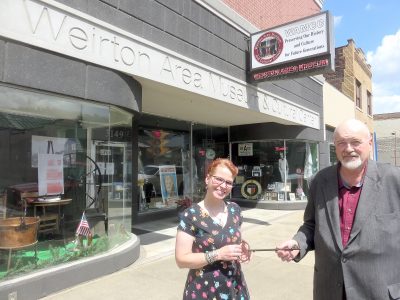
WEIRTON -- At the Weirton Area Museum & Cultural Center at 3149 Main St., there's a change in the "keeper of memories."
An energized Savannah Guz is the new executive director and president of the board, stepping into the volunteer post held by Dennis Jones, ready to pursue a bucket list that includes photography and traveling.
The switch brings expectations for what's to come, a lengthy review of what's been done and a mutual appreciation and respect between the two history devotees.
"After 12 years serving as president and executive director, I think the 'pause' created by the 2020 pandemic has created a great opportunity to reopen with a fresh change of leadership," reflected Jones, a lifelong Weirton resident. "We are so very fortunate to have Savannah come along. Her youth and love of working with history and art will be a super positive for our museum for many years to come.
"The museum will be in great hands here with Savannah," added Jones, who was elected executive director and president in 2008, having served as secretary previously.
A June 9 board meeting officially put Guz on the new journey, one she calls "an incredible honor."
"I call myself 'Keeper of Memories' because I feel that it is my duty to care for our city's collective memory and share it as widely as possible," said the York, Pa., native. "People entrust their treasured objects with us, objects that remind us of who we are, objects that have the power to educate and inspire."
Of Jones she said, "Dennis is an amazing person and a mentor to me. He has created a remarkable foundation here through his scholarship and the example he has set. He also is very modest and doesn't draw attention to his own efforts, but the work he has done is extraordinary. I have very big shoes to fill here."
Guz brings to the position a passion for history, art and the museum's role.
"Weirton has a story that is nationally relevant because here, the American Dream was actualized for so many people," she said. "Immigrants came here, found work, bought homes, grew families, built a life and flourished. And while there is mourning over the loss of the way Weirton used to be and the changes associated with the mill, my perception is that our city is standing at the beginning of an exciting new chapter in a much longer story. And that's, in part, the purpose of the museum -- we preserve the stories of the people who determined our past and now help to define our present so that current and future generations have a reminder and a compass as they move into the future."
Guz's long-standing interest in museums is rooted in frequent childhood trips made with her parents to Williamsburg, the Baltimore Museum of Art and the Smithsonian Institution.
In high school, she worked as a docent at the York County Historical Society, and while attending Juniata College, she took museum studies exchange courses at American University in Washington, D.C., and interned in the Twentieth Century Department at the National Gallery of Art.
Guz graduated from Juniata summa cum laude in 1997 and went on to study German Expressionist art as a Fulbright Scholar in 1997-98 at the Ludwig Maximilian University in Munich, Germany. There, she completed a practicum at the Neue Pinakothek Museum for Alte Pinakothek Museum curator Konrad Renger, specialist in 17th-century Flemish painting. She also served as a correspondence translator for General Director Johann Georg, Prince von Hohenzollern and for the Bavarian National Museum.
She returned to the United States in July 1998 to study at the University of Pittsburgh, where she earned a master's degree in art history in 2000 and worked as a contract editor for the Mattress Factory Museum of Art. In May of that year, she moved to Washington, D.C., where she started as the public information assistant at the Smithsonian American Art Museum and quickly transferred to the Smithsonian Institution Libraries to become their public information officer. She came to Weirton when she met her husband, Michael Guz, in 2005.
"I seek to make the museum a regular destination for both the community itself and those coming from outside the city," she said in comments pertaining to upcoming exhibitions and cultural events.
"We already have a new gift shop on the first floor in which you can purchase both fiction and history books by local authors, Fiestaware mugs and ornaments that support the restoration of P&W Bus No. 99, postcards containing the beautiful photography of Dennis Jones, documentary DVDs and handmade jewelry by local artisans -- all of which make perfect gifts," she said.
"I also have started a rotating exhibition program, whereby we have new content in our gallery spaces approximately every six weeks. Right now, we are featuring three local artists -- Top of West Virginia Arts Council member Dale Biesecker, professional illustrator Bob Dombrowski and 2020 Tamarack Fellow Jaci Rice," she added. "In late July, we'll be celebrating the centenary of the 19th Amendment's ratification with the work of just under a dozen women artists from the Northern Panhandle. In August, we'll be featuring the work of local quiltmakers and fiber artists, including Lea Shirer, Carol McFadden and Kelsey Ohler. In late September, we'll be exhibiting the submissions from a recent call for art that asks people to directly engage with objects or photographs in our collection. And in October, we'll be celebrating the legacy of Weir High art teacher Robert Haworth and the students whom he taught through our annual J. Robert Haworth Memorial Exhibition. Plans for the 2021 exhibition schedule already are under way and will include an exhibition of original, screenprinted Weirton Steel Safety posters," she explained.
"We also have many upcoming cultural events, including our recently launched monthly reading series, Lit at the Museum, which features the work of local writers and published authors. Our July 9 Lit at the Museum event, which begins at 6 p.m., features the poet Pastor Gary Lilly," Guz said, adding that readers for Lit at the Museum, held the second Thursday of every month at 6 p.m., are booked into October.
A membership drive is scheduled for August, and Native American History month will be celebrated with two presentations by Alan Fitzpatrick, author, artist, historian and re-enactor. Fitzpatrick will offer a hands-on educational children's program, titled "The History and Material Culture of Native-Americans in the Upper Ohio Valley" at 10:30 a.m. on Nov. 7 and at 2 p.m., he'll present a program for adults, titled "Captives and Kin in the Ohio Country."
"We look forward to welcoming the community to all these events," she said.
The event scheduling to promote the museum runs parallel to the foundation laid for the facility itself, work initiated by Jones, who became a member when the organization was in its infancy and the museum initially was in a 700-square-foot space at 3393 Main St., now home to the Summit Art Gallery.
Jones volunteered there on Sundays, his day off from working in Columbus at the time for American Electric Power. He retired in 2009 after a 33-year career in electrical engineering.
While Jones said he had no intentions of becoming executive director and president, he accepted the position in 2008, the same year he created the Weirton Area History Game, which raised thousands of dollars for the museum thanks to nearly 50 area businesses and supporters who sponsored question cards all housed in a box made of steel produced in Weirton.
His main goal, he said, was for the museum "to establish an adequate facility to house, keep and display our area's rich history for present and future generations."
In 2010, thanks to fundraising efforts from the history game; the Festival of Nations, a revived staple since 2009; and donations from individuals and board members, including a $12,500 personal donation from Jones, the former Home Furniture Co. building at 3149 Main St. was purchased.
The business had operated there from around 1941 and closed in the late 1970s, according to Jones. "This was kind of like a warehouse afterward. It was all tore up on the first floor," he said.
Purchase papers were signed in December 2010, and work began in earnest the following month.
During 2011, Jones spent nearly every day at the newly purchased building overseeing the renovation of the building's first floor, which included new electrical service, new heating and cooling system, new flooring, painting, new restrooms, etc., -- all performed by contractors and volunteers. "A J.C. Williams grant also was very helpful in this cause," he noted.
"We had our first ribbon-cutting in November 2011 to open the first floor," Jones said.
The next big improvement to the building involved the renovation of the facade, arranged and supervised by Jones during the spring and summer of 2013. "The front of the museum now added great beauty and appeal to the 3100 block of Main Street, welcoming visitors with its nice simulated block/brick appearance, all thanks to a grant from the Pugliese Charitable Trust," he explained.
Jones also planned, arranged and supervised the latest improvement to the building, which was the renovation of the second floor, making it open to the public. In order to use the second floor, it was necessary to have an elevator (vertical lift) installed, according to Jones. "It took a lot of work and two grants from J.C. Williams Charitable Trust and the Pugliese Charitable Trust to have the elevator installed," he explained. "J.C. Williams provided another grant to complete renovation on the second floor with new electrical distribution, a new fire escape and new carpeting. These latest renovations took a few years to complete at which time the new museum celebrated with its third ribbon-cutting ceremony."
The second floor includes themed rooms with a variety of displays of Weirton's history. There's the Discovery Room, used for museum board meetings and as a children's activity area; the "Avenues A to K" room, which includes the history of North Weirton, including the schools, churches and various people; the "Holliday's Cove" room; the "Medical History" room, with items donated by Drs. Ray Greco and J.K. Luthra and the family of Dr. E.L. Bails; and the "School Zone," with yearbooks, memorabilia and other items from Dunbar, Weir and Madonna high schools. There also are displays for the P&W Bus Co. and films made in Weirton, including "Super 8."
Beyond the building but during his tenure, Jones:
¯ Established a monthly newsletter which he posted online from 2008 through 2013, keeping record of the museum's history along with including local history items.
¯ Established the museum website which he built from scratch, learning how to do it as he went. He later established the Weirton Area Museum Facebook Page and the Weirton History Huddle Facebook group which keeps thousands of people attached to Weirton, although they may have moved away years ago.
¯ Designed and created the Weirton Area Museum logo.
¯ Wrote and organized the "Rediscovering Holliday's Cove," a 70-minute documentary which premiered in 2013. This involved coordinating interviews with several local citizens and historians along with editing video production by Enstride Studios. Sold on DVDs, it raised several thousand dollars for the museum. In addition, the video was played on West Liberty University TV channel and on public television in the Charleston area.
¯ Arranged for a historic marker to be placed at the site of the former Cove School building, and during a Rediscovering Holliday's Cove celebration there in 2013, the new DVD and other historical items were buried at the base of the marker in a sealed time capsule.
¯ Co-wrote in 2016 the "100-Year History of Weir High School" and supervised the making of a 45-minute documentary about the school, including interviews with several key people in the history of the school. The documentary was put on DVD and raised thousands of dollars for the museum.
¯ Wrote several historical articles and his picture-captioned history book titled "Images of America -- Weirton" was published by Arcadia and raised several thousand dollars for the museum. He also wrote "Weirton -- A Pageant of Nations" detailing the city's first Festival of Nations events held from 1934 through 1944. Jones also has worked to help several others who wrote books about local history, including Mike Nogay, John Pandelios, Jane Kraina and Tom Zielinsky.
¯ Took several of the museum's fragile collection of historical 16 mm Weirton Steel movies to Charleston, working with Richard Fauss at the W.Va. State Archives to have them digitized and preserved.
Jones said he considers one of his greatest accomplishments and donations during the past 12 years was to personally finance the scanning of all the past issues of the Weirton Steel Employee Bulletin.
"This included scanning all 550 issues from 1934 through 1989 -- more than 10,000 pages size 11×14 -- and having each issue saved as a searchable pdf file," he explained. "Any word in the bulletins can now be found by simply typing in the key word(s), and the entire page they are included on will show on the screen. People really enjoy searching the Bulletins, and this saves on wear and tear and preserves them for future generations."
Jones said his desire to step away from the position is one he has shared with the board going on two years.
"We need someone younger, and Savannah came along, and from day one, she's always been interested in this museum," he said, expressing appreciation for the help of board members and volunteers.
"He is one of my favorite people," Guz said of Jones.
"He has done so much to build this foundation that now I can take care of and help it grow, and we desperately need this here just as kind of an anchor point for revitalization because you want it to kind of spur other people to follow suit and clean up the area and help it grow. This can be the point from which good things radiate, so we're not only preserving history, but we're also generating culture people can come and appreciate," Gus said.
"We're kind of like the identity reminder for who we were as a city and who we can potentially become, standing at the threshold of a new era, how far we have come as a community and also a reminder of how far we can go, what we can do with collective effort, so we're the memory keepers," Guz said.
The museum is open from 10 a.m. to 2 p.m. on Mondays through Saturdays and by appointment. Admission is free, but donations are appreciated. "Eventually I want to have evening hours, too," Guz said. For information, call (304) 224-1909 or visit the museum Facebook page or the website at www.weirtonmuseum.com.
(Kiaski can be contacted at jkiaski@heraldstaronline.com.)