
‘Temporarily’ for decades
Weirton’s Pam Makricosta in her 48th year as host of radio program ‘The Athenian Hour’
Trending
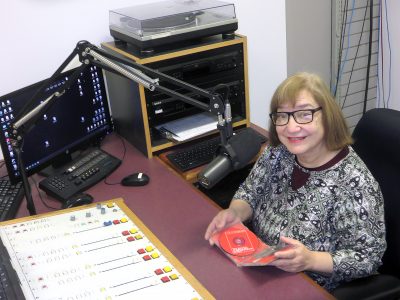
WEIRTON -- "Temporarily" is anything but brief when it comes to Pam Makricosta hosting "The Athenian Hour" local radio program.
"Temporarily" as in starting her 48th year of bringing "a little bit of Greece to the Ohio Valley."
Her first show of 2021 came Jan. 3, but her debut of a program offering a mix of Greek music, language, culture, history and local events began decades before that.
"I started the program on Nov. 21, 1973," Makricosta reflected afterward on her role in a weekly broadcast that actually has a 72-year history.
The originator was Crystal Sanderson, and the show was called "Grecian Melodies."
"She did it over here in Steubenville at WSTV, because we did not have a radio station at the time in Weirton, so after she went to WEIR, she had the program for 25 years," Makricosta said.
When Sanderson became too ill to continue the program, however, Makricosta was asked to step in for the interim.
"I had a friend at the radio station, and they were concerned because everybody would listen to it, and they didn't want to give it up, so he said why don't you do it temporarily until they find someone," said Makricosta, who was urged to consider the idea given Greek is her first language and her collection of Greek music extensive.
"He said 'You have music, you know the language, so just do it,'" she said, smiling at the ultimate interpretation of "temporarily."
"My cousin Faith had just come from Greece, so in the beginning we did it together, and my parents would come up to the station with me, my brother Tony would drive me up there, and it just went from one year to the next and the next," she said, noting her parents would occasionally fill in as hosts when Makricosta was away.
A lifelong resident of Weirton, Makricosta is the daughter of the late Nick and Helen (Koukoulis) Makricosta. She graduated from Weir High School and West Liberty State College, doing master's work at West Virginia University.
She is the Literacy and Lifelong Learning coordinator at the Mary H. Weir Public Library and is a regional trainer for the state through Literacy West Virginia. Before that, she was a Greek language instructor and worked at the Rockefeller Career Center and her church, All Saints Greek Orthodox Church in Weirton.
Ironically, the show Makricosta hosts was always a Sunday staple in her household and one where she made her first appearance as a 7-year-old.
"Mrs. Sanderson had invited all of us kids from Greek School to come and say their poem (about Greek Independence Day) so I am holding the poem in case I was too nervous to remember it, and anyone there got a picture taken so the mic is about as big as my head. There were four of us," she said, gesturing to the photo posted on a bulletin board at the radio station in the Fort Steuben Mall.
"The Athenian Hour" is a one-hour program every Sunday beginning at 9 a.m. broadcast on the FM side, River Talk, at 94.9 or 100.9 and the AM side at WEIR 1430. Listeners also can download the app at 106.3 The River or if they have Alexa, they can say "Alexa, open River Talk" during the show time to access it.
"I've enjoyed doing it, and people have seemed to enjoy listening to it," she said. "I have many people who don't understand the language, but they like the music, and they listen and in fact, some times when we have the local festivals, I'll say the third person who calls will get a free gyro, and it's never somebody who's Greek -- it's always somebody who's a non-Greek and they're from all over so it gives me an idea that it's a varied audience," Makricosta said.
The name of the show changed when she became host.
"They actually picked that name for me at the radio station when I took over. They changed it. Athens is the capital of Greece, so they called it the Athenian program," she said in surmising the thought behind the selection.
"In the beginning, it was Sunday evening, which I liked a lot -- 7 to 8 -- and then the Italians' programs were in the morning, so then the newer person that had purchased the station, they wanted all the ethnic things together, so it went in the morning. I was the organist at our church -- All Saints in Weirton -- and that was always a problem because getting finished up here and running down to the church, but I enjoyed doing both," she said.
The program is a mix of music and information "about history, culture, what's going on in the valley like church services, birthdays, anniversaries, births, weddings, different announcements from various parishes in the area -- not just Greek, because we have many Orthodox churches," Makricosta explained. "We're very fortunate in the valley that we have this ethnically diverse group. In fact I have a PSA that runs that says Weirton is the home of more than 60 ethnic groups and then I list some," she said.
The show's format is pretty much the same, according to Makricosta.
"The music changes but depending on who is sponsoring the program or depending on what I am announcing, some of the music is older because that's what they prefer. Some people are from the mainland, some people are from the islands, and I try to go from there, so modern music, some of the traditional music, and a lot of people from the area are from Asia Minor, which is present-day Turkey, and so I try to give it a mix," she said of her approach.
The show is funded by local businessmen and women, various individuals and organizations throughout the year.
"I really appreciate all the sponsors who have supported the program from the beginning and some of them are newer," she said.
Makricosta believes the program to be unique locally and beyond.
"There isn't another one in West Virginia -- there used to be one in Pittsburgh and they retired and asked me to buy the program. I have been asked to consider doing the program in Pittsburgh," she said.
Doing the weekly show gives her a sense of accomplishment.
"I guess I'm continuing the ties between America and Greece and Asia Minor, continuing the language so people can hear the language even if they don't understand it and sharing the faith and the music and various events, letting people know what's going on in the valley," she said.
As host of the program, Makricosta would make a point to meet Greek dignitaries, ambassadors and entertainers whenever possible and do interviews for the show.
When Greek singers would be performing in Pittsburgh or Cleveland, for example, "we would go as a group, and then I would schedule an interview and I would play it."
She also would interview Greek religious figures, she said, about different holidays and such, and "whenever we would go to Washington for various events, I would try to make appointments with the ambassador or somebody and I would do a little interview."
Makricosta recalled a conversation with actor James Darren after he been in "The Guns of Navarone" filmed in Greece in 1961. "At the end of the interview I asked him if he could be any other ethnicity than what you are, what would it be, and he said, 'absolutely Greek. I loved being there. The people were so nice. I loved the food, the people,' so that was interesting to hear that from him."
Makricosta recalled an experience when there was a national Greek conference held years ago in Warren, Ohio.
"A lot of us went to the conference, and the camera crew showed up because officials were there and because all these people came from the United States and Greece, so the camera crew showed up, but the person doing the interview couldn't get in from New York, so somebody said, 'Well she does a Greek program in West Virginia," she said of going from spectator to interviewer. "I was a nervous wreck because it was filmed and shown in New York. I didn't get to see it, but it was interesting, and I would always ask everybody, do you want the questions in English or Greek, whatever they were comfortable with. I wish I had a copy of that."
Preparing for the program is a reflex after all these years but still involves some work.
"Things change from week to week -- holidays and events, for example, and I have to try and get sponsors, but it doesn't take me as long now as in the beginning," she said.
English is Makricosta's second language.
"My brother Tony and I, we all spoke Greek at home," she said. "They sent my brother and me to Trinity Lutheran Church in Weirton to the kindergarten class so we could work on English before we went to first grade."
Her father was from Greece, Chios. "They moved from Greece to Asia Minor, and he lived in Izmir, and he was there in 1922 as a 7-year-old boy with his family when the Turks came through, and they massacred all those Christians, and they burned the city. He remembers the city burning behind him and being chased by the Turks," Makricosta said of her father, who died in 1990.
"And my mom's family, they left the first time in 1914 when they had the massacre in that period of time. My grandfather -- my mom's dad -- he came here earlier," Makricosta said of his arrival in Sabraton outside Morgantown. "They would write to their people and say this is a great place to live, there's good jobs. They would help each other."
Makricosta said her father was working as a chef in New York City when he came to Weirton to visit a cousin -- a visit in which he would meet his future wife, Helen Koukoulis, and vow to return. "He had six sisters and was the only boy, and it was tradition for a brother to marry off all the sisters," she said of her father. "He was a refugee with the Turks in Greece and he learned and apprenticed himself to a chef in Greece, and when he was old enough he worked on the ships as a cook and then in the Merchant Marines."
Makricosta enjoys writing, volunteering at the Weirton Area Museum and Cultural Center, meeting people and teaching English as a Second Language and U.S. Citizenship. She's been to Greece seven times, the first time as a 9-year-old in 1962.
"There were a lot of people from the Steubenville and Weirton area who went on a charter flight and the people from Rhodes put it together, and we went with them," she said. "The interesting thing is the plane we were going over in was a Flying Tiger from World War II and the face with the teeth was still on there and we crash landed twice, first in St. John's, Newfoundland, the second time in Canada.
"We as kids thought it was really cool, but at one time we had two engines out and one on fire," she said. "Both times we were over the Atlantic Ocean and he was able to get us down safely," she said of the pilot's actions.
"Then Mr. Arness, God bless him, he used to play the clarinet at various functions so now it's not supposed to take three days to get to Greece, so here we are circling Rhodes, he starts playing and all these people get up and are dancing in the aisles, and the co-pilot comes back and says 'What are you doing?' and he puts his clarinet down and says 'We're happy,'" Makricosta said, using an exaggerated Greek accent.
Asked if there were especially funny or sad moments through the years of doing "The Athenian Hour," Makricosta shared a memory from 1974.
"The Turks invaded the country of Cypress and they displaced a third of the island and they were all refugees, that third. I had gotten contacted by the Greek version of the Red Cross because we're talking hundreds of thousands of people were living in tents and they had to leave and couldn't go back, and they still haven't been able to go back and so through all the radio programs, they gave us lists of refugee families, and it would be this family and they have six children or this couple or whatever so through the program I would announce various names, and I said if there are any of you in the listening audience who feel you could sponsor a family, something per month, and I remember Regina Anas said give me all the ones with the most children and continued it for years. They would invite her to the weddings and baptisms -- she never got there, but they felt she was so precious to them," Makricosta said.
"And the other big thing -- there were even people here who were in Greece and they were worried about getting invaded, too, and they wanted me to go on the air -- this is at the old station -- and translate the news that happened to be coming over the wire, like all the updates, and I didn't know how I was going to do that," she said, noting the owner of the Dairy Queens at the time volunteered to be the sponsor.
"He offered to do that, and I appreciated that, God rest his soul," she said.
In explaining the show's longevity, Makricosta said, "I think radio is representative of the area that it serves, so because this is a very ethnic group of people in the valley, I think that's why it's been so many years that it continues. "If people weren't interested, it wouldn't be here."
(Kiaski can be contacted at jkiaski@heraldstaronline.com.)