
Legislature reconvenes for 2021 session
Trending
CHARLESTON -- Wednesday marked the start of a very different general session of the West Virginia Legislature, as lawmakers prepare to debate and pass bills while not passing COVID-19 onto others.
The West Virginia Senate saw 124 bills and four joint resolutions introduced on day one, with members of the House of Delegates introducing 293 bills. Lawmakers will have the next 60 days to debate these bills and pass a balanced budget for fiscal year 2022.
Proposed legislation in the House ranged from efforts to expand broadband, rein in a governor's executive authority during states of emergency, occupational licensing reform, education savings accounts, efforts to make state economic development programs more transparent, and repealing certificate of need requirements for healthcare.
Senate bills included permanently removing regulatory caps from the state's broadband loan insurance program, providing COVID-19 liability protections to businesses, another attempt at creating an intermediate court of appeals, transferring the Office of Medical Cannabis to the Department of Agriculture, tax credits to recruit doctors to come to the state, and looking at insulin cost management.
Both floor sessions ended quickly, recessing until Wednesday evening for a joint session to hear Gov. Jim Justice deliver his annual State of the State address.
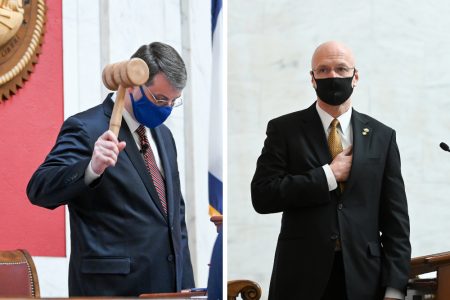
The House and Senate are both taking COVID-19 precautions. Members and staff must wear face masks on their respective floors and committees. Lawmakers can participate in committee meetings virtually from their Capitol offices in order to socially distance.
In the House, where 100 delegates, staff, and press make for close quarters, lawmakers who feel uncomfortable can participate from one of the galleries overlooking the House chamber. Another gallery is set aside for lawmakers who refuse to wear masks. However, all lawmakers were on the floor Wednesday. Members of the press have their own House chamber.
The State Capitol Building itself, under the authority of the Governor's Office, has limited public access to those with appointments and business within the building. However, invited guests of lawmakers can observe legislative proceedings from roped off sections in the great halls in front of the House and Senate Chambers. Video and audio livestreams of legislative floor sessions are available, with archived video available for Senate floor sessions and committee meetings only.
Earlier Wednesday, lawmakers heard a presentation from John Deskins, director of West Virginia University's Bureau of Business & Economic Research and associate professor of Economics at WVU's John Chambers College of Business & Economics. Deskins presented the annual West Virginia Economic Outlook for 2021 through 2025.
While West Virginia's economic outlook has always been challenging, Deskins said the state and nation experienced the fastest economic collapse in modern history due to the coronavirus. West Virginia and other states went into lockdowns last spring, limiting business activities to essential services. Since then, businesses have partially recovered, but many are still hurting due to decreased capacity and social distancing requirements.
"It wasn't the worst economic collapse, but every other economic collapse that we've had before has come over time -- at least a year, if not a couple of years for things to unravel and for things to unfold," Deskins said. "For this kind of collapsed to happen in two months is absolutely unprecedented in every way."
Deskins said the state was able to recover from the March and April shutdown, but the state's recovery went flat going into the fall. Deskins estimates that it will take until the end of 2021 for West Virginia to return to the economic and employment levels prior to March 2020 when the pandemic started.
Deskins encouraged lawmakers to focus on legislation that encourages entrepreneurship, as well as legislation that makes it possible for large and small firms to either locate in West Virginia or locate their remote workers in the state.
"This thing with remote workers is an entirely new strategy … We were finding more people working from home," Deskins said. "We have this opportunity now to market ourselves to people who are living in New York City … people living in Chicago, people living in these high cost-of-living areas across the country. We have opportunity to say, 'hey, keep your high paying job in New York or Chicago or Washington or wherever, but you can come to West Virginia.'"
(Adams can be contacted at sadams@newsandsentinel.com)