
Public provides input on West Virginia redistricting
Trending
WHEELING -- West Virginia's ongoing series of public hearings on redistricting made its way to Wheeling Tuesday night, when members of the public voiced their opinions about how Congressional and legislative district boundary lines should be drawn in the coming months.
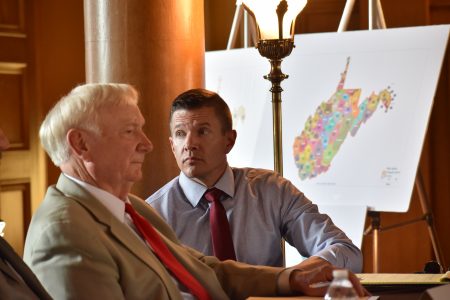
The West Virginia Legislature Joint Committee on Redistricting held its most recent public hearing Tuesday evening at West Virginia Independence Hall. Lawmakers welcomed a roomful of attendees and heard from a handful of citizens.
A common theme was a call for equality in the new districts and transparency during the process, which occurs every 10 years to reflect changes in population as it relates to fresh totals from U.S. Census data. Final tallies from the 2020 Census that will be used for redistricting are not expected to be released until the end of next month, and legislators are expected to continue gathering public input on redistricting over the next several weeks before sitting down to take action on the historic measure in October.
"We currently have blocked out Oct. 10, 11 and 12 as the dates for that extraordinary session," said W.Va. House Speaker Roger Hanshaw, R-Clay.
Because of steady population loss, the state of West Virginia is set to lose one of its three U.S. House seats -- all currently held by Republicans. The state will also lose an Electoral College vote, dropping that total to only four.
Committee Chairman Sen. Charles Trump, R-Morgan, said the committee has been holding public hearings throughout the state since last month, with Tuesday's hearing in Wheeling being the ninth so far. Several additional public hearings are slated. Even if members of the public cannot make it to a session, they can still provide input, Trump stressed.
"We're going to try to do some digital public hearings," Trump said. "When we think of redistricting, we think of maps. It results in maps, but really it's legislation. It works, in many ways, just like every other bill -- but it defines districts. It has to pass both houses of the legislature by a majority vote and be signed into law by the governor."
Citizens speaking Tuesday night urged state officials to use logic and common sense when determining the new district boundaries, not just push to redraw political battle lines or work toward a new map that benefits their own chances for re-election.
"I'd also like to see a prioritized and stated criteria that you're going to use for this redistricting," Ohio County resident Mary Ellen Cassidy stated before the committee, "so that we feel assured that it will be fair and unbiased, and that you are using tested methods, programs and technology that reflect truly the priorities and the values of the people of West Virginia."
Wheeling resident and West Virginia NAACP President Owens Brown stressed the importance of creating Congressional districts in the state that reflect cultural and economic continuity.
"There is a heavy population of minorities in the southern part of the state, and a heavy population of minorities in the Eastern Panhandle and coming this way," Brown said, calling for a balanced representation of cultural and economic demographics when the new Congressional district lines are drawn. "That's what we hope will happen."
Brown and South Charleston resident Thornton Cooper both provided the committee with their own maps showing suggested new district boundary lines. Trump said the committee welcomed the proposals, which were made part of the record and are to be posted on the Joint Committee on Redistricting's website -- along with other maps and public input -- at www.wvlegislature.gov/redistricting.cfm. All public hearings are video recorded and are archived on the West Virginia Legislature's website and YouTube channel, as well.
Cooper suggested that the new maps should be based more on mathematical equalities and should be more compact.
"If you want beauty, that's one thing. If you want equality, that's another thing," Cooper said.
Only six individuals signed up to speak before the committee Tuesday night, but in light of the fact that two hours had been allocated for the hearing, the panel welcomed additional comments from the small crowd on hand. Three additional people stepped forward to provide input, including former District 3 House of Delegates candidate Dolph Santorine from Ohio County.
"I guess most of us don't think that the results will be any different in the redistricting than they were in the last five or six go-arounds for this -- maybe a slightly different slant," Santorine said. "But I think that with this redistricting and the shift in population, many people who are involved in the redistricting will have their seats put at risk. It's going to be different, and this is the time when I hope that our elected officials will make that move that is right for the state of West Virginia, and not necessarily correct for their re-election, and that is key."
Julia Chaplin from Ohio County urged committee members to rely more on people's voices about redistricting and less on straight mathematical data.
"I don't want computers making decisions as to our redistricting," Chaplin said. "We know it's garbage in, garbage out. Please, please listen to your constituents."
Information will continue to be posted on the state website, and public input will be gathered at public hearings in person and online. Citizens can email the committee at joint.redistricting@wvlegislature.gov.