
‘Mended Wings’ preserves Vietnam veteran’s story
Trending
STEUBENVILLE -- There are 10 stories in Colin P. Cahoon's "Mended Wings: The Vietnam War Experience Through the Eyes of Ten American Purple Heart Helicopter Pilots."
Retired Presbyterian Minister Michael Bongart of Toronto is one of them. He's chapter two, its title "Preordained."
In the prologue of the book that became available on Amazon in June, Cahoon, an Army helicopter pilot himself, writes: "This book features the stories of 10 Vietnam War helicopter pilots. Their stories are each unique and extraordinary, but the same can be said for thousands of other guys who rode the whirling craft over Vietnam. The common thread between them is that each was injured while flying in combat, some badly, some not. But each had his wings clipped in battle. The war changed their lives, but their stories didn't end on the battlefield. They all managed to mend their clipped wings, and that's part of their story, too."
Bongart learned about Cahoon's project several years ago, his interest piqued by an advertisement he read in the Vietnam Helicopter Pilots Association magazine that he gets as a member. The author of "The Man with the Black Box" was soliciting personal stories for what he initially was calling the Purple Heart Project.
"Collin became an Army aviator after Vietnam, and he was trained by Vietnam helicopter pilots so he started hearing these stories, and he decided he wanted to write one on Vietnam pilots with Purple Hearts," Bongart said.
"Collin said any helicopter pilot with a Purple Heart, let me hear your story because I want to put this book together, so I sent him an e-mail."
Bongart had a doozy of a story about himself being gravely wounded, a piece of shrapnel lodged in his brain, left for dead in a rice paddy and having an out-of-body, near-death experience.
And that story involves Duane E. "Doc" Garver, the Army medic who saved his life on 4 October 1968 at Plain of Reeds near Dong Tam, South Vietnam.
It was important to Bongart to be a part of the book, he said, "to tell the story of what this guy (Duane) did.
"What I mean is, OK, this whole experience is boiled down to in essence what I feel my calling is, to testify to the good news of the saving grace of God. Period."
"Amen," added Duane.
NOT YOUR EVERYDAY TOURNAMENT
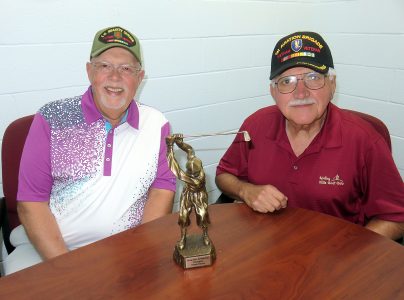
Bongart, a native of Steelton, Pa., near Harrisburg, and Garver, who lives in Michigan, sat in a small conference room at The Herald-Star on Sept. 21, their conversation during the interview marked by back-and-forth banter, laughter, remembrances, questions and serious overtones.
They were on their way to Spring Hills Golf Course in East Springfield to play in an annual tournament involving just the two of them. They call it the Dong Tam Invitational, which has been a tradition for the duo since 1972, its location rotating between Ohio and Michigan.
What's the invitational?
"Well," begins Garver, "that means Mike and I are going to play golf. Mike, really, if you must know, is a terrible golfer."
Bongart laughs and shakes his head. "Wait a minute."
"I'm not much better," Garver quickly admits with a slight smile.
"He saved my life and everything," Bongart fast forwards the story. "I was still in the service, and he got out and went to Michigan, was going to school up in Michigan, so I wound up being stationed in Savannah, and I went up to visit him and his family and tell him in essence what he did (saved his life), to thank him and found out that he plays golf and so do I."
Garver and his wife would come to visit Bongart when they played their first "tournament," so named because the Dong Tam hospital is where the two were airlifted for their wounds. That scene was recorded by an ABC News camera crew that was on board the rescue helicopter and ultimately would be part of a news broadcast on the life-saving medevac unit. It would show the wounded Bongart and Garver.
"We went down to a golf course called Sunset outside of Middletown, Pa., and we played golf," Bongart said. "The thing is we're very competitive, and I beat him. The guy saved my life. I beat him," he says somewhat apologetically.
Garver said, "I don't recall that at all," the being beaten part.
The location flip-flops. "Last year I played up at his home course in Michigan and now he comes down this year to play my home course," Bongart said.
The "invitational" is usually on Oct. 4, the anniversary day when Bongart was wounded in Vietnam, and Garver saved his life.
"Initially we had a trophy and it went back and forth, and he wouldn't give it back when he kept beating me," Bongart said. "I was frustrated because Duane was beating me all the time and that trophy was about yay high so I went out and had a second-place trophy made that's even bigger," he chuckled. "The thing is that year I beat him, and Duane got the second-place trophy that was bigger.
"Over the years, I realized I'm not going to be able to beat this guy again so I had two trophies made up, and one of them, he is champion, and I am runner-up."
All joking aside, the golf outing is a celebration of what Garver described as "two friends who were brought together by events, that by the grace of God -- I want to emphasize that -- and every year we get together, we talk about different things, different things come up, but we still talk about that day in October 1968.
"It's a very real event, and those memories we will both have for the rest of our lives."
WANTING RECOGNITION FOR HIS FRIEND
"To this day I can still feel him pulling me through the rice paddy and telling me to stay with him. It's there. It doesn't go away," Bongart said of the memories from Oct. 4, 1968, when the helicopter he was piloting was shot down by the Viet Cong in a battle near Dong Tam. He managed to land the chopper upright.
Attempting to move away from heavy fire, Bongart didn't hear the Viet Cong mortar. A shard blew off his helmet, piercing the back of his skull.
"We each have different stories to tell from Mike's perspective and from mine," said Garver, who was on Bongart's helicopter but didn't know him. "I was the medic. I recognized that he had a head injury, that he had arterial bleeding from his head so I first stopped that bleeding. Then I gave him mouth-to-mouth resuscitation, and he started to breathe so then I started bringing him back to the medevac helicopter. We couldn't get in it right away because the fire was so heavy."
"How far did you drag me?" Bongart asked.
"I don't know, 200 yards."
"Really?" Bongart responds, sounding surprised. "I often wondered how far he had to drag me."
"It was a ways," Garver said. "We were in water, waist deep. I kept getting weeds wrapped around me, and I couldn't move my legs, and when I got back to Dong Tam they looked at my wounds which were very minor, but I had leech bites all over my legs."
"They finally called in the medevac helicopter, and we were going to it, and I knew Mike had a head injury, so I was trying to keep him conscious, and at that time, the Detroit Tigers were playing in the World Series, Game 7, and so I did anything I could to make sure that he was still conscious, that he didn't lose consciousness, and on the helicopter…."
Bongart interjects, "I remember asking him where he was from and he said, 'Detroit,' and I said, 'Oh, your Detroit Tigers are down three games to zip. They're in trouble,' something to that effect."
Garver also was hit by a small piece of shrapnel on his face and upper back, but his injuries were minor. He would quickly recover in a field hospital, while Bongart went on to the 24th Evacuation Hospital where shrapnel was removed from his brain along with a part of his right occipital lobe. After recovering at Walter Reed Hospital in Maryland, he ultimately returned for a second tour in Vietnam, later leaving the Army in February 1972.
Bongart had always wanted Garver to receive due recognition but initial efforts were in vain.
But ironically, on Oct. 4, 2018, the 50th anniversary of his injury, the House of Representatives of the state of Michigan honored Garver for saving Bongart's life -- a process initiated by Rep. Tom Cochran.
The tribute reads as follows:
"Let it be known that it is a genuine honor to recognize Duane E. Garver in commemoration of the 50th anniversary of his lifesaving actions and exceptional service in defense of the United States during the Vietnam War. In recognition of this great service, we honor and sincerely thank Duane Garver for his heroics throughout his service in Vietnam and particularly for his actions during the events that took place on Oct. 4, 1968.
"On Oct 4, 1968, 1st Lt. Michael Bongart was the aircraft commander of a UH-1H helicopter flying a combat assault mission near Dong Tam, Vietnam. After picking up troops from the fire support and on final approach into the landing zone, Lt. Bongart's helicopter began to take heavy small arms fire and was shot down in the middle of the landing zone. With Viet Cong forces only 50 yards away, Lt. Bongart and his crew were able to exit the downed helicopter and make their way to a nearby rice paddy in the opposite direction of the enemy. The crew worked their way south and eventually ran into the infantry company they had just dropped off. Fearing being overrun by Viet Cong forces, Lt. Bongart helped the commanding officer of the infantry company identify the location of the enemy troops situated nearby the downed helicopter. This information was successful in assisting both artillery and close air support zero in on the enemy to eliminate the immediate threat. The infantry company and Bongart's crew then attempted to make their way to a collection point for the wounded to be extracted, but before they made it there, Bongart was hit by an enemy mortar shell and was incapacitated.
"A stranger to Bongart at the time, medic Duane Garver quickly came to Bongart's aid and began pulling his body through the waters of the rice paddy channel toward the collection point and to safety. In the midst of a firefight, the rest of Bongart' crew assessed his condition and determined him to be dead due to his severe head wound. They headed to the collection point without him and advised Duane to do the same as there was nothing he could do. At this point, Duane Garver was Lt. Bongart's only hope.
"Duane, with fragmentation wounds of his own, ignored the advice of the crew and stayed behind, performing mouth-to-mouth resuscitation on Bongart to quickly get him breathing again. He then applied a bandage to the back of Bongart's head to slow the severe bleeding, which later was determined by a physician's assistant to have saved his life. The two eventually made it to the collection point and were evacuated from the area with Lt. Bongart being flown to the 24th Evacuation Hospital in Long Binh where he received neurosurgery and Duane remaining at the Army hospital in Dong Tam. Both men were awarded Purple Hearts for being wounded in action.
"A year and a half after the events of Oct. 4, 1968, Duane and Michael were reunited. Fifty years later, the two remain close friends. They are lifelong golfing buddies who play annually in the Dong Tam Invitational, a golf tournament where only two golf players are invited: Duane and Michael."
"After 50 years, finally, I was able to get him an award," Bongart said of the ceremony the two attended.
"He went up and got the American flag that flew over the capitol that day and Michigan's state flag."
SOMETHING ELSE SPECIAL
While 2021 brought another year for the Dong Tam Invitational, and the book, something else special happened.
The two were part of an Honor Flight trip to Washington, D.C., two days after their golf outing. The outing honors veterans with an all-expenses-paid trip, flying them to the nation's capital to see the memorials along with other veterans.
Brian Long was their tour guide on the Honor Flight. The group flew out of Columbus.
There were two planes going with buses in Washington, D.C., shuttling the veterans to the various memorials, including the Vietnam Wall.
Bongart applied to go about a year and a half ago, he said. "I get a call, OK, you're on the Honor Flight,' and I said, 'Could I bring my medic?' and I told them the story and everything and they said, 'Oh, yeah.' so they called and talked to Duane. They in essence have gone out of their way to put us together on this flight," he said.
Garver verbalized what it meant to go.
"My own personal story, separate from Mike, when I served in Vietnam for a year, there are six boys who I tended to who died in my arms whose names are on the wall. They're connected by dates where we had firefights because not every day did we have action, but those dates certainly stand out," he said.
Being on the Honor Flight with Garver made the experience extra special for Bongart, who said, "I, too, have names, but not six. There's four that I personally knew and also there's one, I think it's panel 41 west, line 4, that's where my name would have been," he said.
Garver recalled looking at the June 19, 1969, issue of Life magazine after he came home from Vietnam. "The story was it's a picture of a GI in Vietnam, and it was one week's dead. They had pictures of all the boys killed in one week. I started going through that and saw a picture of the medic who replaced me. His name was David Tiffany from Riverside, Calif.
"I still have that Life magazine cover after all these years."
A UNIQUE BOND
Bongart and Garver have a unique friendship, a strong bond, they agree.
"It's very much a spiritual relationship," Garver said.
"Seriously, we believe we were connected by God and in fact the guy who wrote the book he titled it 'Preordained,' and he saw the interactions of God in the midst of all this," Bongart said.
"You've heard of Paul Harvey and how he ended his commentary 'and now for the rest of the story?'" Garver questioned. "The thing about Michael is after that event on 4 October 1968, what did he do with his life? He went to seminary, he became a preacher, a pastor in God's word and served for 22 years," Garver said.
The decision to do so was no expressway trip, but in retrospect a career contemplated in pre-teen years when Bongart had written a note he would ironically discover years later after earning a seminary spot at Princeton Theological Seminary.
It read: "No one can foretell the future, but I, Michael Bongart, have an idea. I like aviation, science, electronics, and like to play football, basketball, baseball, and I think I will become a preacher. I think I will be a preacher because I was meant to be a preacher by the act of God."
"It took me a long time to get to seminary," Bongart admitted of a decision marked by detours.
"God had a plan," Garver said.
(Kiaski can be contacted at jkiaski@heraldstaronline.com.)