
Lawmakers look at mitigating the next major flood
Trending
CHARLESTON -- While much time was spent Monday during December legislative interim meetings talking about the 2016 flooding disaster and the rebuilding that continues, little time was spent on preparing for the next flood disaster.
Lawmakers on two different committees heard reports Monday about West Virginia's spending plans for flood mitigation dollars, the progress of the State Resiliency Office, and continued issues with dumping of trash in state creeks and streams.
Members of the Joint Legislative Committee on Flooding heard a presentation from Jennifer Ferrell, director of the Community Advancement and Development division of the West Virginia Development Office.
The state received $106.5 million in Community Development Block Grant-Mitigation funding from the U.S. Department of Housing and Urban Development. West Virginia received approval to spend those dollars in January 2021.
The CDBG-Mitigation funds must be used for projects that increase resilience to flooding, lessen the impact of future natural disasters, reduce the risk of loss of lives and property as well as future suffering and hardship.
The funds can only be spent in 12 counties affected by the 2016 flood: Clay, Greenbrier, Kanawha, Nicholas, Fayette, Jackson, Lincoln, Monroe, Pocahontas, Roane, Summers, and Webster counties. The state has to spend 50% of the CDBG-Mitigation funds in six years, and fully spend the dollars in 12 years. Of the funds, 50% must be spent on projects to benefit low-income and moderate-income persons.
Ferrell said the funding budget was divided between general infrastructure and public facility hardening; state, regional, and local planning and hazard mitigation planning; and administration.
For the first round of funding, the state received 37 applications and approved 18 applications. Projects include nine stormwater projects, two water treatment plants, two dam projects, one sanitary sewer relocation projects, and four planning projects. The total cost for the 18 approved projects was $65 million.
The state is accepting applications for projects in 2022 for the remaining $40 million in funding. Ferrell said they are also working with applicants who were rejected to help them qualify.
"I will tell you several of the projects had technical issues, like they didn't meet certain HUD requirements like public hearings that have to be held, things like that," Ferrell said. "We're working closely with any of the people that did not receive funding for those to try to clear those up to help them move forward."
The Flood Committee also heard from Bob Martin, director of the State Resiliency Office. Martin is the second State Resiliency Officer since the program was created by Senate Bill 586 in 2020 after discussions between Gov. Jim Justice and the Flood Committee.
"I've been trying to build an airplane while I'm flying," Martin said. "That is what it feels like, so I'm trying to keep up with everything that's happening."
The State Resiliency Office works with state agencies to ensure that parts of the state hit with natural disasters and man-made emergencies can bounce back quickly. It also manages non-federal disaster and hazard mitigation grant funding. The office is assisted by an advisory committee of state cabinet and constitutional offices as well as other state agencies and legislative appointees.
Martin said the State Resiliency Office has worked on the Milton Flood Wall Risk Management Project and on the RISE West Virginia Community Development Block Grant-Disaster Recovery program which still continues to build new houses and bridges destroyed during the 2016 flood. The Office has created committees to develop plans to create a debris management plan, planning for hazard mitigation, and statewide flood protection plan.
Future plans include a flood symposium in February with state agencies and representatives of the Pew Charitable Trusts.
"We had a meeting with the Pew Trust last week," Martin said. "We're looking there as we bring together all the flood-involved personnel from the state to local flood managers and community leaders...one of the key points of that is to try and get some involvement and buy-in from them at the local level."
During an afternoon meeting of the Parks, Recreation and Natural Resources Subcommittee, Brian Farkas, executive director of the West Virginia Conservation Agency, asked lawmakers to consider upping his agency's budget by $2 million. The funding would be used to partner with cities and counties to clean up debris in creeks and streams.
"Every year, we have a declared (flooding) event in the State of West Virginia, but every year we have significant rainfall that never reaches the level of a declared event," Farkas said. "When those occur, they have the potential for creating a lot of blockages. Or just the mere fact that you have trees that die and fall into the stream, that's occurring for one reason or another."
Farkas said 75% of the stream has to be blocked to be considered a blockage regardless of what the blockage is. WVCA officials also look to see If the stream starts to revert and create bank erosion, and if it threatens public and private property.
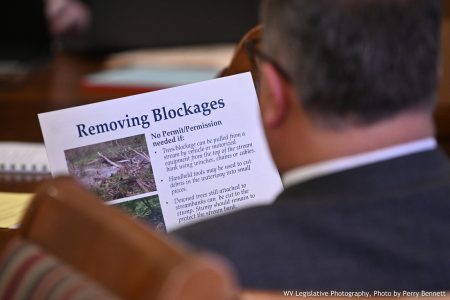
Private individuals can remove blockages on their own without a permit as long as no heavy equipment is used. But larger blockages require permits and sometimes involve other state and federal agencies depending on if trash is being dumped or an endangered species is found.
The WVCA focuses on the removal of wood debris, trash, and other items that negatively impact streamflow and soil erosion. The agency has agreements with 27 counties and two cities to share costs of removing stream blockages. In the wake of the 2016 floods, the WVCA created a five-tier system for evaluating blockages, with tier 1 being serious and tier 5 being the least serious. WVCA focuses on tier 1 and tier 2 blockages.
(Steven Allen Adams can be reached at sadams@newsandsentinel.com.)