
Going back in ‘time capsule’
Church’s discovery and donation to Weirton museum includes mystery letters
Trending
WEIRTON -- Come June, a mystery involving the Weirton Area Museum and Cultural Center at 3149 Main St. will finally be solved.
And that means resolution as well for All Saints Greek Orthodox Church parish counsel members.
The two have a connection because of a time capsule found Sept. 22, 2021, and donated by the church to the museum.
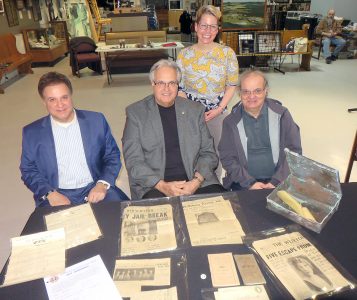
The particulars of all this were revisited earlier this week when Savannah Schroll Guz, the museum's executive director, met at the museum with representatives of the church's parish counsel -- President Nick Tranto, Secretary Dean Makricostas and member Nick Latousakis.
There they marveled anew at the piece-of-Weirton-history find discovered during the demolition of the former Independent Order of Odd Fellows building on West Street. The church had purchased that building as well as the former Tri-State Church of God.
The time capsule found in the saved ceremonial cornerstone of the IOOF building that Wednesday was brought to the museum the next day for preservation, and that's where it has a fitting new home to be enjoyed by visitors.
But first the back story, which Tranto offered.
"In December of 2020, All Saints Greek Orthodox Church inquired about the sale of two properties across the street from our church on West Street -- one was the Tri-State Church of God and the other one was the IOOF building, which had been converted into an apartment house," Tranto began.
"The curious thing about that was we knew that the Tri-State Church of God was originally a Nazarene church built in 1942, but then the cornerstone of the IOOF building indicated 1929, so we said to ourselves there's no cornerstone in the Tri-State building, but I bet there's a time capsule behind the IOOF cornerstone, so we contacted our demolition contractor, and I said, 'Be very, very careful when you tear down that corner to make sure you preserve that because we think there could be a time capsule,' and, lo and behold, he discovered it when he was tearing the building down," Tranto said.
"We suspected there was a time capsule because in those days people put time capsules in those buildings for posterity, so we just took a shot and said let's see if we can preserve it, and we preserved the cornerstone," Tranto explained. "We have that actually in our church, and we plan to somehow display that on the property once all the construction's completed and grass planted. We plan to do something with that cornerstone just to commemorate the IOOF," Tranto continued.
The time capsule was discovered by the demolition contractor, Steve Vukelic of RSV Inc.
"It was encapsulated in a brick nest built around it to kind of protect it, but they actually found it and soldered it open and brought it untouched into the church office, and the church office called me and said, 'We have something for you, you might be interested in.' The box was opened, but the contents were still sealed, and some of the papers were wrapped up in this coiled yellow sheet of paper. Most of these documents were all in there," Tranto said in recalling details surrounding the discovery made in the fall.
"We immediately thought this would be great for the city, for the museum to be able to share this and have this as part of the display. It's Weirton history, 1921, but there's a curious part about that," Tranto pointed out. "On the cornerstone there are two dates actually -- 1912, the other 1929. I can't figure that out -- why it is that way," he verbalized what he had initially wondered. "This says Cove Valley Lodge 380, but I don't know what 1912 1929 means. This is my guess. They founded the lodge in 1912 but didn't have the funds to build the lodge until 1929."
That conclusion is one Guz validated with a nod and a "yes, that's correct. From the little bit of research I had done, it took them a while to be able to build the building."
The time capsule -- "tarnished and flecked with blue patina" -- is a copper box whose lid had been soldered closed to keep moisture and other contaminants out.
Inside it was a contents list, which Guz noted in a Sept. 23 post on the museum's Facebook page, was written "in the beautiful, filigree-style script that usually issues from the nib of a fountain pen."
There also are several letterhead pages containing the names of officers and charter members, which in 1929 boasted 114.
Other contents include several newspapers from Sept. 14, 1929 -- The Weirton Daily Times, Steubenville Herald-Star and The Wheeling Sunday News, which detail the ceremony planned for the following day. The event would be led by IOOF's Wheeling chapter, and 17 other IOOF chapters would also attend, according to the post by Guz, who thanked volunteer Beth Fracasso who began the inventory process.
"A parade of some 700 district Odd Fellows would be directed by the Weir-Cove American Legion Drum and Bugle Corps and the Weirton AHEPA Band."
Booklets outlining the lodge's constitution and bylaws, tokens, the signatures of the presiding officers of the day, and a list of charter members, officers, trustees, the building committee and members were part of the time capsule's contents.
And then there's that mystery that won't be solved until summer -- three sealed envelopes.
What's inside them, they all wonder.
"Each has a 1-cent embossed postage stamp and the lacy script of the early 20th century," Guz explained in her post. "One is addressed to the Cornerstone Committee of Wheeling Lodge #9, I.O.O.F. Another indicates that it is 'Compliments of J. Walker,' while yet a third is 'Compliments of E.E. Turner.' Based on the contents list, we know that there must be IOOF tokens inside these envelopes, but there is also paper."
Guz connected with a representative of the IOOF Wheeling Lodge No. 9 about interest in opening the sealed envelopes together in a ceremony, noting the museum would be excited to do so.
"What we're going to do with the Odd Fellows from Wheeling, because there's no longer a Weirton Odd Fellows, we're going to open those at their annual meeting in June in Wheeling. We thought we'd do a ceremonial opening of them," she said, noting a Wheeling member visited the Weirton museum to check out the time capsule's contents and was "really excited about it."
On the museum Facebook page post about the time capsule donation, Guz included an image from the Weirton History Game, designed and produced by former museum director Dennis Jones. "It features a picture from the day of the cornerstone ceremony, Sept, 15, 1929, when the Weir-Cove American Legion Drum and Bugle Corps stood on the parcel of land that would eventually become the Cove Station Post Office and All Saints Greek Orthodox Church," Guz had written. "Behind them, the first phase of the IOOF building's construction is visible. In 1929, it cost $25,000 to construct this two-story, brick building with its symmetrical Ionic pilasters and vaguely Neoclassical facade. When adjusting for inflation, that amount would total approximately $400,000 in 2021," she noted.
That the contents of the time capsule are in such good condition impressed the church representatives and Guz.
"My initial reaction was the condition of the material was absolutely amazing," Tranto commented. Ditto for the news of the day beyond the IOOF.
"It was especially interesting to see the headlines from 1929, which was a big jail break in Steubenville and they were looking for five convicts, and then this other couple was arrested for carrying moonshine in their car because it was Prohibition, so it really takes you back to another time and place," Tranto said,
"The other element that's so important is that each of those newspapers has a reference to the big celebration that happened when they put the time capsule in the cornerstone so that's why they kept these," Guz said of the clippings. "But it also shows the news happening around the same time.
"The newspapers are absolutely wonderful time capsules in their own right," noted Guz, referring, for instance, to an article about Peter and Anna Viola, who were found by "federal dry agents" with five gallons of liquor in a tin container in the back of their "Willys-St. Clair" (or Wills Sainte Claire, an automobile make manufactured in Marysville, Mich., from 1921- c. 1927). Prohibition was still in force in 1929 and would continue to be until the 21st Amendment was passed in December 1933, according to Guz.
The newspapers and other documents have been placed in acid-free bags initially so they won't be exposed.Makricostas said it was his first time to see the time capsule and its contents in person.
"It's great for the community and gives us some history and keeps on allowing the Odd Fellows Chapter to live through this memorabilia," Makricostas said.
"What surprised me more than anything was that back then, there was a Weirton paper," Latousakis said. "I didn't realize that."
Latousakis explained his understanding of the origin of the name Odd Fellows. "There were gentlemen groups that were wealthy and ones that didn't have a whole lot like steelworkers. Well they all meshed together to do good for the community and that's why they were called Odd Fellows," he said.
The discovery of the time capsule further validates the importance of Weirton having a museum, according to Latousakis.
"When you find finds like this that you can display for people who live in Weirton, have lived in Weirton or travel to Weirton, it's a showpiece of the history of Weirton because if the museum was not here where would this be?" Latousakis commented.
Tranto agreed.
"The preservation of history defines who we were. It's who we were, and in my own opinion who we aspire to continue to be, to reflect the values of those times," Tranto said. "Here's a group of men who had no money in 1912 but by 1929 this group of men built this beautiful three-story building with the Greek columns, put a cornerstone and said we want to capture who we are now for our grandchildren and great-grandchildren and they had the vision to say this is who we were -- either emulate us or at least try to mimic who we were with our deeds," he added.
"The Odd Fellows did a lot of good deeds -- what they're trying to say is kindness was in place then and it continues now, 92 years later, so pay it forward," Tranto said.
Guz expressed gratitude to All Saints Greek Orthodox Church and Tranto for allowing the museum to preserve and exhibit what she described as "this amazing piece of Weirton's history."
"It's part of our identity of who we are, who we can be and who we will become," she added. "We have had visitors from Texas and overseas -- people have come from all over the world, even during the pandemic, and it helps to tell the story of who we are," she said.
"This is a great place to display them so everyone can enjoy them," Tranto said.