
January tax collections continue surplus streak
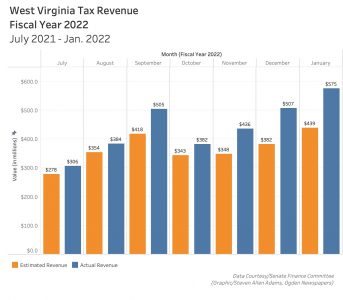
CHARLESTON -- Year-to-date tax surplus for the fiscal year topped more than $500 million as January tax collections came in above projections for the seventh month in a row in West Virginia.
According to data released Wednesday by the Senate Finance Committee and an updated revenue estimate published Jan. 12 by the Department of Revenue, January tax collections of $575.3 million came in 31.9% above the $438.5 million updated revenue estimate for the month, resulting in approximate $136.8 million surplus for the month.
"We had another incredible surplus for the month of January," Gov. Jim Justice said Wednesday during his COVID-19 briefing at the Capitol. "We continue to set more and more records every single month as far as what our collections are and what our revenues are...this is unbelievable."
Year-to-date tax collections for the current fiscal year beginning in July 2021 were $3.1 billion, which is 20.7% more than the $2.6 billion revenue estimate, giving the state a $530.6 million surplus for the remaining five months of the fiscal year 2022 ending in June.
"I've said it a thousand times, you can't find anybody on the planet who is more proud to bring these kinds of numbers to you," Justice said. "Believe you me, these numbers didn't just happen just from somebody rolling off the pickle truck...so many people in West Virginia deserve a lot of credit."
The severance tax on coal and natural gas once again led the way on tax revenue by percentage. January severance tax collections of $81.9 million was 135.2% more than the updated $34.8 million estimate, resulting in $47.1 million in surplus for the month. Year-to-date severance tax collections of $336.1 million was 95.2% more than the updated $172.2 million estimate. Year-to-date surplus for severance tax revenue was $163.9 million.
By dollar amount, the personal income tax collections brought in the most revenue for the month. January personal income tax collections of $289.5 million was 28.6% more than the $225.2 million estimate, resulting in $64.3 million in surplus for the month. Year-to-date collections of $1.3 billion were 15.9% above the $1.1 billion estimate, giving the state a $181.7 million surplus in personal income tax collections.
Consumer sales and use tax revenue for January was $149.3 million, which was 11.1% more than the $134.4 million estimate for a $14.9 million surplus for the month. Year-to-date collections of $936.7 million was 9.4% more than the $856.3 million estimate, giving the state $80.4 million in surplus. January corporate net income tax revenue was nearly $9 million, which was 79.9% more than the $5 million estimate. Year-to-date collections came in at $181.8 million with $98.6 million in surplus revenue.
"This is all across the board," Justice said. "This isn't just sales tax. This isn't just severance. It's not corporate net. It's not personal income. It's everything. Absolutely really and truly, when you get the snowball rolling down the side of a snow-covered hill...it gets bigger and bigger. This snowball includes everything and everybody. Let's keep it going, for crying out loud."
Justice called for continuing to put a certain amount of current fiscal year surplus dollars aside for matching funds to recruit new businesses and manufacturers. The Legislature approved a series of tax breaks last year to lure North Carolina-based steel manufacturer Nucor to Mason County to build a new $2.7 billion steel mill. The state also set aside $315 million in matching funds that will kick in when Nucor meets certain investment thresholds.
"In my opinion, we ought to put a major amount of these monies into a fund so we can go out and attract more and more and more great businesses to West Virginia," Justice said. "That will set this state up to go for decades and decades to come. That's the kind of stuff we need to be doing."
Speaking during remarks from members in the House of Delegates Wednesday morning, Delegate Todd Longanacre, R-Greenbrier, said he believes the tax revenue surplus could grow to close to $1 billion toward the end of the fiscal year. He called for tax relief to be considered.
"In an era when we are running some pretty substantial, significant surpluses in the State of West Virginia, that is a good thing," Longanacre said. "If we do not deliver some sort of tax relief back to the people who put that surplus here, we would be remiss and none of us deserve to be re-elected."
Last month, members of the House and Senate Democratic minorities proposed using surplus tax revenue to offset a cut to the consumer sales and use tax from 6% to 4.75%, which would cost $312.5 million, with another .25% cut at the end of the fiscal year if the Rainy Day Fund hits the $1 billion mark like it did last summer.
(Adams can be contacted at sadams@newsandsentinel.com)