
Legislative leadership lay out goals for remainder of the 2022 session
Trending
CHARLESTON -- With just over three weeks left in the 60-day session, majority and minority leadership in the West Virginia Legislature addressed members of the press to set out their remaining priorities.
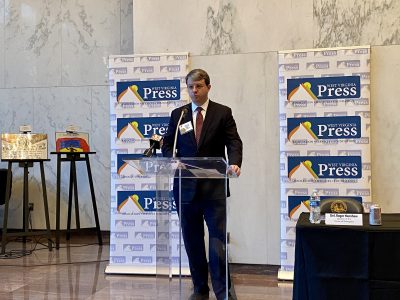
House Speaker Roger Hanshaw, R-Clay, Senate Minority Leader Stephen Baldwin, D-Greenbrier, and House Minority Leader Doug Skaff, D-Kanawha, attended the West Virginia Press Association's Legislative Breakfast at the Culture Center in Charleston on Thursday morning.
Hanshaw said much of the 2022 legislative session that began on Jan. 12 has focused on lessons learned during the recruitment of several large manufacturers to the state this year, including North Carolina-based steel manufacturer Nucor, Canada-based electric bus manufacturer GreenPower, and Virginia-based medical supply maker Owens & Minor Inc.
"I think it's fair to say that for many of us, the priorities that we've tried to advance this year and that we'll be continuing to advance over the course of the next several legislative sessions are in the clear outgrowth of what we learned during the process of recruiting the largest economic development announcements ever in the history of West Virginia," Hanshaw said.
One of these lessons was having sites ready for these manufacturers to build on with infrastructure already in place. The House passed House Bill 4002 Wednesday, creating the Certified Sites and Development Readiness Program. The bill requires the Department of Economic Development to create evaluation and certification criteria for possible manufacturing and large business sites across the state.
"We learned that having sites ready for development matters," Hanshaw said. "It's important that we make the kind of investments here in West Virginia that allow us to have sites ready to be marketed, ready to be constructed, and ready to have capital deployed immediately, because capital doesn't wait three years for us to run a water line."
Hanshaw said another positive thing large businesses and manufacturers look for is financial stability in state government. West Virginia has been seeing record monthly tax revenue surpluses due in part to greater federal investment from the American Rescue Act and other COVID-19 relief and recovery dollars, with many believing the state will net nearly $1 billion in surplus by the end of the fiscal year in June.
The state's Rainy Day Fund also is healthy, with more than $1 billion saved, nearly 20 percent of the state's annual general revenue budget. Hanshaw said bills have been introduced to cap the Rainy Day Fund at $1 billion, with any remaining surplus at the end of the fiscal year returning to the general revenue fund. Combined with infrastructure funding through ARPA and reinvestment of surplus tax dollars, Hanshaw said the state needs to develop a long-term strategy for investing those monies in a way that does the most good.
Skaff pointed to a bill he co-sponsored with Hanshaw that would help bring investment to the state. House Bill 4259, the West Virginia Small Business Jumpstart Act, would create a venture capital program to fund small business development in West Virginia.
"There was over $200 billion of investments out there for small businesses in the country last year. None of it was in West Virginia," Skaff said. "We want to switch that by offering incentives for those people to consider investing in rural West Virginia"
Baldwin and Skaff praised bipartisan efforts with Republicans to incentivize economic development and recruit more workers to the state. But the two minority leaders believe that other bills, such as Senate Concurrent Resolution 44 to put a expiration date on the state's 1972 ratification of the Equal Rights Amendment or House Bill 4011 that put limits on how issues of race and discrimination can be discussed in classrooms, push potential new residents away and drive the state's young people out.
"We've got this wonderful opportunity right now … What I hear though from young people, especially young professionals, is that they're being driven away.," Baldwin said. "I'm afraid that we are risking the future by spending so much time and so much energy on so many socially divisive bills before us that protect immediate political interests, but do not protect the long-term interests of West Virginia."
"We've done a lot of fantastic things up here … but then it's counteracted because of the divisive issues that do nothing to keep people in West Virginia and bring people here," Skaff said.
Baldwin also cited lack of job opportunities in certain fields, the substance abuse crisis, and lack of anti-discrimination protections for the LGBTQ community as more reasons why young people are leaving the state. Baldwin said the state has a golden opportunity between now and the end of the legislative session to make changes that will bring new job creators to the state and encourage graduates to stay and make a life here.
"I think the next three weeks are going to have a significant impact on the next three decades," Baldwin said. "With folks looking to be in West Virginia right now, are we going to give them a reason to be here, or are we going give them a reason not to be here? That's the choice before us in the next couple weeks."
(Adams can be contacted at sadams@newsandsentinel.com)