
Paul Brandt: The POTA guy
Local amateur radio operator makes connections in Parks on the Air
Trending
STEUBENVILLE -- "What are you doing?" is a question Paul Brandt has gotten used to being asked ever since he's been "a POTA guy" going to parks.
An acronym for Parks on the Air, POTA is a nonprofit organization founded in 2010 that supports the use of amateur radio operators being in state and national parks and communicating with other operators, wherever they may be.
It's something the local resident got interested in as recently as last summer -- an effort that involves going to a park, getting set up and hoping to make at least 10 contacts with other operators for POTA credit.
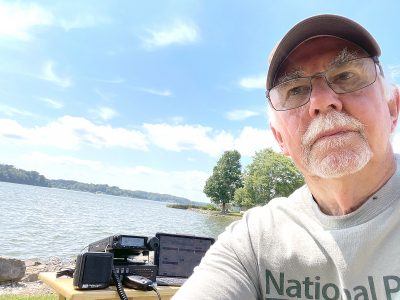
The sight of Brandt doing this, seated at a fold-up table with an antenna, his iPad and other equipment along with a POTA flag, attracts some people's interest, and hence the inquiry about what he's up to.
The response might be initially playful to inquisitive children, that he's sending out special signals so the fish will come to shore, but to the accompanying adult, he'll turn serious.
Brandt has found some are interested in details, while others are content with an abbreviated overview.
Either way, he's happy to oblige.
Why would you want to communicate from a park?
"Why would you want to communicate from anyplace," is Brandt's comeback to the question, supplemented with a chuckle.
"As a hobby it's because that you've learned to use your equipment and want to see if the equipment you have can reach other people, so it's a hobby of being able to actually make that radio communication," he explained.
Discovering parks is a big bonus, too.
"The goal of POTA is for ham radio people to have fun. That's the goal," Brandt said.
"I didn't start doing this until July," Brandt said of the activity where amateur radio operators, often called "hams," find parks, set up temporary portable radio stations and work to contact as many fellow hams as possible.
The goal is 10 to get POTA credit, according to Brandt, who noted that visiting a park and getting on the air is referred to as an "activation." After these, operators submit a list of their contacts to POTA. The goals are to activate as many parks as possible and to talk to as many stations as possible. Such efforts are rewarded with certificates given for varied categories. "If you've activated the same park 10 times, I think you get a nuisance award," he said.
"Normally I'm trying to get those 10 contacts because I don't get credit for activating that park unless I get those 10 contacts. I've driven X number of miles and set up my equipment, so I want to get that credit through POTA," he said.
"My call sign is W8PAB," Brandt said. It's a coincidence that PAB are his initials.
"This is Whiskey 8 Papa Alpha Bravo calling for Parks on the Air," Brandt will identify himself on a call, "and then you listen and hope somebody heard you."
In Brandt's experience, they have.
On 28 occasions since July, Brandt has visited 17 parks and made at least 10 contacts at each, visiting some locations more than once. Those include Fernwood State Forest, Jefferson Lake State Park, Beaver Creek State Park, Beaver Creek State Forest, Guilford Lake State Park, Barkcamp State Park, Salt Fork Wildlife Area, Tomlinson Run State Park, Raccoon Creek State Park, Harrison State Forest, Jockey Hollow Wildlife Area, Wolf Run State Park, Milton Lake State Park, Pymatuning State Park (one in Ohio and one in Pennsylvania) and Mosquito Lake State Park.
"I happen to have two parks that I've been the first to ever activate -- Jockey Hollow out near Piedmont Lake and the other one was the Salt Fork wildlife area. I am the first activator of those two," he said.
The POTA website, he added, acknowledges such data.
And Brandt has made some contacts from "across the pond" -- Palencia, Spain; Kaposuar, Hungary; Korycany, Czech Republic; Miskoic, Hungary; Seville, Spain; Angro do Heroismo, Portugal; Vrhnika, Slovenia; and Palazzolo, Italy.
Brandt, who lives in Cross Creek Township with his wife, Marlies, is a retired automobile dealer who worked for the American Red Cross when it had a Jefferson County Chapter presence. He is active in the Steubenville Kiwanis Club and Wintersville United Methodist Church and serves on the LEPC, an acronym for Local Emergency Planning Commission.
A native of Steubenville, he was a member of Steubenville High School's Class of 1959, the school's 100th graduating class.
He holds membership in the American Radio Relay League, the Steubenville-Weirton Amateur Radio Club which he helped establish, the Tri-County Emergency Radio Association and the Amateur Radio Emergency Service.
There are around 730,000 Amateur Radio operators in the United States, licensed by the Federal Communications Commission and trained in communications techniques and basic electronics theory.
"There is a test, and there are three different levels of license," Brandt said. "The beginning level is a technician; the second level is a general, what I am; and the third level is amateur extra, and I am studying for that," he said. "You have more privileges with the higher license and you have more knowledge. You have to know about how radios operate and how the antennas operate, how the little radio wave bounces off the ionosphere and comes back down and why does it do these type of things and you have to have some electrical and electronics knowledge, and the higher your license is theoretically the more knowledge you have," he said.
The interest originated in childhood.
"I probably got interested way back as a kid because my dad bought me a short-wave radio, and I used to enjoy it, but I was never very good at Morse code and you used to have to pass a Morse code test to be able to get a license," he said.
"I had friends who were ham radio operators when I was in the Navy, but the real reason I got interested was when I was working for the American Red Cross at the Jefferson County Chapter, and the ARES (Amateur Radio Emergency Service) members had a ham radio station in the Red Cross office."
Brandt got to talking to them, and the interest graduated to involvement.
He studied for his test and got his technician's license. That was in 2012.
"I'm a newbie," he said.
Parks on the Air isn't that old either, having been established in recent years.
Brandt got interested in it last July, when he read about it, and realized that even though you could participate in Parks on the Air indoors if you wanted, being in a park itself is far better, not to mention a way to enjoy park systems available.
The contacts made can be brief or linger.
"It can be both," Brandt said, noting "rag chewing" is the ham radio world equivalent of "BS'ing."
"You can be in a park and in a hurry to make contacts to go to another park or am I going to stay there all day and enjoy the park and I don't care how fast I make contacts," Brandt explained.
"So I am enjoying the park. I've found that I've got to know parks in places I've never been to because I drove there and sought it out. Normally what I do is before I kind of select where I'm going to go and how much time do I have and how far do I want to drive to get there," he said of his strategy.
"Once I've selected a couple parks in that area, then I pull up the information from going on the Internet about the park, print out a map of the park so I can study the map to see what the lay of the land is, where do I think I'm going to want to locate. When I get there, I have an idea in my head.
"Then I normally drive around the park. Even if I find a location to be good to set up and operate, I might continue to drive around the park just to see the park and what the facilities are," he added.
"If there's a park office, a lot of times I'll stop and say, 'Hey, I'm going to set up a radio,' and I more or less tell the park rangers what I'm doing because there might be a location they don't want me in, maybe an activity going on, maybe they have some good advice where I can go. I hand them a (POTA) pamphlet as a public relations thing," he said.
Normally, Brandt will set up in a horsemen's area of a park because it's on a higher elevation and better for reception.
Riders often express curiosity about what's he doing.
"Some people get very interested in what you're doing and want to talk and others are, 'Oh, OK,' and they go about their business."
What time Brandt spends in a park varies.
"I've been into Fernwood five times. When I go there I just go and set up and get my 10 contacts or more, and then I leave. And I may be trying different frequencies and antennas, playing around. If I go up to Milton Lake north of here and I've made the trip up there, I want to get in there and get my 10 contacts and I don't play around, I get on a frequency and I'm going to get my 10 contacts," he said.
The activity is one that can be done any time of year. "Radio waves don't care," Brandt said.
"I'd hear people on the air saying POTA, and I thought I don't want to talk to them, and then I finally started making some contacts and looked into it and thought this sounds kind of interesting, but I'm not interested in sitting in my basement trying to contact all these parks. Does an 80-year-old man go out and go to the parks? The answer is I did," he laughed.
"My bucket list is to try to activate a park in every state," he said. With Ohio, Pennsylvania and West Virginia done, only 47 to go.
Brandt said being involved in Parks on the Air gets him out of the house, brings him enjoyment, has a competitive adventure element to it and it's good to visit parks.
"I found I really enjoy going to the parks -- we've got these great parks out there. Why did I wait 80 years to start finding these parks? Go look at what we have. I mean taxpayers are paying for it. They're your parks, and there are some really great facilities and beautiful areas to go to, and they're not that far from home," he said.
"It's fun to make the contacts, to talk to new people and it's the excitement of making the contact. It's like when I sold cars -- the excitement of seeing the tail lights go down the road."