
Steubenville basketball great turned misfortune into opportunity for others
Trending
STEUBENVILLE -- While playing for Hank Kuzma's winning College of Steubenville basketball team, "Big" Jim Smith Betsill scored 2,048 points and set a record for rebounds, but it was his "assists" to many following his college athletic career for which many remember him.
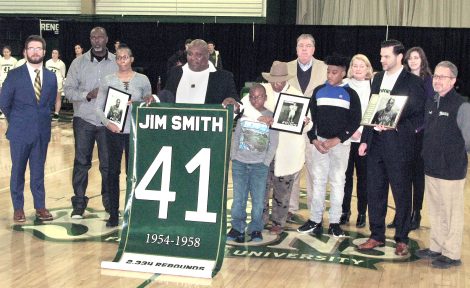
Betsill's grown children -- J.P., Tracey and Michelle -- were on hand Saturday at the Franciscan University of Steubenville to accept tokens commemorating their father's addition to the All-American Wall of the school's Hall of Fame and retirement of his number, which was 41.
Scott Greve, the university's athletic director, noted Betsill helped the Kuzma-led College of Steubenville Barons (forerunner of the Franciscan University of Steubenville) through a 24-1 season for which the team was named the Number One Small College Basketball Team by United Press International in 1958.
With Betsill on board, the Barons chalked up 96 wins, with just 19 losses, over a four-year period.
And he set a NCAA record for rebounds -- with 2,334 over a three-year period.
His performance on the court led to his being named an All-American twice by the Newspaper Enterprise Association and to being drafted, in the second round, by the Boston Celtics.
But that same summer, Betsill also was drafted by the Army for service in Vietnam. Injuries to his knee led to his being discharged in 1960 and also ended his career in basketball.
But the life of the Pittsburgh native turned toward public service and community activism, including participation in the Civil Rights Movement.
J.P. said while working for the U.S. Office of Economic Opportunity in Wilkinsburg and Hazelwood, Pa., Betsill helped many Blacks to learn trades and pass apprenticeship tests and joined others in demonstrating for the inclusion of minorities in trade unions.
J.P. recalled seeing his father in television news broadcasts of sit-ins and other protests aimed at earning equal rights for all. He said he was unaware at the time that his mother, Mary, had been called more than once to post bond for his father, who had been jailed with other demonstrators.
Nor did Betsill's children know, until years later, that their father had received threats to his life.
Tracey noted her father also worked with others to establish a YMCA for his community, a project that came to fruition after the family had moved to Harrisburg.
J.P. noted Betsill took a job there as a regional director for the Pennsylvania Bureau of Corrections Education, through which he helped inmates to attain the equivalent of a high school diploma and the hope for a better life.
He was known for delivering addresses of encouragement to prisoners, and J.P. said his father more than once told him, "Be all you can be. Education is key."
J.P. said his father went to great lengths to attain a college education.
Wishing to play college basketball, a young Jim Betsill was adopted by the Smith family so he could move to another Pittsburgh area school district where the chance of his being offered a scholarship was better, they revealed.
The surname was passed on to his wife and children until years later, upon his parents' 50th anniversary, Jim arranged for everyone's names to be changed to Betsill.
"We walked out of school one day as Smiths and came back the next day as Betsills," said Tracey.
Betsill died in 2002, at the age of 67, of leukemia. Mary, his wife of 41 years -- who was from Steubenville -- died in 2010.
Had Betsill not been drafted into the Army, he would have gone on to play for Basketball Hall of Famer Red Auerbach with NBA greats Bill Russell, Bob Cousy and Sam Jones.
Asked if he ever spoke of that missed opportunity, Tracey said, "He never spoke about any regret. His regret, I think, was that he didn't think he did enough."
She said she believes her father saw basketball as a step on a ladder that led to his education, his wife and family and his role in the community.
It was just a part of his journey," she said.
J.P. said his father didn't talk about his accomplishments as a player but he spoke of the camaraderie he enjoyed with his teammates and kept in touch with them over the years.
"He was so about the team," he said.
Joining Joe Wallace and Sean Kirk, head coaches for the university's men's and women's basketball teams, for a presentation to the Betsills between two Barons games Saturday was Chuck Kuzma, son of the late Barons basketball coach and long-time supporter of the university, and his wife and daughter.
Kuzma said he was on a team in a Hershey, Pa., summer basketball league when the 6-foot-6 Betsill stepped in to set straight an opposing team that was playing rough.
"He was our enforcer. Growing up, my brothers and I always heard (from their father, Coach Kuzma), 'Bring your elbows back like Jim Smith. Clear the boards."
"It's an honor to come back and honor Jim Smith," said the younger Kuzma.
(Scott can be contacted at wscott@heraldstaronline.com.)