
Weirton Museum features look at area’s industrial history
Trending
WEIRTON -- The industrial history of Hancock County can be traced through very distinct phases, according to historian and author Lou Martin.
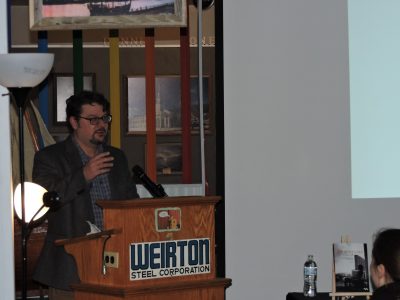
"Hancock County has gone through three major economic transitions," Martin explained during a presentation Saturday at the Weirton Area Museum and Cultural Center.
Martin, a New Cumberland native and associate professor of history at Chatham University, presented some of his findings in "Hancock County: From Pre-Industrial to Post-Industrial," where he traced a path through the local economy for a group of about 25 residents. The presentation was part of the "Crossroads: Change in Rural America" exhibit currently on display at the museum.
Martin noted, coming out of the days of the frontier, the first major industrial phase for the region featured commercial agriculture, and lasted from 1790 to 1900. Initially, the main crop of the area was wheat, he noted, but, eventually, residents transitioned to the production of apples and raising sheep.
"They believed it was one of the best ways to reinvigorate the soil," Martin said of the sheep, noting the British heritage of many of the local farmers at the time.
Around 1900, the area began its industrial era, Martin said, relaying it would last for approximately 100 years with the founding of the local steel and pottery industries.
"The farmland offered somewhat of a clean slate," he said, explaining the flat areas within the valley provided space to build factories in Weirton, Newell and Chester, attracting business from nearby states and, eventually, workers from around the world. "It was probably the only time in history people came from Ohio to West Virginia in search of flat land."
By 1950, he said two out of every three workers were employed in manufacturing, although the decline in major industry would begin in the next decade.
In the 1960s, pottery saw reductions in its market by 60%, with steel following in the 1970s with production falling by 44% and employment by 67%.
By 2000, the post-industrial era had begun, according to Martin, marked not only by a shift of business from manufacturing to healthcare, education and services, but a population migration as younger residents looked for other opportunities.
Martin's discussion also touched upon the influence technology, shifts in society and politics played on the changing economies.
"Crossroads" will be at the Weirton Area Museum and Cultural Center through March 7. Additional events include a discussion with Samuel W. Black, director of the African American program at the Senator John Heinz History Center at 11 a.m., Saturday, and a performance by Ohio Valley Cloak and Dagger Co. at 7 p.m., as well as a kid-friendly scavenger hunt and a celebration of Weirton's 75th anniversary at 10 a.m., March 5.
(Howell can be contacted at chowell@weirtondailytimes.com, and followed via Twitter @CHowellWDT)