
U.S. Supreme Court hears clean power plan arguments led by AG Morrisey
Case presented regarding alleged authority over carbon dioxide emissions
Trending
CHARLESTON -- West Virginia got its day before the U.S. Supreme Court on Monday, where the state Attorney General's Office presented its case against the U.S. Environmental Protection Agency over its alleged authority over carbon dioxide emissions.
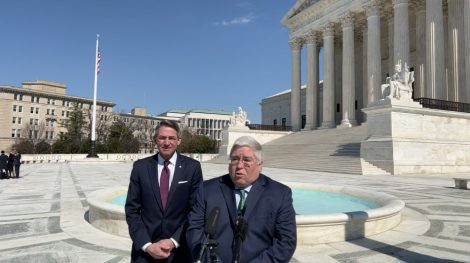
Attorney General Patrick Morrisey virtually briefed the press on the case Monday from the steps of the Cass Gilbert-designed U.S. Supreme Court Building in Washington, D.C., shortly after arguments ended in West Virginia v. EPA.
"I think we made some very strong arguments to push back against the opposition's arguments on standing and mootness," Morrisey said. "We were able to articulate a lot of strength as far as why this represents a major question of the day and also to make the argument that we have very compelling textual arguments as well. We're cautiously optimistic about this."
West Virginia and 18 other states are challenging a ruling by the U.S. Court of Appeals for the District of Columbia Circuit that blocked the Affordable Clean Energy rule, a Trump-era rule that replaced the Clean Power Plan with less stringent regulations on coal-fired power plant emissions.
Morrisey appealed the case to the Supreme Court in April 2021.
Morrisey and supporters of his legal case believe that the Clean Air Act, passed in 1970 and signed by former president Richard Nixon, only gives the EPA authority over individual coal-fired power plants and the authority to make wholesale, broad rules for the entire energy-producing sector. Morrisey believes that it is up to Congress to pass specific regulations for the EPA to enforce and not through the agency's executive authority.
"This is a critical case for this Supreme Court term," Morrisey said. "I've always said very clearly that major questions of the day need to be resolved by Congress as opposed to unaccountable bureaucracy. Those arguments were made very plain and clear today, and we're hopeful the court heard them and agrees to that perspective."
Opponents of West Virginia's legal case, such as environmental law firm Earthjustice, believe it is clear that the EPA does have the authority to regulate greenhouse emissions broadly. They see any ruling against the EPA's authority as a sign that other environmental regulations could be at risk.
"Despite the broad language Congress used to grant regulatory authority to EPA, some Supreme Court Justices seem poised to rule that the law does not mean what it says, and that they get to decide what federal agencies can do to protect the air we breathe and the water we drink," said Sam Sankar, senior vice president of programs at Earthjustice. "Today's oral arguments demonstrate that our environmental laws are only as strong as the Justices who must uphold them."
The Supreme Court previously blocked the Clean Power Plan rule in 2016, first proposed under former president Barack Obama, preventing the rule from taking effect. The rule would have given expansive powers to the EPA to regulate the carbon dioxide emissions of coal-fired power plants. Morrisey led a 27-state coalition to secure the 2016 stay of the Clean Power Plan.
Former president Donald Trump scrapped the Clean Power Plan and replaced it with the ACE rule. The D.C. Circuit vacated the ACE rule in January, requiring the EPA to start over from scratch on a new rule. President Joe Biden announced a goal in April of cutting U.S. greenhouse gas emissions by between 50 percent and 52 percent of 2005 levels by 2030. Biden's EPA is also developing its own rule similar to the Clean Power Plan.
The majority conservative Supreme Court has already taken a hard line against the executive branch using its agencies to implement rules and regulations that go beyond their authority to do so. In a January decision, the high court blocked the Occupational Safety and Health Administration from requiring employers with more than 100 workers from either requiring COVID-19 vaccines or testing.
Morrisey said the Supreme Court could render a ruling on West Virginia v. EPA as soon as June.
"I think overall this was a good day. And now we wait," Morrisey said. "I feel very good. The effort we put in vindicates years of work. We've been focusing on these issues…for a long, long time."
(Adams can be contacted at sadams@newsandsentinel.com)