
West Virginia juvenile caseloads up slightly in new judicial system report
Trending
CHARLESTON -- Juvenile caseloads for West Virginia circuit courts went up slightly in the second year of the COVID-19 pandemic according to a new report.
The West Virginia Supreme Court of Appeals released its 2021 West Virginia Court System Annual Report on Wednesday.
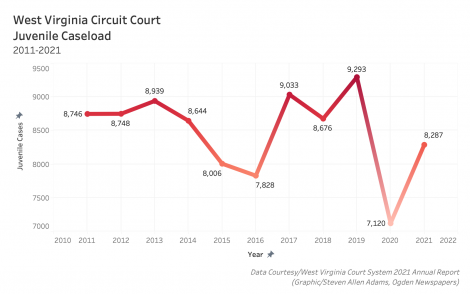
According to the report, circuit courts across the state's 31 judicial districts, the juvenile caseload was 8,287 for 2021, an increase of 16.4 percent from 7,120 juvenile cases in 2020, the first year of the COVID-19 pandemic.
Juvenile cases include child abuse and neglect, delinquency, and other status offenses. Of the 40,987 total cases filed in circuit courts in 2021, 20 percent of the cases were juvenile matters.
Schools were shut down from March 2020 until the end of the school year that summer to curb the spread of the coronavirus. At the beginning of the new school year that August, schools would close and go to remote learning depending on the level of virus spread using a color-coded map as a guide.
By the start of the 2021-2022 school year in the late summer/early fall of 2021, officials with the Department of Education announced that it would be up to individual county boards of education and schools to decide to close due to virus spread. In August 2021, the Department of Education released statewide assessment data showing a loss of learning among West Virginia students during the previous school COVID-19 shutdowns, citing the data as a reason to avoid shutting down schools going forward.
At the time, State Superintendent of Schools Clayton Burch pointed to additional data to justify keeping schools open. Burch cited the number of children in the state's foster care system, an increase in Child Protective Service referral rates, and the spike in opioid overdose deaths between 2020 and 2021. In many cases, Burch said students simply left the school system altogether.
"I just want to put into context as these are released, that they do have to be part of a bigger puzzle that we're looking at," Burch said. "We want the students to be successful, but oftentimes, their home lives just put so many challenges in."
Despite the slight increase in juvenile caseload numbers in between 2020 and 2021, the 2021 caseload numbers are still 10.8-percent lower than the 9,293 juvenile caseload numbers from 2019 - the highest number over a 10-year period. The 2021 numbers are also 5.2-percent lower than the 8,746 juvenile caseload number from 2011.
The Supreme Court's Juvenile Justice Commission marked its 10-year anniversary last December. The commission, created in 2011 after the unexplained death of a juvenile at the Industrial Home for Youth, works on issues of justice when it comes to juvenile offenders. The commission was created by former justice Margaret Workman.
According to the report, the Division of Probation has 3,334 juveniles under supervision in West Virginia, with 3,098 on regular probation, 119 on bond release, and 117 in the Juvenile Drug Court system.
As of 2021, there were a total of 261 juveniles in the Juvenile Drug Court system including the 177 new participants, with 52 graduates of the program. Drugs of choice for juveniles included marijuana, alcohol, methamphetamine, synthetic cannabinoid, and cocaine. According to the report, there were no reported relapses by juveniles in the program.
The report highlights case statistics, budget information, and the work of Supreme Court justices, the administrative office of the court, circuit judges, family court judges, and magistrates across the state.
"Re-establishing an annual report as an electronic document is part of the Supreme Court's effort to be transparent and fiscally accountable," Chief Justice John Hutchison said. "Our 1,500 judicial system employees are proud of the work we do, and we hope this document gives the public a sense of the depth and breadth of the ways we serve West Virginians every day."