
Supporters, opponents of Pleasants Power plan make case to W.Va. PSC
Trending
CHARLESTON - The future of the Pleasants Power Plant remains uncertain even if the West Virginia Public Service Commission approves an interim plan and temporary surcharge to keep the plant functional for one year while two FirstEnergy subsidiaries consider purchasing the plant.
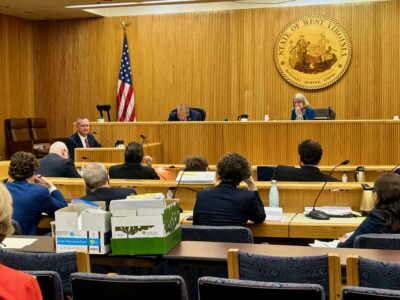
The PSC held an evidentiary hearing Friday to hear the merits and concerns about a proposal from Monongahela Power Co. and Potomac Edison Co. - both subsidiaries of Akron-based FirstEnergy Corp. - to lease Pleasants Power from Texas-based Energy Transition and Environmental Management (ETEM) before it begins demolishing the plant after May 31.
The 12-month lease agreement between Mon Power/Potomac Edison and ETEM would begin in June and end in May 2024 once the two groups sign a letter of intent. While Pleasant Power would no longer generate electricity during the 12-month period, the plan would keep the plant warmed up and maintained while Mon Power/Potomac Edison decides whether to purchase the plant.
As part of the plan, the companies are seeking a $36 million temporary surcharge on Mon Power/Potomac Edison residential, commercial, and industrial ratepayers in North Central West Virginia and the Eastern Panhandle to reimburse ETEM for maintaining Pleasants Power over the 12-month period and paying to keep the plant's 154 workers employed. However, in a filing last week, the companies believe that unknown costs and risks could require more than $36 million to cover the 12-month period.
Christopher Callas, an attorney representing Mon Power and Potomac Edison, said the companies never set out to consider a purchase of Pleasants Power. The PSC gave the companies until March 31 to submit a report to the commission on the feasibility of purchasing Pleasants Power separate from an approved $91.9 million increase in the Expanded Net Energy Costs surcharge at the end of 2022.
"The Commission directed a response by March 31. We were able to provide the commission with such evaluation that we had done," Callas said. "There is more to be done. It is a complex process … there are many, many factors to be considered."
Callas said the companies have no interest in operating three coal-fired power plants in West Virginia, but it could potentially purchase Pleasants Power if it can close its power plant in Fort Martin outside of Morgantown. The aging Fort Martin plant doesn't have the newer environmental controls that the Pleasants Power plant has, Callas explained. Mon Power/Potomac Edison also own the Harrison Power Plant near Clarksburg.
"We believe it is not appropriate and not in the customer's best interest at this time for Mon Power to operate three coal-fired power plants," Callas said. "It is a comparison, effectively, of Pleasants and the decommissioning of another coal-fired power plant in Fort Martin … It's a question of one or the other."
Mark Valach, the director of Fuels and Generation Commercial Operations for FirstEnergy, said the temporary surcharge could be less than $36 million if Mon Power and Potomac Edison are able to complete their evaluation of purchasing Pleasants Power prior to May 2024.
"The uniqueness of this situation is the plant may have value to the customers of Mon Power. We don't know for sure," Valach said. "But the ability to realize those benefits will be lost if put into a state where demolition is the ultimate goal. The equipment needs to be put into a condition to be restarted."
Valach said the companies must consider the impact of environmental changes and what the plant needs to comply, disposal of waste materials, investigation of emission reduction (NOx) credits and whether those can be transferred to the plant.
"It is a decision that should not be rushed," Valach said. "The environmental changes that have occurred here just recently in March have the need to be fully investigated. We have dedicated resources up to this point with no request for surcharge to do an analysis. However, the pending demise of the plant puts a sense of urgency on how this analysis should be done.
"It was never anticipated that the cost of maintaining that plant would be part of the analysis," Valach said. "We're requesting the surcharge to allow that plant to be an option that would be considered for our customers' use going forward."
The companies are seeking an order from PSC by Tuesday to approve the plan and the temporary surcharge. The surcharge would only be approved once the letter of intent is agreed to between Mon Power/Potomac Edison and ETEM. The plan is supported by the West Virginia Coal Association.
"We certainly support the urgency and creating even more urgency in this process," said Jacob Altmeyer, an attorney representing the WVCA. "Ultimately, this is the last chance for anyone to step in before Pleasants is, by what's been reported, going to close in a little over 30 days and stop generating electricity in 30 days and West Virginians become unemployed before the summer is out."
The Pleasants Power plan is opposed by Longview Power and the West Virginia Energy Users Group (WVEUG), an organization representing large commercial and industrial ratepayers in the state.
"Longview requests that if any extended evaluation of Pleasants is going to succeed, an equally thorough evaluation of Fort Martin and other alternatives to Fort Martin should also take place to fully determine what would be in the best interests of ratepayers and the future of West Virginia," said Nelson McKown, an attorney representing Longview, a coal-fired power plant located near the Fort Martin plant.
"In looking out for the ratepayers of Mon Power and PE (Potomac Edison) - and that is all the ratepayers, not just manufacturing and industry - the Commission should reject the proposed surcharge," said Derrick Williamson, executive director for WVEUG. "The Commission can order the companies to continue their evaluation of whether or not to acquire Pleasants. The companies can bear those costs and seek to recover them at a future date, at which time we will know what those costs are."
The Pleasants Power plan is also opposed by the Sierra Club and several environmental and consumer advocate groups part of West Virginians for Energy Freedom (WV4EF), including Solar United Neighbors of West Virginia, the West Virginia Citizens Action Group, and Energy Efficient West Virginia.
"It should be noted by the Commission that companies do not want to make this investment. They don't appear to be eager to obtain this plant," said Evan Johns, an attorney with Appalachian Mountain Advocates representing the Sierra Club. "That surcharge is a large fraction of the price that would have previously been used to purchase this plant. At the end of this commitment of $36 million-plus, ratepayers will have no idea if they are getting anything."
"The question before you is not whether Pleasants operating is what is best for our state -- a political question in general," said Emmett Pepper, policy director for Energy Efficient West Virginia and an attorney representing the organizations within WV4EF. "What is before you is whether paying this surcharge...is what is best for ratepayers. As all but one party has already stated in comments, there is no benefit to ratepayers for this surcharge."
In written testimony in last year's Expanded Net Energy Costs surcharge request from Mon Power/Potomac Edison before the PSC, a witness for the PSC's Consumer Advocate Division first recommended the companies consider the purchase of Pleasants Power as an alternative to operating the Fort Martin Plant. But Consumer Advocate Division Director Robert Williams said Friday it was not his division's intention for the companies to burden ratepayers while the purchase of the plant is considered.
"What you have before you isn't a proposal to acquire a plant. It is a proposal to let it sit idle for a year while ratepayers incur all of the expenses of letting it sit idle," Williams said. "Not one ton of coal will be burned. Not one kilowatt hour of electricity generation will be coming out of that plant.
"They're saying they want another year to look at this," Williams continued. "We don't think that is a prudent outcome and that's certainly not what the Consumer Advocate Division was looking at when we were encouraging the company to look at the serious issues of operating Fort Martin."
(Adams can be contacted at sadams@newsandsentinel.com)