
U.S. Attorney’s Office discusses civil rights protections in Weirton
Trending
WEIRTON -- The Office of U.S. Attorney William Ihlenfeld is expanding its enforcement civil rights violations in the state and is taking that message on the road with a series of presentations to speak directly with West Virginians.
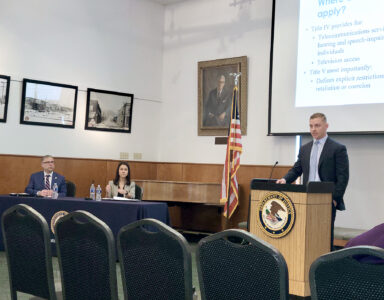
The tour kicked off Thursday morning before a few dozen residents at the Weirton Millsop Community Center.
"There's no better place to start than here in such a historic building," said Christopher Prezioso, assistant U.S. attorney and Civil Division chief, explaining Thursday's presentation is the first of four scheduled by the office.
Thursday's discussions focused on four areas, beginning with identifying, reporting and preventing hate crime.
"Hate crimes, they create fear, and they divide communities," noted Assistant U.S. Attorney Jarod Douglas.
He pointed to several high-profile hate crime incidents in recent years, including the shooting in October 2018 at the Tree of Life Synagogue in Pittsburgh, the May 2022 shooting at the Tops Friendly Markets store in Buffalo, N.Y., the August 2019 shooting at a Walmart in El Paso, Texas, and the August 2012 shooting at a Sikh temple in Oak Creek, Wisc.
"We want to prevent them from occurring in the first place," Douglas said of efforts to stop such terror attacks before they happen.
Douglas reviewed the protected classes of people under both federal and state law, with West Virginia recognizing ancestry, political affiliation, race, color, national origin, religion and sex, and national laws adding recognitions for disability, sexual orientation, familial status and gender identity.
He encouraged those experiencing, or suspecting, a hate crime to reach out to law enforcement, but admitted it's not something that happens in every instance.
"It's critically important for community members to report all hate crimes," he said.
In 2020, Douglas explained, the FBI received statistics from 15,000 law enforcement agencies, with 85% reporting no hate crime occurrences. In West Virginia, that year, there were 30 hate crimes based on race or ethnicity, 16 on religious basis, four related to sexual orientation, two related to gender, one for gender identity and one because of a disability.
Those in attendance also learned more about identifying and preventing violations of housing and disability rights, with Prezioso, as well as Assistant U.S. Attorneys Max Nogay and Carly Nogay, offering advice.
"One in four American adults live with a disability," Max Nogay reported.
He explained disabilities may not be used as a basis to prevent employment, the receipt of government services, access to telephone or television services, or access to public accommodations and many private businesses including hotels, restaurants, private schools, medical offices, funeral homes and daycares.
Carly Nogay, meanwhile, focused on the use of service animals, noting, under the Americans with Disabilities Act, service animals include only dogs which are individually trained to do work or perform a task for the benefit of a person with a disability.
Other animals might be classified as emotional support animals and are allowed under the Fair Housing Act and Air Carrier Access Act, but don't necessarily fall under the ADA.
Prezioso, then, discussed aspects of the Fair Housing Act.
Max Nogay also offered a presentation on environmental justice.
In addition, the event included a discussion with Timothy G. Swanson, supervisory special agent from the Pittsburgh Division of the FBI on the agency's role in upholding the law in relation to civil rights matters.
Additional sessions are being planned in Ohio, Hampshire and Harrison counties.