
Canadian wildfires create unhealthy local air quality
Trending
Several factors -- among them a "double whammy" of wildfires in two Canadian provinces -- led Wednesday to unhealthy air quality numbers and a rare statewide air quality advisory from the West Virginia Departments of Environmental Protection and Health and Human Services.
And, according to the National Weather Service in Pittsburgh, that air quality won't significantly improve until later Friday and the Independence Day weekend.
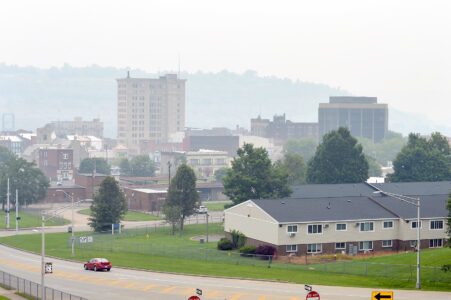
The compromised air quality around the Tri-State Area was evident to the naked eye. A thick haze sat over the region, limiting visibility and irritating eyes and lungs. It was made even more evident by the air quality numbers recorded around the region.
According to the federal government's AirNow.gov website, which monitors air quality nationwide, a permanent air quality monitor in Moundsville peaked at a 208 air quality index at 11 a.m. Wednesday. That reading put the area's air at "very unhealthy" status. By 2 p.m. Wednesday, the AQI in Moundsville slipped just below the "very unhealthy" threshold to "unhealthy" at 196.
Under those conditions, everyone in the area should choose less strenuous activities, like walking instead of running, to not breathe as hard, shorten the amount of time active outdoors, and be active outdoors when air quality is better. Those among more sensitive groups -- like seniors, young children and people with respiratory or pulmonary issues -- should avoid strenuous outdoor activities, keep outdoor activities short and consider moving physical activities indoors or rescheduling them.
The local air quality likely won't get much better for a couple of days, said Lee Hendricks, meteorologist for the National Weather Service in Pittsburgh.
"We're looking for weather systems to start coming in here on Friday that switch the winds around to bring some rain to the area and that should improve conditions," he said. "Tomorrow, conditions will improve slightly, but not to a great, great degree at this point."
The main culprit for the poor air quality is wildfires in British Columbia and Quebec, Hendricks said. A trough of low pressure is sitting right over the eastern and northeastern United States, he said. On the backside of that are northwest winds moving into the Ohio Valey and a ridge of high pressure over most of the western U.S.
On the lead side is an easterly wind bringing the smoke from the British Columbia fires to the region, Hendricks added. The low-pressure trough has northerly winds bringing smoke from Quebec.
"So we get the double whammy of the extra smoke," he said.
Air quality is poor even further out. Hendricks said Beaver Falls, Pa., had an AQI of 232 earlier Wednesday. According to AirNow.gov, a monitor in Steubenville recorded an AQI of 189 at 2 p.m. Wednesday. A monitor in Canton recorded an AQI of 276 at the same time.
The Morgantown and Charleston areas also were dealing with poor air quality, which led the DEP and DHHR to issue their statewide air quality advisory.
"It's not something we've typically done in the past, but ... we're trying to amplify and echo what the EPA is recommending," said DEP spokesman Terry Fletcher. "We're advising folks to keep an eye on it and, if they're experiencing any symptoms, to stay indoors, contact their health provider and take as many precautions as they can."
Air quality plummeted quickly between Tuesday evening and Wednesday. The AQI was in the good to moderate range for the 10 days previous and fell to unhealthy for sensitive groups at 5 p.m. Tuesday.