
Gov. Justice to announce Point Pleasant hydrogen project Wednesday
Trending
CHARLESTON - A new project to produce clean hydrogen from natural gas in Point Pleasant and deposit greenhouse gas emissions beneath state-owned wildlife areas is coming to West Virginia.
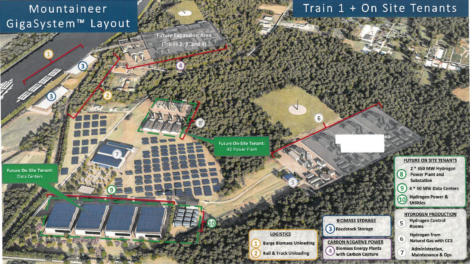
Gov. Jim Justice is set to announce Wednesday that the Department of Economic Development and the Department of Commerce have signed a memorandum of understanding with Houston-based Fidelis New Energy for its proposed Mountaineer GigaSystem LLC for Point Pleasant.
According to the memorandum of understanding dated July 6, Fidelis has acquired the option to purchase four properties in Point Pleasant on more than 1,000 acres of land for a hydrogen production facility, a biomass power plant, and carbon capture and sequestration equipment. The project is an estimated $2 billion worth of investment.
Once completed, the project would provide clean hydrogen power to chemical manufacturers, transportation companies, other electric utilities, and data centers. The project will produce hydrogen using natural gas in a process called blue hydrogen. Fidelis would then take the greenhouse gas emissions and pump the carbon dioxide underground, making the facility a near net-zero emissions facility.
"...The goal in developing, financing, constructing, and operating the Project is to deliver clean hydrogen power to industrial and business users...that are interested in decarbonizing and co-locating on the NPP (North Point Pleasant) site or in the region.," the MOU stated.
The state Economic Development Authority is set to meet Wednesday at 10 a.m. to approve up to $62.5 million in forgivable loans through the High Impact Development Project program. The loans would come in two tranches, starting with $25 million in tranche one and $37.5 million in tranche two.
Fidelis is required to obtain permits and drill its sequestration wells and have air permits in hand within two years to have the first $25 million forgiven and receive its class VI sequestration permit and receive all remaining air permits by year three.
Senate Bill 729 passed last year allows the Economic Development Authority to use monies in the newly established Economic Development Project Fund for high impact economic development projects. These are projects with investments of more than $50 million and expected to create at least 200 jobs.
Fidelis states in the MOU that the Mountaineer facility will create 125 permanent jobs and up to 5,500 construction jobs. It estimates it could produce $105 million in annual tax revenue to the state.
According to the MOU, Fidelis sees the Mountaineer facility as an anchor in a possible Appalachian Clean Hydrogen Hub. Last year, multiple natural gas and clean energy companies announced the creation of the Appalachian Regional Clean Hydrogen Hub, or ARCH2, which would take advantage of the state's access to natural gas supplies and existing infrastructure to manufacture blue hydrogen and store the carbon emissions underground.
Fidelis said it wishes to use pore spaces beneath state forests, wildlife management areas, and other properties owned by the state to storing its greenhouse gas emissions underground. Two bills passed during the 2023 legislative session would allow for this.
"...The CCS (carbon capture and sequestration) component of the Project envisions the development of interconnecting pipelines, wells, and infrastructure to establish an underground warehouse...for the safe and secure sequestration of carbon dioxide produced at the NPP site, to be located beneath the aforementioned State properties and provide the State with substantial royalties," according to the MOU."
Senate Bill 161 would allow the Division of Natural Resources within the Department of Commerce to sell, lease, or dispose of property under its control, though it would prohibit the sale, lease, or disposal of property in state parks or forests without legislative approval.
Senate Bill 162 would allow DNR to lease state-owned pore spaces beneath state forests, wildlife management areas, and other lands under DNR's jurisdiction for use in carbon sequestration, pumping carbon dioxide emissions underground. The bill only prohibits DNR from leasing pore spaces beneath state parks.
According to the MOU, DNR would directly award leases to Fidelis for the development of pore spaces for carbon capture and sequestration on state-owned properties, provided that the leases will afford DNR with a market value for greater royalty.