
Water, sewer issues discussed in Follansbee
Trending
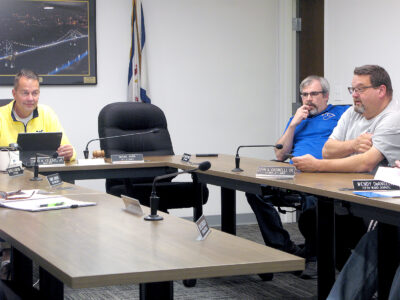
FOLLANSBEE -- The city's water and sewer boards received updates on planned improvements to the city's water and wastewater systems and learned the city's water and sewer customers will be billed in a different manner in the near future.
On Thursday, Jeff Ekstrom of Ghosh Engineering of Charleston said $2 million awarded for the water project by the Army Corps of Engineers is expected to be released in April and plans call for it to be advertised for contractors early next year.
Ekstrom said work could start in April, with completion possible in April 2025.
But he cautioned a shutdown of the federal government could halt the issue of federal funds, potentially delaying its completion by as much as six months.
Funded also with city funds, the $3.1 million project includes upgrades to two water treatment systems serving customers in the city and the suburb of Hooverson Heights.
On Thursday, Chief Water Operator Sam Mazzone said he met with Ekstrom to discuss extending a line from the city's water plant to tanks serving Hooverson Heights so the city could draw on them in the event of an emergency.
He noted the Hooverson Heights plant currently can draw on water from the city if needed.
Ekstrom estimated the cost for the extension at about $25,000 and agreed to add it to the water project in place of other work that had been included but was done earlier.
At a meeting of the sewer board that followed the water board's, Ekstrom provided quotes for two additions to the upcoming sewer project.
One was for about $576,000 to upgrade the Center Avenue pump station for the Hooverson Heights wastewater treatment system.
Mayor David Velegol Jr. said once completed, the station will be able to pump up to 180 gallons per minute, compared to its present 80 gallons per minute, which should prevent overflows.
The other quote was $164,931 for the replacement of a concrete spillway near Neville Street and installation of a 6 foot 30 inch wide stormwater line to ease the flow of runoff from the hillside.
Velegol said during the 2016 flood, the spillway became clogged and about 6 feet of debris, including tree limbs, dirt and silt was washed into the street.
Funded by $10.2 million in federal funds, $2.7 million in state funds and a $2.7 million private loan secured by the city, the sewer project will include upgrades to the sewer plant, pump stations at the city's south end and near the fire station and the separation of combined sanitary and stormwater sewer lines.
The U.S. Environmental Protection Agency has ordered the combined lines, found in many communities, to be separated to prevent raw sewage from being expelled into waterways when sewers become overtaxed by heavy rainfall.
Its start is pending review by the U.S. Environmental Protection Agency.
In other business, Michael "Mac" Casini, the city's office manager, advised the West Virginia Public Service Commission has recommended monthly bills for its customers be based not only on each 1,000 gallons of usage but also on the nearest 100 gallons after that.
Currently customers are charged for each 1,000 gallons used each month, with any additional usage added up and applied to a later bill.
Councilman at large John Casinelli said the move should normally result in smaller amounts added to each monthly bill instead of accumulating in a larger sum applied periodically.
He said as a result, customers should see bills that are more consistent while the city is likely to have a better cash flow from the revenue.
Casini noted that regardless of usage, customers still must pay the monthly minimum rate of $11.29 per 1,000 gallons.
The change is expected to be implemented some time in the next two months and also will affect customers
sewer bills, which are based on water usage.
Velegol also advised the city has been approached about entering a class action lawsuit against the producers of per- and polyflouroalkyl chemicals, often referred to as PFAS substances.
Used often in firefighting foam, the chemicals are the focus of multiple suits alleging their manufacturers were aware they posed significant health risks before their use caused them to contaminate waterways and other natural resources.
Following the meeting, Velegol confirmed the city wouldn't be responsible for any attorney's fees, which would come from any settlement that may be reached, and it's not clear how much the city may receive as one of many litigants that may be involved.
The water board is expected to receive more information at a future meeting.