
Questions, concerns voiced in Follansbee for recycling plant
Trending
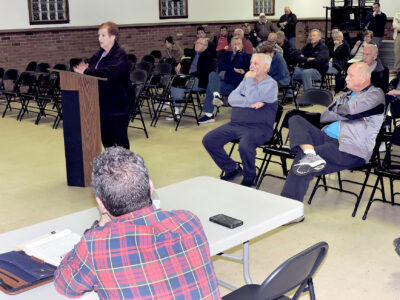
FOLLANSBEE -- Follansbee Council heard from several residents with questions or concerns about a proposed plastics recycling plant and a few in support of it before voting, at a special meeting Wednesday, to approve a building permit for a structure needed for its operations.
Voting to accept the permit were Councilman at large John Casinelli, 1st Ward Councilwoman Tammy Johnson, 2nd Ward Councilman Charles McCoy, 3rd Ward Councilman Nick Cekinovich and 5th Ward Councilwoman Wendy DeAngelis.
Opposing it was 4th Ward Councilman Frank Pedersen, who said, following the meeting, "A lot of the residents on my hilltop (the Parkview area) are against this and personally, I am, too. There are a lot of unknowns here, both for health and money."
Before voting, Cekinovich said he also had many questions about the facility, which Empire Diversified Energy plans to build on property formerly occupied by the Koppers plant at the city's north end.
He asked Mayor David Velegol Jr. what other approval is needed from the city by Empire.
Velegol said pending approval of a permit sought by Empire from the West Virginia Department of Environmental Protection's Division of Air Quality, the company must apply for another building permit to install equipment for the plant.
For construction of the estimated $450,000 structure, Empire must pay a $2,200 fee to the city.
The WVDEP is accepting comment on the permit, which would allow the plant to discharge the following potential emissions: particulate matter, 5.7 pounds per hour or 25 tons per year; particulate matter of 10 microns or less, 3.20 pounds per hour or 14 tons per year; volatile organic compounds, 5.48 pounds per hour or 24 tons per year; carbon monoxide, 22.6 pounds per hour or 99 tons per year; nitrous oxide, 5.48 per hour or 24 tons per year; sulfur dioxide, 8.9 pounds per hour or 39 tons per year; hazardous air pollutants, 0.46 pounds per hour or 2 tons per year; toxic air pollutants, 0.46 pounds per hour or 2 tons per year; and other, 0.17 pounds per hour and .75 tons per year.
They should be submitted no later than Jan. 4 to: West Virginia Department of Environmental protection, Division of Air Quality, 6 157th St. SE, Charleston, WV 25304.
"We're the last step in the line on that," said Velegol, who also noted officials with Empire announced plans to hold a series of informational meetings at the first such meeting they organized, at his request, on Dec. 12.
The permit approved on Wednesday was for a bladder building said to be needed to regulate gases released during pyrolysis, a process through which the plastic waste is decomposed through intense heat in the absence of oxygen.
Frank Rocchio, a local resident heading Ohio Valley Environmental Advocates -- a nonprofit grassroots group -- noted if approved, the plant will be the only one in the U.S. to use pre-pyrolysis, an additional step in the treatment that Empire officials said will allow it to process all types of plastics.
Rocchio had encouraged council to learn about plants in Europe that use pre-pyroysis before voting.
He noted Velegol had indicated the special meeting to approve the building permit, delayed from earlier meetings, was needed so Empire could meet deadlines imposed by bonds invested in the facility.
Rocchio suggested that shouldn't come before the public's safety.
"Let's do due diligence from a safety aspect," he said.
Velegol said later in the meeting that he has read more than 20 articles about the process.
Pat Biesecker was among residents who voiced concerns about pollution from the plant, stating for many years residents had endured odor from local steel mills before they closed.
"I don't want to live down here with all of that smell again," she said, adding, "The plastics plant isn't going to be good for Follansbee."
After resident Iris Ferrell stated city officials aren't prepared for any emergency that would arise from the plant, City Fire Chief Larry Rea asked to respond.
Rea said for 100 years, the city's fire department has been responsible for fire protection for local steel mills and has experienced "some hellacious fires."
He said while the department, like many volunteer companies, is shorter staffed, it has mutual aid agreements that have led to departments from Weirton and Steubenville assisting the Follansbee firefighters.
Rea added local firefighters also have responded to chemical spills from vehicles traveling state Route 2 and U.S. Route 22.
"I will guarantee -- my life is on the line -- anything that goes through this town will be safe," he told attendees.
Resident Shelly Smith noted the region has been cited for its high incidence of cancer and suggested, "Money is being put ahead of human lives."
Following the meeting, Pedersen said he also is concerned about the proposed facility's proximity to the local ballfield.
But a few residents indicated they have dealt with pollution worse than they anticipate from the plastics recycling plant.
Officials with Empire have noted yearly potential emissions for the plant are in the double digits, compared to those for the steel mills, which were triple-digit.
Local resident and business owner Vito "Skip" Cutrone recalled a time when he and others found traces of graphite on their house windows and cars.
Noting the pending WVDEP permit, he asked, "Why would they give a a permit if it's dangerous?"
Cutrone noted with the closing of the Koppers and Mountain State Carbon plants, the city lost significant revenue -- estimated at $1.2 million per year by Velegol.
"This is an economic opportunity," he said, then advised council, "This is what you're voting on -- the future of our city."
Rick Casini, who said as a long-time resident, he experienced "awful pollution" from the steel mills "But we need to be realistic. This is an industrial area, not a resort area."
Casini said future development is more likely to occur with new industries, adding enforcement of environmental regulations is what led to the closing of local steel mills.
"We've got to have opportunities for young people. We've got to create jobs here. We've got to consider what's good for the the city," he said.
But Alex Perry, a young adult living in Brooke County, said the closed steel mills may be a sign it's time for the local economy "to move on to other things."
"If you really want people to live here, it's not going to be with a garbage processing facility," he said.
Some questioned whether the creation of 25 jobs at the plant justified the concerns.
Officials with Empire have stated plans to hire union workers to build it.
Asked how much tax revenue the plant was expected to generate, Velegol said he didn't know.
But following the meeting, he said studies have shown the addition of each new job results in five others in support businesses.
He noted Empire plans to use synthetic gas produced by pyrolysis to power, with fuel from a proposed hydrogen hub eyed for the riverfront port it owns, to power a pig iron plant at the city's north end.
Following the meeting, Casinelli said environmental remediation of former industrial property can take years and isn't likely to be used for non-industrial purposes.
"Anything we put up there, industrial-wise, is going to be regulated by the DEP, OSHA and others and without them, we're not going to get to first base," he said.
"Hopefully, this is the first step and we will continue to grow from this," said Casinelli.