
W.Va. House considers changes to election laws
Trending
CHARLESTON -- With the 2024 election already underway, and the candidate filing period ending this Saturday, members of the House of Delegates considered changes to several election laws Monday.
The House passed two election-related bills unanimously: House Bill 4428, requiring candidates to live in the state or local election district for the office they are seeking; and House Bill 4552, requiring that a candidate for office's party affiliation is consistent with their voter registration.
HB 4428 requires candidates for state, county, or local elected offices to reside in the state and district they are seeking election to. The provisions would not apply to circuit judges, family court judges, or prosecuting attorneys that are already allowed under State Code to reside outside their counties and/or districts. The bill lays out the definition of residence and what qualifies as proof of residence.
HB 4552 requires the notarized certificate of candidate announcement form submitted to the Secretary of State's Office for partisan elections to include the candidate's political party affiliation on the date the certificate of announcement is submitted. Prior to accepting the certificate of announcement, state and local election officials would be required to electronically verify the candidate's current party affiliation.
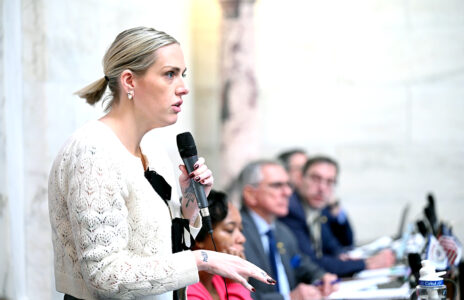
House Minority Leader Pro Tempore Kayla Young, D-Kanawha, said she would support the bill but wished the legislation included electronic verification of a candidate's address to determine whether the candidate resided in the district for the seat they are seeking. Young cited a case from the 2022 election when a lawsuit was filed questioning the eligibility of a Republican candidate for state Senate.
"I think it is great we are electronically verifying this information," Young said. "I would hope that this body ... would include bringing those things in so we can stop some of those things on the front end."
The committee recommended House Bill 4205 for passage, giving the West Virginia legislature legal standing to bring actions against a governor, secretary of state, or other state officials who attempt to make unauthorized changes to state election laws and rules. It would open up the Legislature to participate in lawsuits that contest the legality or constitutionality of state election laws and regulations.
"The intent here is to give the Legislature standing to enforce what we as a body decide should be law," said the bill's lead sponsor, Del. Josh Holstein, R-Boone. "As you saw with examples in previous election years, there were election officials who changed rules unilaterally, and then the Legislature had no standing to bring court cases up against that, so there was no contest to those changes."
The U.S. was hit by the COVID-19 pandemic in the winter of 2020, with Gov. Jim Justice issuing a state of emergency in March and moving the primary election date from May 12 to June 9. Secretary of State Mac Warner, working off an advisory opinion from Attorney General Patrick Morrisey, submitted an emergency rule that March allowing county clerks to accept the COVID-19 pandemic as a valid medical excuse to issue an absentee ballot.
County clerks mailed absentee ballot application postcards to all registered voters for the June 2020 primary, though the same was not done for the November 2020 general election. According to the Secretary of State's Office, sending absentee ballot applications to every registered voter for the 2020 primary cost approximately $900,000 with only 22% of registered voters filling out the applications.
But during testimony, Chief Deputy Secretary of State Donald Kersey explained that passage of HB 4205 would not have affected the moving of the 2020 primary election and deadlines or the mailing of absentee ballot applications leading up to that primary since the Legislature granted the governor broad authority during a state of emergency.
"The governor's authorization in current code was granted by the Legislature to do things, like issue a state of emergency for various reasons ... it authorizes other things, such as relaxing certain statutory requirements that couldn't be followed because of the state of emergency," Kersey said. "He delayed the date in the statute by one month so our primary during COVID was in June."
HB 4205 would have also allowed registered voters in the state to file writs of mandamus against state and local election officials who are alleged to not have abided by state election laws and regulations. In the event of a contested election in the state, a case would be allowed to be brought within 30 days of the conclusion of vote tabulation.
However, a successful amendment from House Judiciary Committee Minority Chairman Joey Garcia, D-Marion, removed that section from the bill. While citizens can bring lawsuits regarding elections now, those citizens must be able to show standing. Garcia said the bill as written would allow for citizens on one side of the state to interfere with elections in another part of the state that they had no part in.
"My main issue with this bill is it is a bill that will allow for lots more lawsuits, especially by people who just want to mess with people across the state without having any direct interest, especially in local elections," Garcia said. "I don't think that is right."
Also on the House Judiciary Committee's Monday agenda was House Bill 4016, making it unlawful for a voter to receive an unsolicited application for an absentee ballot, even from election officials, except when requested by a voter.
The absentee ballot application period opened in West Virginia for the 2024 primary on Jan. 1 and closes May 8. County clerks will mail out absentee ballots to voters who applied beginning March 29.
House Bill 4017 would make it a felony for an individual who votes in person in an election after having voted with an absentee ballot, with a fine of up to $10,000 and between one and 10 years in prison if convicted. The bill also adds criminal penalties for coercing or bribing voters to make changes to their voter registration, making such an act a misdemeanor.
And House Bill 4350 would prohibit local and district political party executive committees from being able to fill vacancies on a general election ballot when potential candidates fail to file during the candidate filing period.