
Watchdogs: Householder, Jackson make case to be next state auditor
Trending
EDITOR'S NOTE: This is part one of a two-part series on Republican candidates for state auditor in West Virginia. Listen to the full interviews on the Mountain State Views podcast, available on most major podcast platforms.
CHARLESTON - The race to succeed Republican State Auditor J.B. McCuskey is on, with four GOP candidates vying to be the state's new watchdog for wasteful and fraudulent spending.
McCuskey is seeking the Republican nomination for attorney general along with state Sen. Mike Stuart, R-Kanawha. McCuskey was elected state auditor in 2016 and is wrapping his second term. He was the first elected Republican state auditor since 1928.
The duties of state auditor are more complex than the title suggests. The office has the constitutional and statutory duty to supervise and manage all requests for payment from the state by vendors, making it the state's accounts-payable office, examining all claims and requests and issuing checks for which the state treasurer provides funds. The office acts as the state's version of the Securities and Exchange Commission and licenses brokers and dealers.
The auditor also is the state's bookkeeper, keeping track of all expenses and revenues. The office keeps track of all state-owned property. It receives property taxes collected by county sheriffs and public utility taxes. But above all, the office performs financial and compliance audits of county and city governments, serving as the chief inspector and supervisor of public offices.
There is only one Democratic candidate for state auditor. Mary Ann Claytor, a 20-year veteran of the state auditor's office under former Democratic State Auditor Glen Gainer, is making her third attempt to seek the office. She was defeated by McCuskey in both 2016 and 2020.
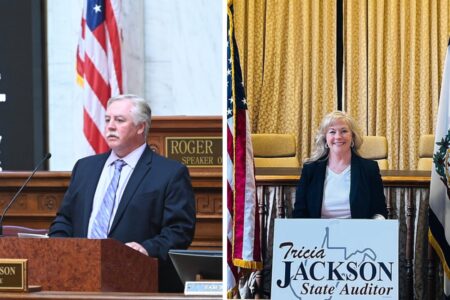
The Republican primary is crowded. The field includes House Majority Leader Eric Householder, R-Berkeley; state Sen. Mark Hunt, R-Kanawha; former Nicholas County delegate Caleb Hanna; and Jefferson County Commissioner Tricia Jackson.
Householder was first elected to the House of Delegates in 2010. He spent two terms as chairman of the powerful House Finance Committee under House Speaker Roger Hanshaw, R-Clay, before being named House Majority Leader last year.
A small business owner, Householder holds a bachelor's in economics from Shepherd University and master's in business administration from Frostburg State University. Householder said his platform has remained consistent throughout his time in the House and now his campaign for state auditor.
"I've been about transparency and accountability. I'm all about taxpayers first. That's been my platform ever since I've been down here," Householder said. "Why do I want to do this? I believe now is the time to end fraud and corruption in West Virginia. That's my message that I'm taking to the citizens each and every time that I'm standing up before them."
Jackson is in her first four-year term as a member of the five-member Jefferson County Commission. Also a small business owner, Jackson holds a Bachelor of Science degree from Liberty University in Virginia as well as several certifications in human resources management. As a county commissioner, Jackson has worked closely with the State Auditor's Office.
"When our current state auditor decided to move on to other ventures, I thought it was a perfect opportunity to take a look at the auditor's office," Jackson said. "I'm still working very hard for the people of Jefferson County as a commissioner, but this opportunity presented itself and I thought, you know, I know a lot about what's going on with the auditor's office, and I have some ideas on how to improve things, so why not?"
Householder said he wants to continue McCuskey's work in the State Auditor's Office in rooting out waste, fraud, and abuse in state and local governments.
"We all know that fraud and corruption siphons away valuable taxpayer dollars from our roads, from our schools, and from our seniors and veterans programs," Householder said. "Not only that, fraud and corruption erodes the public's trust in government, and it is happening across all levels of government. I try to explain to taxpayers, they should be mad because it is theft of their money."
Both Householder and Jackson said they want to work to get more counties and local governments on West Virginia Checkbook, the state auditor's government spending and transparency portal at wvcheckbook.com. As of now, 27 counties participate and 11 counties have agreed to participate but haven't sent data to the website, and 24 cities participate.
"I would like to make transparency a top priority to provide clear and accessible information to the public," Householder said.
Jackson said she would like to find ways to expand access to West Virginia Checkbook information to people who might not have ready access to the internet.
"I do believe transparency and accountability is very important in any role of government," Jackson said. "I would like to enhance that program and make it easier for the general public to use ... I think the biggest job of the auditor is to protect and defend the taxpayer's money and to be transparent with them and let them know how it's being used."
Householder wants to increase the number of investigations into waste, fraud, and abuse of taxpayer dollars. The State Auditor's Public Integrity and Fraud Unit recently assisted the U.S. Attorney's Office in a case where a Dunbar man - Sean Patrick Boyd Jr. – admitted to defrauding the federal COVID-19 Paycheck Protection Program of more than $20,000 by creating a fictitious business. He was sentenced this week. Householder also wants to increase the number of audits of government programs.
"I feel that another role that I should be doing is to safeguard the taxpayer dollars by rigorously auditing government spending," Householder said. "I've said time and time again, now is the time to audit all agencies and state government because it's your money and you deserve accountability."
The State Auditor's Office and the Attorney General's Office have recently teamed up to help monitor spending by counties and cities of the nearly $1 billion opioid settlement, as well as provide advice and guidance to local governments on the appropriate way to use those funds. Both Householder and Jackson believe that state government has a role in ensuring those funds are not wasted.
"Without a doubt, obviously the opioid problem in West Virginia ... created devastation across our state," Householder said. "We're at the opportunity now where we have obviously this large sum of money ... We need to make sure that there's complete transparency of how that money's going to be spent."
"Most recently we have the opiate settlement. That would be something that I would like to see the auditor's office be involved in with tracking and how those funds are dispersed and used," Jacksons said. "I do think people want to see what is actively being done for addressing (opioid) abuse and providing services ... I think it's very important that we have those collaborative roles and that we're showing and working together on how we're going to use all these funds."