
Vaccine bill, neuroscience funding veto become part of U.S. Senate campaign
Trending
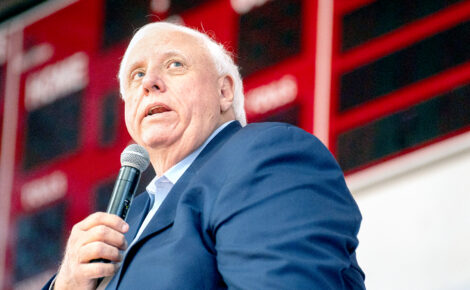
CHARLESTON - Bills either awaiting the approval of Gov. Jim Justice or already vetoed are now becoming part of Justice's Republican race for U.S. Senate, with U.S. Rep. Alex Mooney criticizing the governor.
Last week, Justice vetoed House Bill 5014, which would have provided $2 million in state surplus appropriations for West Virginia University's Rockefeller Neuroscience Institute.
The funding would have helped fund the institute's groundbreaking and internationally recognized ultrasound research to help people with Alzheimer's disease and even help with substance use disorder and other addiction disorders. The successful treatment program was the focus of a CBS News 60 Minutes feature late last year.
The U.S. Food and Drug Administration has approved the institute to begin further studies using its ultrasound program for eating disorders. House Speaker Roger Hanshaw, R-Clay, was the lead sponsor of HB 5014, having praised the program prior to the start of session and urging support for the bill.
However, the state Senate amended the bill to include an additional $4 million to be used for hospital grants and research programs. In his veto message issued March 14, Justice said there was no explanation in the bill for what the additional $4 million would be used for or what the grants were.
"While I wholeheartedly support our hospitals and medical centers and the advancement of vital medical care for the citizens of West Virginia ... The language of the bill is ambiguous as to the Legislature's intent and just what types of research may be funded from this appropriation," Justice wrote.
Speaking Wednesday afternoon during his weekly administration briefing, Justice further explained his reasoning for vetoing the bill.
"We did a bunch of things for a few, and we left out an awful lot of our hospitals across the state," Justice said. "In this situation, I didn't want a few to be neglected."
Mooney, one of Justice's Republican opponents for U.S. Senate, issued a statement Wednesday criticizing Justice for vetoing the bill. He singled out Justice's approval two years ago for $10 million for Marshall University to build a new baseball stadium.
"Jim Justice has been clear that he does not support groundbreaking medical research nor our veterans and seniors that would benefit from it," said Mooney, R-W.Va. "As your next U.S. Senator, I will always do everything I can to support our hospitals, medical research, and the lives saved as a result of it."
According to an official in the Governor's Office, Justice didn't feel it was fair to provide funding for the WVU Rockefeller Neuroscience Institute from surplus funds while other items to be funded from surplus tax collections are on hold. Justice's introduced budget for fiscal year 2025 - given to lawmakers on the first day of the 2024 legislative session on Jan. 10 – included $100 million to be appropriated to the state's rural hospitals from available surplus tax dollars at the end of the current fiscal year at the end of June.
"I proposed $100 million in my deal for all the hospitals, and we just kind of went out and just picked a couple of winners," Justice said.
The Legislature passed a skinny version of the budget bill on the last day of the session on March 9. Senate Bill 200 set the general revenue budget for fiscal year 2025 beginning July 1 at $4.996 billion – 5% less than the governor's introduced budget of $5.265 billion.
While state officials expect to end the fiscal year with close to $800 million in surplus, lawmakers are awaiting approval of a waiver from the U.S. Department of Education for COVID-19 education spending. If the waiver is not granted, the state might have to use $465 million for education spending to meet a required federal threshold.
Justice is expected to call lawmakers into a special session sometime either in April or May to restore funding in the surplus section of the FY25 budget pending the waiver approval, as well as to restore several cut line items Justice would like to see restored.
"When we call everybody back in, everything will be on the table to be able to put it back together," Justice said. "When we call everybody back in, (WVU) will be in the equation and we'll work through all the stuff and come to a better resolution of looking at everybody instead of just looking at a few."
Justice also said he is still waiting on House Bill 5105 – eliminating the vaccine requirements for public virtual schools, private schools and parochial schools - to make it to his desk. Justice is under pressure on one side by doctors and public health advocates to veto the bill, while health freedom advocates are putting political pressure on Justice to sign the bill.
"As far what we would call the vaccination bill, we haven't gotten it yet," Justice said. "We're still waiting on that ... give us time to get it at least."
The bill would eliminate vaccine requirements for school students attending statewide virtual public schools or future county-level virtual public charter schools except when those students are participating in activities supervised by the West Virginia Secondary Schools Activities Commission. It also expands vaccine exemptions to students attending private or parochial schools in the state, while allowing those schools to set their own vaccination requirements.
In a series of social media posts on X (formerly known as Twitter), Mooney expressed his support for HB 5105, calling it "common sense."
"West Virginia House Bill 5105 passed by the West Virginia Legislature is a common-sense bill that allows private and parochial schools, and those with a religious exemption, to establish their own vaccination policies that align with religious beliefs," Mooney said. "The bill also rightfully exempts virtual students who are not physically present in public schools. This legislation balances public health with religious freedom."
Justice said he was carefully considering whether to sign the bill or veto the bill once he receives it.
"I've said a million times I want to be respectful to everyone's freedoms. I still want to do exactly that," Justice said. "But we've also got to protect all of us. That's all there is to it."