
Trending
STEUBENVILLE -- Entering a new life situation is difficult for anyone, especially when a person has no one to guide him or her through the experience.
The same goes for first-generation college students, or those who are the first in their families to enroll in or complete a postsecondary degree program. These students comprise a significant portion of those in higher education, with the National Association of Student Personnel Administrators reporting that, as of 2020, the number of undergraduate students whose parents do not have a bachelor's degree was 54 percent in the U.S.
That was the situation Gaby Taylor found herself in when she began attending Franciscan University of Steubenville in 2015. The first in her Southern California family to attend a four-year academic institution, Taylor had to figure out a lot of things by herself.
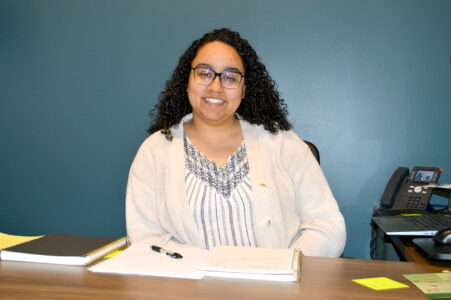
After graduating in 2019 and teaching for a time at Steubenville Catholic Central High School, Taylor has since returned to Franciscan University to work in its Center for Success office. From her current role, she's been heading efforts to help first-generation students become acclimated to the university environment and thrive to their fullest extent through new efforts.
"We recognize that the number of first-generation students in higher education is growing," Taylor said. "We knew that those students were here, and we wanted to make an extra effort for them."
The Center for Success is a staff department that addresses individual students' academic needs, whether they be dealing with a disability, looking for a tutor or working to get off academic probation.
Programs to that end include testing services, academic coaching, accessibility services, general academic advising, tutoring and Franciscan PLUS, which allows students -- who would not otherwise have been accepted into the university based on grade-point average or test scores in high school -- to be provisionally admitted and provided individualized mentoring to ensure they succeed.
Taylor, who has since become director of the Center for Success, joined the team several years ago as a student success counselor, focusing on the center's First-Generation Student Organization. She estimates that there are roughly 250 first-generation students at Franciscan, with 20 percent being minority individuals and 10 percent being local residents.
When she became involved in July 2022, Taylor said, Franciscan was looking to expand its efforts toward serving first-generation and minority students. That mission was pursued primarily through joining a multi-year program under NASPA, a student affairs organization that aids its 15,000 professional members and 1,200 partnered institutions with overcoming challenges.
NASPA's Center for First-Generation Student Success program takes on institutions for a year and hosts mostly meetings, during which the schools are mentored as a group on how to build support for their first-generation students, Taylor said. The second year sees schools partnered with a mentor school -- one that has previously completed the program -- for individualized training. By the third year, schools will themselves become mentors to others in the program.
Taylor said she's in the program's second year and has so far lived out her training by making resources more available for Franciscan's first-generation students. She's aimed at making the Center for Success, which is located in Franciscan's St. John Paul II Library, a "one-stop-shop" for pertinent information. Workshops have been hosted on alternating Fridays, with topics including internships, financial aid, activities and the study abroad program.
Activities this spring semester have been slower-paced due to staffing changes, Taylor said, but the demand is still strong from students who want to learn about logistical topics that others, whose parents went to college and can give more advice, might take for granted. The first-generation students tend to have a unique "sense of pride and drive" that pulls them through adversity, Taylor said, noting that they're not afraid to ask questions.
Taylor said she's gained a good rapport with the first-generation students, who see the Center for Success office as a comfortable place to go and learn. Taylor's hope for the future is to create a formal organization of first-generation students, similar to a club, that can meet and discuss issues concerning them, with "very heavy support" from staff and, hopefully, a multi-grade level mentorship system.
Under Taylor's purview are international students who are the first in their families to attend a four-year degree program in the U.S. These students, who are growing in number, have the added challenge of English frequently being their second language. Taylor said Franciscan is investigating how to better serve these students, with one current step being a 50 percent reduction in tuition for international students.
Before her time with the Center for Success, Taylor said, first-generation students were not necessarily neglected, but there was more that needed to happen. Taylor said that, when she was a student, the center "would've been a big help and made me feel like I'm not alone."
Taylor said, "It's great to get to work and contribute and give back to the place that formed me so well as a college student."
For Taylor, the Center for Success position is "exactly what I wanted to do" in terms of helping others though situations she experienced herself, such as imposter syndrome, or doubting one's own abilities and feeling anxiety over being perceived as a fraud.
There are students whose challenges overcome them in the end, Taylor said. It's difficult to see, she added, but those individuals often are not unable to succeed. Rather, they are in need of a break. Taylor recalled one student who took leave from school for a time to reassess, and he was able to thrive upon return and is now set to graduate this weekend. Stories like that are "really a joy," Taylor said.
As the director, Taylor will oversee all of the department's programs and have a hand in developing the center's vision. Although her role will be more administrative, Taylor said she wants to maintain a heavy hand in her previous program.
"Since I've come from that position, I still want to have a strong presence working with those students."