
W.Va. education officials working to close homeschool reporting loophole
CHARLESTON - State education officials and some lawmakers want to fix a gray area within West Virginia's homeschool laws that could have possibly put county education officials in contact with the family of a Boone County girl who died in April, though other lawmakers urge caution in enacting new limits on homeschool families.
Reporters were briefed last week on an internal investigation by the Governor's Office regarding past encounters by state agencies with the family of 14-year-old Kyneddi Miller. Boone County deputies found Miller dead in April in a skeletal and malnourished condition. Miller's mother and grandparents were charged with child abuse causing death.
Child Protective Services had prior contact with Miller's family in 2009 and 2017 unrelated to Miller herself, and West Virginia State Police troopers performed a welfare check at Miller's home last year when family members reported having not seen Miller in a while.
The Governor's Office said the troopers found no signs of abuse or neglect, and that a visit by troopers to the regional CPS office was only to relay informal concerns. The CPS workers the troopers reported talking to were unable to recall the visit, but no CPS referral was made.
According to the investigation, Miller had not been in public school beginning in the Spring of 2020 when schools went to virtual learning due to the COVID pandemic. She was officially pulled out of the public school system in 2021 to be homeschooled.
According to State Code, homeschool children are exempt from laws governing compulsory school attendance as long as the parent and/or guardian submits to the county superintendent the results of the child's academic assessment for grades three, five, eight, and 11 by June 30 of the year the assessment was administered.
Parents who do not submit the required assessments could be found to be in violation of the compulsory school attendance law and face criminal misdemeanor truancy actions. But State Code leaves jurisdiction over compulsory school attendance laws up to the individual counties. According to the state Department of Education, State Code does not outline specific requirements or permissions for county attendance directors or superintendents regarding homeschool families who don't comply with submitting the required assessment.
According to the governor's internal investigation, Miller's family had not filed her eighth-grade assessment with Boone County Schools and the county never followed up with the family.
MAKING THE GRADE
Paul Hardesty, the president of the West Virginia Board of Education, said homeschool parents used to be subject to specific requirements. But the Republican-led Legislature in 2016 passed House Bill 4175, which changed requirements for assessment from once a year to third, fifth, eighth, and 11th grades, limiting direct contact between homeschool parents and county school systems.
"There were quite a few rules and regulations with regard to homeschool, but in 2016, the Legislature decided with House Bill 4175 to basically take away those covenants and restrictions with regard to homeschool. Maybe they went too far. We went from one extreme to the other and there had been continual activity by the Legislature to take away requirements with regard to homeschool."
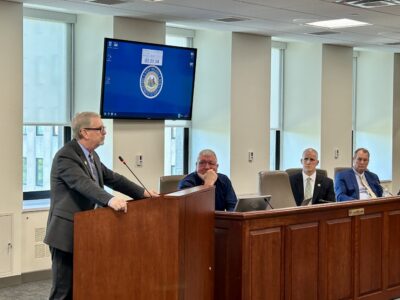
Micky Blackwell, executive director of the West Virginia Association of Elementary and Middle School Principals, agreed. Blackwell addressed members of the state Board of Education Wednesday in Charleston at their monthly meetings.
While acknowledging that there are many homeschool families doing things right, Blackwell said some level of contact needs to remain between homeschoolers and the school systems.
"We must work together to come up with sustainable checks and balances for these organizations," Blackwell said. "To allow people just to go out and do whatever they want to do with no watching over is unacceptable. If we allowed parents to let their children just roam and have no control and have no supervision, we would call that child abuse."
Hardesty said there is little the state Board of Education or the Department of Education can do when it comes to making sure counties have contact with homeschool families. That would require legislative action, even to clear up language requiring counties to make contact if they don't receive the required assessments and take criminal action if the family does not comply.
"Being a former legislator also, I kind of wear two hats here," said Hardesty, a former Democratic state senator from Logan County. "I always am a firm believer that statute trumps policy. I think we need to put it in law, be clear in what that law says, and define parameters on that law to where this does not happen again."
Hardesty said he is already working with lawmakers and others to craft a bill that could be ready for a possible special session agenda in August to close the homeschool assessment loophole and other recommendations. But both Hardesty and Blackwell said without additional resources for county schools, it could be hard for counties to both ensure the attendance of public school students and also follow up with homeschool families.
"No, (schools) are not equipped and they are stretched thin," Hardesty said. "There again, when you've got people trying to pull children out of the public school system, why would you put the burden back on (public schools) to go and make the rules and policies for such? That's why all the stakeholders need to come to the table. Let's find something that's cohesive and works together."
"Our schools are overwhelmed," Blackwell said. "A school principal, a school counselor, an assistant principal has plenty to do all day, and it should not be their responsibility to check on everybody that is in a homeschool or a charter school," Blackwell said. "There should be positions made within the school, within the county, and one or two people should be responsible for this and they should be able to do so."
CIVICS LESSONS
Gov. Jim Justice and state Senate President Craig Blair have both said the Legislature needs to take another look at homeschool laws and close any loopholes that exist alongside reforms to Child Protective Services and how abuse and neglect referrals are investigated.
"The homeschooling issue, we probably need to find a way to tighten it," Justice said last week during his weekly administration briefing. "That's an area I'm sure we can make things a little better. Any and every idea I'm open to...I do believe that the actual following up on our homeschool kids is more of an issue than specific homeschool laws. But I think this is still somewhat in its infancy. We have to do more work with the Legislature."
"What has become apparent above everything else is that this child was failed by her local network of safety nets," said Blair, R-Berkeley, in a statement last week. "This case has highlighted that our current system of checks and balances has cracks. To that end, we will work with the Governor's Office, the Department of Education, the Department of Human Services, and the State Police to discuss ways that we, legislatively, can improve our regulations related to homeschooled children to ensure that no children suffer this same outcome."
However, the Republican supermajority in the Legislature has grown hostile to any limitations on homeschooling and has increased school choice options. Even Blair - a supporter of school choice who created the Senate School Choice Committee - saw defeat in the May GOP primary to attorney and West Virginia National Guard Lt. Col. Tom Willis, who campaigned on further expanding school choice.
"Unlike my opponent, I pledge to make educational freedom a reality," Willis posted on his campaign website. "I will work to pass full universal school choice where the money follows the child...(and) fight for parents' right to make decisions for their children as a God-given sacred right. The government's interest is secondary to parents' rights!"
Both Senate School Choice Committee Chairwoman Patricia Rucker and Del. Kathie Hess Crouse - a homeschool parent and vocal advocate for homeschool freedom - won GOP primary contests in May. In op-eds released this week, both Crouse and Rucker pushed back on the need for any new homeschool regulations or closing reporting loopholes, pushing the blame solely on Child Protective Services for not doing more for Kyneddi Miller.
"Despite concerned family members contacting the Department of Human Services, the necessary actions were not taken. The appropriate tools and procedures were in place, yet those responsible did not utilize them effectively," said Hess, R-Putnam. "The Governor, some legislators and agencies are advocating for new laws, but how can we trust new legislation when existing laws are not being enforced? We need genuine leadership, not blame-shifting. Rather than implementing new homeschooling laws, we should be looking at substantial reform to our child welfare system."
"When mandatory assessments were not submitted, county officials had every tool they needed to follow up and intervene. Regrettably, this did not happen," said Rucker, R-Jefferson. "It is wholly inappropriate and unacceptable to attribute this tragic death to homeschooling, which unfairly maligns the thousands of West Virginia families who are responsibly and effectively educating their children. How can new laws work when government officials won't even follow the ones that are on the books?"
Since 2016, the Legislature created a public charter school system, including a statewide virtual charter school that allows students to remain at home. The Hope Scholarship program – originally billed as an educational savings account but in reality acts as a voucher program – provides families with the equivalent of the per-pupil state expenditure for their child to use for private or homeschool education. And lawmakers passed a law in 2022 allowing for microschools and learning pods with limited regulations.
An attempt earlier this year by the House of Delegates to require microschools and learning pods to abide by the same assessment requirements that homeschools are required to abide by was never taken up by the state Senate after the House amended the bill to include protections for children being pulled out of public school to avoid scrutiny for alleged child abuse and neglect.
House Bill 5180, as amended, would have prohibited a county board of education from authorizing home school instruction for currently enrolled public school children when there is a pending child abuse or neglect investigation against a parent or custodians that is initiated by a school teacher of other school personnel.
A county superintendent would have been required to request confirmation from the Department of Human Services once aware of an active investigation. DoHS would have been required to provide the information within 48 hours of the request. If the complaint couldn't be substantiated within 14 days of an initiated investigation, the superintendent would have then been able to authorize home school instruction.
The amendment would have also required county superintendents to develop policies to ensure they are contacted when a report of suspected child abuse and neglect is made by a teacher or other school personnel.
The amendment was a tailored version of Raylee's Law, named for Raylee Jolynn Browning, a child in Oak Hill who died in 2018 due to child abuse by her father, Marty Browning. Raylee had been pulled from public school by Marty Browning. He, along with his girlfriend and girlfriend's sister, were sentenced in 2022 after being convicted of child neglect causing death. The lead sponsor of Raylee's Law - House Minority Whip Shawn Fluharty, D-Ohio - has been advocating for the law for years.
"Raylee's guardians and Kyneddi's family removed those girls from public school, places where these girls could be seen and heard. And now they are no longer here to tell their stories," Fluharty said. "Government has failed to protect these children. The Legislature should pass Raylee's Law immediately and conduct evidentiary hearings to identify other changes we should implement to fix our broken child welfare system. Protecting our children should be our #1 priority. Fixing these loopholes will save lives."
Members of the House Democratic caucus have been reaching out to county school systems to determine what changes need to be made to the current homeschool assessment requirements and truancy laws.
"We need to collaborate with local school officials to ensure that they have the resources and necessary information to protect children whose parents do not comply with home school regulations," said Del. Joey Garcia, D-Marion. "We know that most homeschool parents are doing the right thing for their children, but we need to correct loopholes in the law and empower local boards of education to act where the law is not followed so children are not abused or falling through the cracks."
"Our people – child protective workers, law enforcement officers and educators – must have the authority and ability to check on these kids," said House Minority Leader Sean Hornbuckle, D-Cabell.
All sides of the issue agree that homeschool families doing the right things and following current law and procedures should not be punished. But Hardesty said there has to be something done when homeschool families and their children fall off the radar.
"We're not throwing stones at homeschool people. That's an option that they deserve," Hardesty said. "I don't have an issue with school choice, but we've got to do something that's cohesive and seamless to where people don't fall through the cracks because of unintended consequences."