
Lawmakers receive sobering report on West Virginia’s substance use disorder crisis
Trending
CHARLESTON -- West Virginia's substance use disorder crisis was put into sobering perspective for lawmakers this week.
The Joint Standing Committee on Health received a report Monday afternoon from Jeremiah Samples, a senior adviser to the Joint Committee on Government and Finance, regarding West Virginia's drug use statistics and policies.
"I won't bury the lead. The bottom-line thing is we have not made enough progress on this crisis," said Samples, a former deputy secretary for the since-renamed Department of Health and Human Resources. "We are nowhere near where we need to be, and our data relative to other states and even our own expectations has fallen far short. We need to reassess all of our SUD (substance use disorder) strategies and expenditures through the prism of what is impacting real people in our society."
According to recent reports by the federal Substance Abuse and Mental Health Services Administration, approximately 208,000 West Virginians reported using illicit drugs in the last month. According to the Mountain State Assessment of Trends in Community Health (M.A.T.C.H.) survey through West Virginia University, 359,880 West Virginians used drugs in the past year.
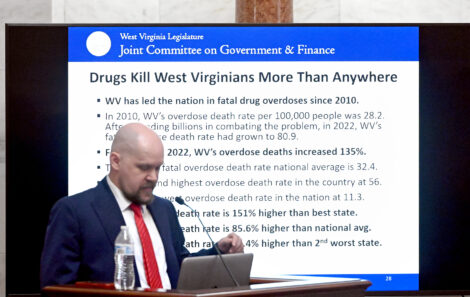
Citing statistics from the U.S. Centers for Disease Control and Prevention, West Virginia experienced 1,335 known overdose deaths in 2022. For perspective, overdose deaths between 2017 and 2022 increased by more than 55%, overdose deaths between 2010 and 2022 increased by 135%, and overdose deaths between 1999 and 2022 increased by 1,690%.
As a result, West Virginia has led the nation in fatal overdose deaths since 2010. West Virginia's overdose death rate in 2010 was 28.2 per 100,000 people. In 2022, it was 80.9 per 100,000 people. The national average was 32.4 per 100,000 people.
Tennessee had the second highest overdose rate of 56 per 100,000 people, and South Dakota had the lowest, 11.3 per 100,000 people. By comparison, West Virginia's overdose death rate was 36.4% higher than Tennessee, 151% higher than South Dakota, and 85.6% higher than the national average.
As a result, West Virginia had the second lowest life expectancy in the nation and the highest death rate for working age adults.
"That's outrageous," Samples said. "We can't sustain that as a society. It is crippling to the state."
Samples said that total state spending on substance use disorder is hard to track and can only be estimated, with direct expenses well into the hundreds of millions of dollars annually. That's not including indirect expenses on the criminal justice system and through the Department of Human Services.
"We've not ignored the problem; there's been hundreds of millions and billions in expenditure and impact in the state," Samples said. "But we're not seeing results and not reversing a trend. We've struggled."
One report estimated that the drug crisis in West Virginia costs the state more than $11 billion annually. According to Samples' report, the drug crisis costs the state's economy an estimated $8.8 billion annually in terms of health care, substance use treatment, criminal justice costs, lost worker productivity and overall societal burdens. That's about one-eighth of the state's total economy. The per-person cost for West Virginians comes to $4,793.
The data was not all bad news though. Provisional data available shows that the number of overdose deaths in West Virginia decreased by more than 7% over a 12-month period between May 2023 and May 2024. Similar federal provisional data shows that the number of drug overdoses in West Virginia decreased by nearly 5% between March 2023 and March 2024, though national overdose deaths decreased by more than 9% during the same period.
Samples urged lawmakers to not sleep on these numbers, stating that provisional data can be misleading. Once death investigations are finalized, those numbers could go up.
West Virginia's substance use disorder crisis has a direct connection to the state's explosion in the number of children in state foster care. According to Samples' report, 83% of child welfare removals were from homes with known drug use, with West Virginia ranking either 49th or 50th for the number of children in state custody - a 61% increase from 2010 to 2021.
In 2020, the state had the highest rate in the nation for the number of infants screened for prenatal substance exposure. That year, Child Protective Services screened 712 infants for drug exposure compared to California - a state with a substantially larger population - which screened 526.
There have been a number of legislative reforms in recent years aimed at helping to reduce the state's substance use disorder numbers, including the creation and reorganization of the Office of Drug Control Policy. Dr. Stephen Loyd, the chief medical officer for Cedar Recovery in Tennessee, was recently appointed as West Virginia's sixth ODCP director by Gov. Jim Justice.
Other bills have focused on improving the quality of care at substance use disorder treatment facilities and recovery residence reform. There are more than 23 state agencies that have some kind of substance use disorder treatment and recovery programs. And the new West Virginia First Foundation is still working on plans to distribute hundreds of millions of dollars from the $1 billion settlement with opioid manufacturers and distributors.
But Samples said the state needs to do a much better job at tracking expenditures and programs to see what is working, with programs needing to be reassessed constantly. Samples said the state needs to focus less on process measures and more on tracking societal outcomes and whether programs deliver quantifiable results.
"The most important thing we need to do, in my opinion, is we need to measure what matters so we can then pivot and organically improve our response to this crisis," he said. "We need to measure every aspect of our substance use disorder policies and expenditures, and tie those back to a core societal measure."