
Candidates for W.Va. governor weigh in on Gov. Justice’s tax cut proposal
Trending
CHARLESTON - Gov. Jim Justice proposed a new 5% cut in personal income tax rates less than four months before he walks out of the Governor's Office for the last time, but it will be up to the next governor to implement that tax cut as well as craft the next general revenue budget.
Justice said he will announce Monday a special session of the West Virginia Legislature by the end of September to consider specific items, including a childcare tax credit and another cut to personal income tax rates.
"The biggest driver to more goodness in this state hands down is getting rid of the state income tax," Justice said Wednesday during his weekly administration briefing from his offices in the State Capitol Building. "We can't do it all in one swoop. I get that. We've got to take care and mind the store properly. I get that. But absolutely at the end of the day, get rid of the income tax."
Justice first announced his desire for lawmakers to pass a 5% cut in personal income tax rates in July during a press conference celebrating the end of fiscal year 2024, when the state brought in a $826 million surplus. According to the Department of Revenue, the state has $562 million in unappropriated surplus from the end of fiscal year 2024 after expenses and $80 million in unappropriated money for the current fiscal year.
Speaking Wednesday, Justice said now is the right time to take those unappropriated tax dollars to make further cuts to personal income tax rates. Lawmakers and Justice approved a 21.25% personal income tax cut in 2023 which returned $488 million to taxpayers, and a trigger and formula within that 2023 law resulted in a 4% personal income tax cut also going into effect in January 2025, returning $92 million to taxpayers.
"We managed the store. We did exactly what we were supposed to do," Justice said. "That's why I say now we need to deliver that additional tax cut to our people. At the end of the day, if we can show the world we are truly, truly on that pathway of getting rid of our state income tax and willing to do something more than just cutting the income tax one time and we're really on the way to getting rid of our state income tax, people will come."
He had expressed a desire to call the Legislature into special session in August coinciding with legislative interim meetings last month, but no special session was called. Legislative leadership was blindsided in July. Some have declined to take a position one way or another on Justice's tax cut proposal until they see a bill. Others have said any additional tax cut needs to involve an equal cut in state spending in the current fiscal year.
Based on Department of Revenue estimates, a 5% personal income tax cut would return approximately $115 million to taxpayers if approved by lawmakers. But the full cost of that tax cut would go into effect for fiscal year 2026 beginning in July 2025, affecting the crafting of the general revenue budget bill when lawmakers gavel in for the 60-day legislative session in February 2025.
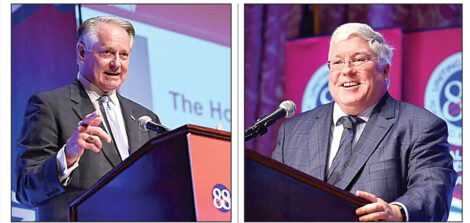
That next general revenue budget will be presented to lawmakers by whoever wins the November election for governor. Republican Attorney General Patrick Morrisey and Democratic Huntington Mayor Steve Williams have less than 60 days until Election Day to campaign.
During the Republican primary campaign, Morrisey said several times that he not only supported the 2023 tax cut package, but that he supports the phase out and elimination of the personal income tax. Yet, Morrisey also took issue with one primary opponent - Huntington businessman Chris Miller - who vowed to eliminate the personal income tax on day one. Personal income tax collections make up 39% of the state general revenue collections.
In a statement Friday, Morrisey said he supports Justice's end goal of phasing out the personal income tax. But Morrisey also said any further change to tax rates should wait until the next governor and the new Legislature take office next year and review the state budget and expenditures.
"I applaud Governor Justice's advocacy to lower our state income tax. Indeed, I plan to double down on that advocacy and advance the next phase of the Justice income tax cuts as the state's next governor," Morrisey said. "At the same time, it's crucial that any major changes to the income tax system be accompanied with changes rightsizing government and paying for these tax cuts. This is best achieved during the next regular session of the Legislature when we can make the best-informed decisions."
Speaking to attendees of the West Virginia Chamber of Commerce Annual Meeting and Business Summit at the Greenbrier Resort in White Sulphur Springs last week, Morrisey said he is in favor of what he calls a "backyard brawl," making West Virginia's tax and regulatory environment competitive with neighboring states.
"We want to have a backyard brawl economically with all the states that we touch," Morrisey said. "I think having that comparison from a tax perspective, a regulatory perspective, is going to make it much easier to start to move up...I want to make sure West Virginia competes and wins as the lowest income tax state – ultimately no income tax."
Williams, who trails behind Morrisey in both fundraising and recent polling, is running on a fiscally conservative platform and touting his success as a three-term mayor in turning around a deficit in Huntington's when he first took office.
"As Mayor of Huntington, I successfully cut taxes, including the (business and occupation) tax, to encourage business development in our downtown area. But we did it responsibly, ensuring we didn't bust the budget or jeopardize essential services," Williams said in a statement Thursday.
Williams said he supported the 2023 tax reform package, which included the 21.25% personal income tax cut, the trigger mechanism for yearly personal income tax rate cuts, the rebate on motor vehicle tangible property taxes, the reduction of tangible personal property taxes for small businesses, and the 100% homestead tax credit for service-disabled.
But Williams said he was concerned about cutting personal income tax rates too quickly, citing testimony during legislative interim meetings last week from Deputy Department of Revenue Secretary Mark Muchow that future end-of-fiscal-year tax surpluses would not be as big going forward. He also said future tax cuts should be aimed at helping working West Virginians.
"From what I've seen, legislative leaders and the state Department of Revenue aren't convinced we've met those benchmarks yet," Williams said. "Furthermore, I feel additional tax cuts should be targeted to working families and not the super wealthy."
Williams accused Justice of trying to "bribe" voters as he seeks the U.S. Senate seat being vacated by U.S. Sen. Joe Manchin, I-W.Va. Justice faces Democratic former Wheeling mayor Glenn Elliott in November. Williams also cited the state's critical needs, such as the teacher shortage, the foster care crisis, and the growing need for affordable and available childcare for workers.
"West Virginia is facing a critical shortage of certified teachers in math, science, and special education. We have the highest number of children in foster care per capita in the nation, and working families are struggling to find childcare," Williams said. "Unless these (revenue) benchmarks are truly met, this push for an additional 5% cut smacks of an election-year bribe designed to earn votes for the governor's Senate campaign, rather than addressing the real challenges facing our state."