
Special session underway, action on tax legislation delayed one week
Trending
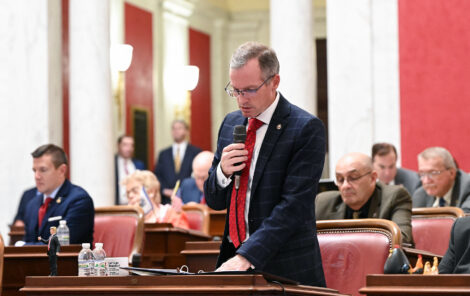
CHARLESTON – The West Virginia Legislature gaveled in Monday for its second special session of the year, but consideration of Gov. Jim Justice's request for a 5% cut in personal income tax rates and a childcare tax credit will have to wait until next week.
Both the House of Delegates and state Senate convened Monday morning for the special session called by Justice Saturday. But beyond both bodies completing action on six supplemental appropriations bills, the House and Senate adopted concurrent resolutions allowing them to adjourn the special session until 6 p.m. Sunday, coinciding with the start of October legislative interim meetings.
The seven-day break will give the governor and legislative leadership more time in their negotiations toward passing Justice's 5% personal income tax bill that would return approximately $115 million to taxpayers when fully implemented. The Senate version of the plan, Senate Bill 2025, is on second reading, while the House version of the bill, House Bill 225, is pending in the House Finance Committee.
Both House Finance Committee Chairman Vernon Criss, R-Wood, and Senate Finance Committee Chairman Eric Tarr, R-Putnam, said those negotiations are ongoing.
"I would assume ... as far as I know," Criss said following the adjournment of the House when asked if the negotiations would continue through next Sunday.
"That's the discussions that are still going forward," Tarr said after the Senate floor session. "I'd say between now and next Sunday, we'll be having more discussions with the (Republican) caucus."
Criss and Tarr appear to be on opposite sides of an additional 5% personal income tax cut on top of the 4% cut that goes into effect in January 2025, returning $92 million to taxpayers. Criss supports finding a way to make the 5% cut happen for taxpayers, while Tarr is more cautious about the long-term effects of cutting personal income tax rates too quickly for revenue and expenses to keep up.
"I am a 100% for this," Criss said. "I have no issue giving money back to the people. The government needs to be able to work with the money they need. The taxpayers have endured for a very long time. They need a break."
"Right now, I'm doubtful," Tarr said. "I want the tax cuts to go on in the future, and what we risk doing by cutting the income tax too aggressively is going back and having to raise taxes to cover the cost of government."
During a press conference Monday afternoon, members of the House Democratic Caucus criticized Justice for calling lawmakers into a special session prior to next week's regularly scheduled October interim meetings without any consensus on the 5% personal income tax cut bill. Justice, the Republican candidate for U.S. Senate, first proposed a fall special session following the May special session, and he first proposed his tax cut plan in July.
"(Justice) had more than ample time to reach a consensus with the supermajorities in the House and in the Senate and he failed to do so," said Del. Mike Pushkin, D-Kanawha, the chairman of the West Virginia Democratic Party. "We're stuck here twiddling our thumbs on the taxpayers' dime."
"Here we are down here on the taxpayers' dime taking care of Jim Justice, the ringmaster of this circus," said House Minority Whip Shawn Fluharty, D-Ohio. "We're frustrated, you can hear it in my voice."
Tarr said the bills both the House and Senate passed Monday were bills that had overwhelming agreement by lawmakers on both sides of the State Capitol Building and the Governor's Office.
"We've been going through these potential appropriations like what just went out," Tarr said. "We went through back-and-forth to see where agreement is between those three chambers and what you saw today is where the easiest agreement was today."
The Legislature completed action on House Bill 201, approving $10 million for the Communities in Schools program; House Bill 202, giving the Division of Highways spending authority for $150 million already approved by the Legislature in May's special session; House Bill 203, providing $1.2 million for capital improvements at the state Veterans' Home in Barboursville; House Bill 204, providing $375,000 to the West Virginia State Police for capital overlay and improvements; House Bill 206, providing $2.1 million for the Rockefeller Neuroscience Institute at West Virginia University; and House Bill 207, providing $379,468 to the state Department of Education's Aid for Exceptional Children program for pay increases not included in the budget bill passed earlier this year.
The House passed two other bills that were not taken up by the Senate Monday. House Bill 205 would provide more than $15.6 million to the West Virginia National Guard for capital outlay improvements and its Recruit WV employment program. It passed 90-1.
House Bill 208 would allow the state to be in an agreement with the U.S. Nuclear Regulatory Commission. The bill would allow the state to work with the commission to begin developing rules and regulations on low-level radioactive materials, handling, and disposal for items. The state already regulates disposal of x-ray machines and MRI machines, but not certain radioactive materials used in cancer treatments or other medical purposes.
"With this bill, we would comply with the Appalachian States Low-Level Radioactive Waste Compact," said House Energy and Manufacturing Committee Chairman Bill Anderson, R-Wood. "It would eliminate the duplicative inspections between both the federal government and the state government of these facilities."
"This makes good sense, in that it gives West Virginia primacy on these things," Del. Bob Fehrenbacher, R-Wood. "I believe this is a good step for West Virginia in that it is not dealing with wastes from nuclear power generating facilities ... I do not see this as cracking open the door to such wastes to come to West Virginia."
HB 208 passed the House 73-18, but not before questions arose about the purpose of the bill and why it was urgent enough to include on the special session call. A similar bill – House Bill 2896 – passed the House in 2023 in a 91-4 vote but died in the Senate. The only changes between the 2023 bill and the 2024 special session bill were switching the state agency in charge from the Department of Environmental Protection to the Department of Health.
"I'm not sure why there is a rush to pass this bill during a special session," said Del. Evan Hansen, D-Monongalia. "It could be if this bill was in committee and we could put people under oath and ask questions and get satisfactory answers, that some of my concerns could be answered. But a topic like this dealing with radioactive waste deserves a greater amount of scrutiny and discussion and investigation just to make sure we're getting it right."
"I have some concerns about this," said Del. Jim Butler, R-Mason. "I don't know if anyone else has given this some serious consideration, and I don't know if there is a rush that we have to do this during this special session."
Lawmakers will have 22 bills left to consider next week out of a total of 28 bills introduced on Justice's special session call, including a child care tax credit and other supplemental appropriations. Other bills pending include allowing public charter schools to seek funding for facilities from the School Building Authority and allowing for clinical trials for opioid treatment programs.
Democratic lawmakers were critical of what was not on the special session call, including legislation to remove a loophole in state law regarding the submitting of assessment by home school families. Several high-profile child abuse and neglect incidents in the state over the last year have involved families who home school their children and county school systems that don't check in when those families fail to turn in their required assessments for third, fifth, eighth, and 11th grades
"I think it's not necessarily what's on the call this legislative special session but that is not on the call, which is protecting our children," Fluharty said. "The governor, who has had ample time, didn't put anything on the call. It's too complex of an issue for him ... the governor is admitting he's not willing to put in the time and effort to fix this child care crisis in this state."