
New tool enabling proactive response to drug overdoses
Trending
STEUBENVILLE -- A new tool from the state of Ohio aims to help officials proactively address heightened drug overdose risk in local communities.
RecoveryOhio's Overdose Early Warning Dashboard is a "first-of-its-kind resource, designed to predict when a community is at heightened risk for drug overdoses," according to a release. Utilizing the dashboard, local leaders can take action early and save lives.
Fueling the dashboard's predictive model are various data sources, including emergency medical reports, naloxone administration, socioeconomic indicators and law enforcement data. The model uses these sources to forecast when Ohio ZIP codes are at an increased risk for overdoses up to 30 days in advance, and it generates a color-coded map categorizing ZIP codes into five risk levels: Low, minor, moderate, significant and severe.
"This innovative resource provides local leaders with a critical window for intervention," the release states. "With this information at their disposal, first responders and community health leaders representing local health districts, hospitals, ADAMH boards, coroners' offices, treatment providers and others can work together to spread awareness in their communities."
The dashboard -- which is updated daily -- offers "dynamic, real-time insights into the evolving landscape of drug and overdose prevalence across the state" and, for the first time, allows for proactive rather than reactive response, the release states.
"The model's forward-looking approach marks a significant shift in the state's means of responding to overdose threats," the release added. "Historically, drug trends in local communities have shifted so rapidly that alarming patterns have only been detected after coroners report a rise in fatalities."
Individuals can access the tool by visiting RecoveryOhio.gov/ODEarlyWarning.
The Jefferson County General Health District celebrated the state's announcement Jan. 17, with Health Commissioner Andrew Henry describing separately his thoughts on the dashboard's anticipated benefits.
"I think, since it's a predictive model, it will allow us to take proactive measures to ensure local partners have adequate information for potential response to an influx of overdoses -- that would be health care facilities, law enforcement, EMS," Henry said. "Typically, when we put out an overdose alert, we're behind ... because there has already been an influx of overdoses int he community, so ... this allows us to be forward thinking."
RecoveryOhio's Overdose Early Warning Dashboard is another tool in the toolbox for the health department, which Henry said already monitors several dashboards, such as for infectious diseases.
Building on Gov. Mike DeWine's efforts to combat substance use through the RecoveryOhio Initiative, the dashboard includes links and contact information for local prevention resources, according to the state's release. Resources include community support services, family and individual counseling, naloxone distribution programs like the Ohio Department of Health's Project DAWN and outpatient treatment programs -- presented in partnership with ReLink.org.
The release notes the dashboard "provides an opportunity for resources like naloxone and fentanyl test strips to be surged into potential hot spots."
Henry said the dashboard will benefit the health department's naloxone distribution efforts, which are its "most boots-on-the-ground intervention."
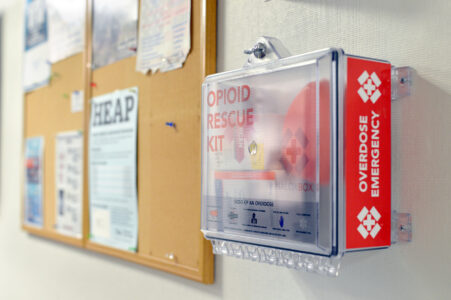
The health department provides the public with doses of the overdose-reversing drug naloxone out of its sixth-floor office in the Jefferson County Tower Building. It also supplies several community naloxone distribution boxes, placed in strategic places in the county.
Henry said that the dashboard's insights could help promote the department's boxes, encouraging community partners to host one and expand public naloxone pick-up locations.
"That gives us more information to share with potential locations that could benefit from (the boxes). I still think there's a stigma with housing naloxone, so if we really can prove it from data that some of these ZIP codes would really benefit from them, then they might be more open to the idea."
As of Sunday, Jefferson County had listed three ZIP codes with a "significant" rink classification of future drug poisoning: 43952, 43953 and 43903.
A release from the JCGHD states that the department is "committed to working with local partners to reduce overdose fatalities." It adds that overdose fatalities in Jefferson County reaches "record highs" in 2022 with 40 deaths, though a "steep decline" has occurred over the past two years with 22 deaths in 2023 and 14 in 2024.
"While these numbers are promising, non-fatal drug overdoses continue to remain steady," the JCGHD states. "This new dashboard is another vital step in community recovery efforts."
Creating the RecoveryOhio initiative was one of DeWine's first official actions upon taking office, according to the state. The initiative is "dedicated to unifying state and local efforts to address substance use disorders and mental health challenges, as well as providing support for individuals and families affected by these challenges."
DeWine announced Oct. 30 that Ohio witnessed a 9 percent decrease in overdose deaths in 2023, as reported in the Ohio Department of Health's 2023 Ohio Unintentional Drug Overdose Report. That marks the "second consecutive year of progress," the state's release says, and it positions Ohio "well ahead of the national average."
Led by RecoveryOhio developed in partnership with the InnovateOhio Platform, the dashboard was created with support from the Ohio Department of Health, Ohio Department of Job and Family Services, Ohio Department of Public Safety, Ohio Board of Pharmacy, Ohio Supreme Court, Ohio Department of Mental Health and Addiction Services, Ohio Department of Medicaid, and Ohio Department of Administrative Services.
Creation of the dashboard exemplifies "Ohio's whole-of-government approach to tackling the addiction epidemic," the state says.