
House of Delegates quickly passes bill to help Hancock County Schools
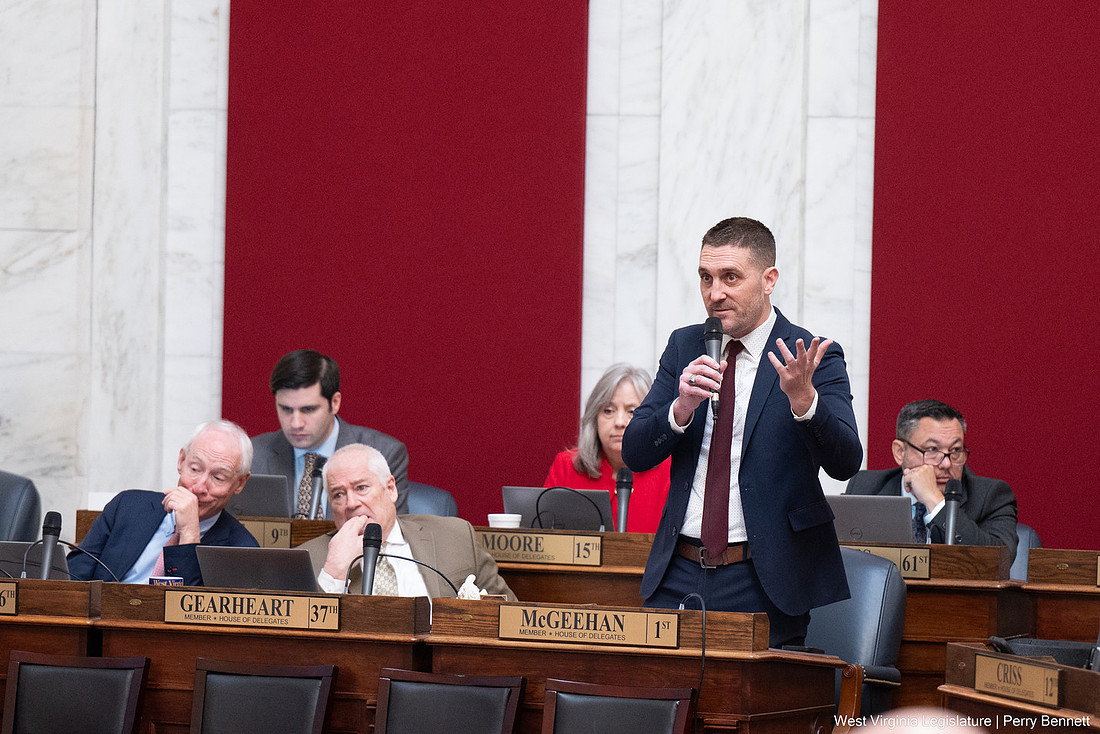
House Majority Leader Pat McGeehan said two bills passed Monday will help Hancock County Schools and its financial issues that causes it to be taken over by the West Virginia Department of Education. -- Photo Courtesy/WV Legislative Photography
CHARLESTON – With the West Virginia Department of Education intervening in Hancock County schools following severe financial discrepancies, the House of Delegates quickly originated and passed a bill today providing emergency financial aid to the county.
The House passed House Bill 4574, creating a path for condition-based emergency funding for financially distressed county school systems, in a 91-2 vote. The House also passed House Bill 4575, making an $8 million supplemental appropriation to the state Board of Education for the proposed fund, in a 92-2 vote.
Both bills originated out of the House Finance Committee this morning, and rules were suspended to bypass the House’s new committee process for bills in order to recommend them for passage for today’s House floor session, where state constitutional rules requiring bills be read on three separate days were suspended in order for the bills to be passed in one day. The bills are now in the state Senate.
House Majority Leader Pat McGeehan, R-Hancock, said following today’s House floor session that it was important for lawmakers to move quickly to help the students, teachers and staff at Hancock County Schools who became victims of possibly criminal financial decisions made by former school officials.
“It’s good to get this out early. There’s a lot of uncertainty in Hancock County right now,” said McGeehan. “There are a lot of people that are innocent, that are caught up in this, and we really just need to honor our obligations, keep those folks paid, make sure schools are open for the rest of the year.”
HB 4574 establishes the “Temporary Shortfall Supplement Fund for County Boards of Education,” a new fund to provide loans for temporary shortfalls in county school systems. Counties eligible for the funding must be considered a financially distressed county, meaning a county school system either in deficit or on the most recently established watch list by the Department of Education for counties at risk of becoming in deficit.
Local News
House of Delegates quickly passes bill to help Hancock County Schools

US futures sink after Trump warns of higher tariffs for 8 countries over Greenland issue

Army puts 1,500 soldiers on standby for possible Minnesota deployment, AP sources say
$1 billion gets a permanent seat on Trump’s Board of Peace for Gaza, as India and others invited

The current US political climate is spurring a ‘reclaim’ and rallying on the MLK holiday
Brightway, Courtland boil orders lifted
WEIRTON - The boil orders issued for the 4000 and 4100 blocks of Brightway and the 1300 block of Courtland Street ...