
House passed six bills Tuesday, including human smuggling bill
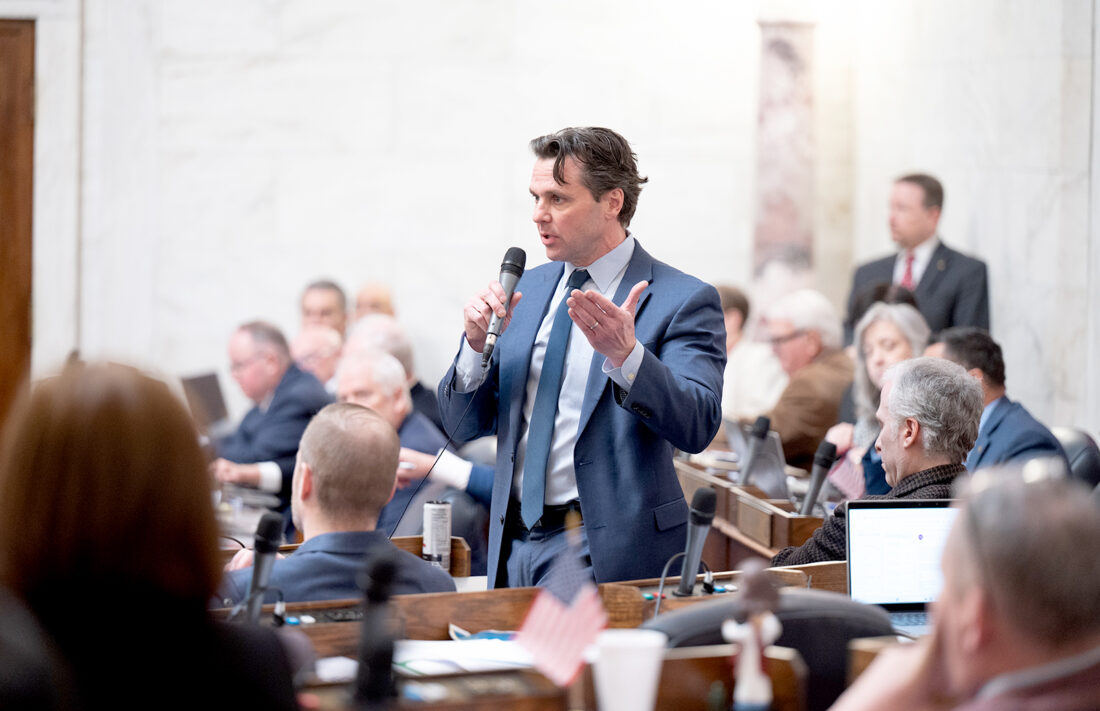
OFFERING A DEFENSE — House Judiciary Committee Chairman JB Akers defends a bill on the House floor Tuesday adding a new crime of human smuggling to State Code. -- Photo Courtesy/WV Legislative Photography
CHARLESTON — The West Virginia House of Delegates was back to work Tuesday after an abbreviated floor session Monday due to Winter Storm Fern and delay Tuesday due to near-zero temperatures, passing six bills, including a bill dealing with smuggling of undocumented immigrants.
The House passed House Bill 4433, prohibiting human smuggling and trafficking, in an 81-9 vote with the entire House Democratic caucus voting against the bill, which now heads to the state Senate for further consideration.
HB 4433 – whose lead sponsor is Del. Bill Ridenour, R-Jefferson – creates new state-level crimes for human smuggling, defined as “knowingly transporting, transferring, receiving, isolating, enticing, or harboring an illegal alien to avoid enforcement of the laws of this state, another state, or the United States.”
The bill creates separate felonies for the human smuggling of adults and minors, carrying sentences of up to 10 and 15 years, respectively. It also imposes much stricter sentences for existing criminal offenses – such as human trafficking, forced labor, debt bondage and sexual servitude – with some sentences reaching a maximum of 50 years.
“This bill seeks to prevent human smuggling and sends a message we won’t tolerate it in West Virginia,” said House Judiciary Committee Chairman JB Akers, R-Kanawha. “We can all be sympathetic to people who try to come to this country and do things the right way, of which there are many … What we also know, though, is that smuggling costs lives.”
The bill eliminates parole eligibility for any individual convicted of an offense under this article where the victim is a minor. It includes enhanced penalties for existing human trafficking offenses and establishes a vehicle forfeiture mechanism tied to these crimes.
HB 4433 includes exemptions, such as when the alleged illegal alien is being voluntarily transported by family members, or individuals contracted by the state or federal government transporting illegal aliens through the state. The legislation carves out legal and medical exemptions for professionals providing essential services to individuals regardless of their immigration status.
This is the third time a similar bill has been considered by the full House. Akers said it was fitting that the House was passing the bill in the final week of Human Trafficking Prevention Month. He argued that many instances of human smuggling and exploitation occur with people, including children, entering the U.S. illegally.
“There are presently about 40 million illegal immigrants currently living in the U.S., many of them obviously very good people who, if they had entered the country legally, would be working hard, contributing, and we would want them here,” Akers said. “The sexual exploitation that we talked about, the smuggling and trafficking of children, that occurs within at least some of that population.”
House Minority Leader Sean Hornbuckle, D-Cabell, said there are many good things in HB 4433 he can support, such as greater penalties for human trafficking, which are already crimes in State Code. But by adding in human smuggling, Hornbuckle said the language was too vague and encroaches on federal laws that already make it illegal to provide assistance to undocumented immigrants in an effort to avoid federal law enforcement, such as Immigration and Customs Enforcement.
“I fear that the bad outweighs the good,” Hornbuckle said. “This is the state Legislature, it’s not Congress. This is a federal issue that we’re tampering with here. It’s not a state issue. What this bill is looking to do, what it can do, is it will create conflicting laws.”
Hornbuckle raised an issue that the House Democratic caucus has raised during committee debate on the bill and the bill’s amendment stage last week: that the bill could potentially ensnare religious organizations and nonprofits providing general assistance to undocumented immigrants.
“As this bill is written, it goes after West Virginians and not illegal aliens,” Hornbuckle said. “It targets and captures innocents, not just those with ill intent.”
In his closing arguments for the bill, Akers said that focusing on human smuggling through the state could help save federal and state taxpayer dollars trying to tackle trafficking by South American drug cartels. He acknowledged that HB 4433 was less strict than similar federal laws already on the books but having the law on West Virginia’s books would allow the state to prosecute cases that federal prosecutors might choose not to. Akers also argued that the bill does not target religious organizations and nonprofits.
“That’s probably been the most frustrating part about this bill and the thing that’s been the most difficult for me to watch over the past few days because the plain wording of this bill makes it clear that everyday West Virginians who provide humanitarian assistance or aid only for the purpose of providing that aid face no criminal culpability whatsoever under the provisions of this bill,” Akers said.
Akers then criticized recent media reporting about HB 4433, accusing some in the media of misreporting the bill’s provisions to garner clicks for stories.
“For example, there’s one TV station that put up a clickbait post a few days ago that said the West Virginia House was debating a bill that would criminalize assistance to illegal aliens. 100% wrong,” Akers said. “It was obviously designed to get people to click on their story, but it was misinformation that I agree would cause concern to people who only want to provide help to these folks. But it was 100% wrong.”
Other bills passed by the House to the Senate Tuesday include:
• House Bill 4002 (passed 76-12), which creates the West Virginia Collaboratory, a research hub based at Marshall University designed to connect academic expertise with state policy needs.
• House Bill 4005 (passed 83-5), which allows individuals aged 16 and older to earn educational credits through a combination of classroom instruction and supervised on-the-job training. The bill revises existing child labor laws to clarify which occupations are prohibited or permitted for minors, aligns state law with federal law, and grants limited exceptions for students to perform certain hazardous tasks under strict supervision.
• House Bill 4022 (passed 88-0), which mandates that the Department of Human Services assign Child Protection Services staff to specific counties by evaluating population data, referral rates, and typical workloads.
• House Bill 4196 (passed 83-5), which requires opioid addiction treatment programs to provide long-acting reversible contraception to individuals in recovery.
• House Bill 4354 (passed 88-0), which mandates an initial assessment by welfare workers and caregivers to determine if a child requires an initial clothing allowance, which is set at a minimum of $375.
Local News
House passed six bills Tuesday, including human smuggling bill
Deadline for candidate filings fast approaching
With ongoing winter weather and a looming deadline, West Virginia’s secretary of state is encouraging those ...
American Lung Association tobacco report gives West Virginia Bad grades
WHEELING — More funding for education to prevent tobacco use in children and adults is needed in the Mountain ...
Senate Education Committee begins discussion of Hancock schools funding bill
Report: WVU, WVU Hospitals have $14.3 billion impact on state
Well pad proposed on 153-acre parcel in Steubenville
STEUBENVILLE — Ascent Resources has proposed putting a well pad on a 153-acre parcel just east of Lovers Lane — ...