
House Speaker Hanshaw, Senate President Smith talk session goals during Issues and Eggs event
Trending
CHARLESTON -- The day before the start of the 2026 legislative session, the leaders of the West Virginia House of Delegates and state Senate took time to answer questions about their goals for the next 60 days.
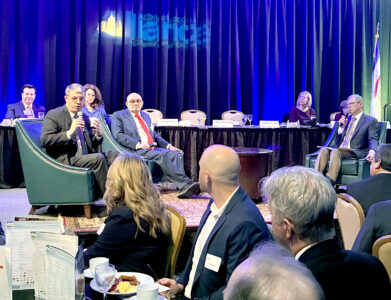
House Speaker Roger Hanshaw, R-Clay, and state Senate President Randy Smith, R-Preston, sat down Tuesday morning with former WV MetroNews Talkline host Hoppy Kercheval during the annual Issues and Eggs event put on by the Charleston Regional Chamber of Commerce at the Charleston Marriott Town Center.
The House Republican caucus released its "Jobs First - Opportunity Everywhere" legislative agenda featuring workforce-ready education, a job-creating business climate, and economic growth. But the Senate Republican caucus has been quiet about its legislative agenda, with one member saying the caucus had no census.
When asked about the Senate GOP majority's agenda, Smith said that he is leaving it up to his committee chairs to drive whatever agenda develops during the session.
"I've got a job to do and all I can tell you is I'm going to do my job. We do have a plan," said Smith, who is in his second year as Senate president. "I've got committee chairs sitting in there that's been working on things, their agenda ... To say that we don't have a plan is kind of unfair because we do have a plan."
Hanshaw said the House Republican Jobs First - Opportunity Everywhere agenda includes many parts, including TEAM West Virginia, an acronym for Technology, Energy, and Advanced Manufacturing. TEAM West Virginia is modeled on JobsOhio, a private nonprofit corporation that handles economic development in Ohio.
"Our priority is to make sure we're doing it better and that we're creating an apparatus that's focused entirely on marketing the state of West Virginia outside our borders, bringing in capital, bringing resources, bringing potential employers here in the way that our neighbors to the west have done in Ohio," Hanshaw said.
Smith said many things in the House GOP's Jobs First - Opportunity Everywhere package could receive support from the Senate Republican supermajority. But Smith said he also wants to see the Legislature focus on helping existing small businesses and cutting red tape and regulations at the state level.
"I want to focus on small business on the state side," Smith said. "We did a great job with the big companies we brought in and we continued to do that in the economic development part ... But I feel, being a small business owner, over the years we've kind of neglected the small businesses."
"One priority that we haven't talked enough about over the past 10 years is how do we come to the aid and how do we support those multi-generational family businesses, those entities that have been here through the thick and the thin in the long haul," Hanshaw added.
While both leaders prioritize job creation as a solution to social issues, they expressed caution regarding Gov. Patrick Morrisey's proposed personal income tax cut of between 5 percent and 10 percent, citing the need for fiscal responsibility. Smith said he supports "responsible tax cuts" but will not commit until he sees a proposal that does not risk bankrupting the state or destroying programs.
"The House and the Senate, sometimes we have to be the adults in the room because we have to pay the bills," Smith said. "We have to make sure that we're not going to bankrupt the state or we're not going to destroy programs ... Until we see exactly what he's wanting to do, it's hard to say we're going to support or not support tax cuts, but I support responsible tax cuts."
"I think it would be irresponsible for me to prematurely judge the governor's proposal until he lays it out tomorrow night," said Hanshaw, referring to when Morrisey presents his fiscal year 2027 general revenue budget to lawmakers tonight when he gives his second State of the State address.
"There's an appetite for tax reduction in almost any form. We want to be the lowest tax environment we can,' Hanshaw continued. "I don't want to prejudge this proposal until (Morrisey) gives us some details about it tomorrow. We're certainly not a no, I'll put it that way."
Tuesday's conversation also touched on education reform, specifically addressing declining student populations and the potential oversight of the Hope Scholarship educational voucher program, which all West Virginia families will be eligible to apply for beginning in fiscal year 2027 in for the 2027-28 school year.
"We know that our school funding formula has got some dust on it," Hanshaw said. "We know that we're in an environment of declining population. We're losing student numbers, but what we're not losing is the need to heat those school buildings and run those school buses ... That specific element of our school funding formula has to have some attention."
"The Hope Scholarship is here to stay ... But I'm going to say that there are some flaws in it that we've been looking at," Smith said. "I'm a supporter of the Hope Scholarship, but I'm also a supporter of it being used the way it's supposed to be used. We're going to look at it."
Hanshaw said to expect some focus from his majority caucus on improving the state's foster care system. Smith said he expects his chamber will pass some tweaks for the data center/microgrid bill passed last year to make sure those kinds of projects are not being located too close to schools and residential areas.
Neither leader could guarantee that hot button issues would not come up during the session, but the primary focus would be improving the lives of West Virginians through improvements in the economy.
"If you want to advance a conservative agenda, and if you want to advance and move forward on what you believe to be conservative principles, the way you do that is you put people in a job," Hanshaw said. "That's why I talk so much about putting people on a payroll, putting people in a good job, because it allows progress on every other issue so many of us believe to be important."