State had been providing support for Hancock County Schools for months prior to decision
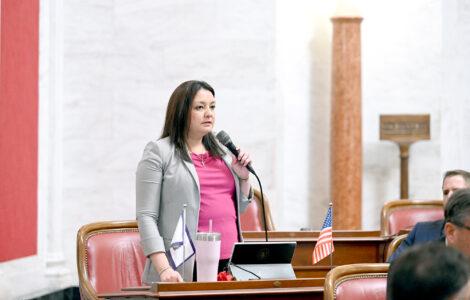
WEIRTON — While West Virginia legislators debate a pair of bills aimed at providing emergency aid for school systems in distress, spurred by financial problems within the Hancock County School System, others in Charleston have spent the last four months providing guidance in the hope of preventing the situation from getting worse.
During Friday’s emergency meeting of the West Virginia Board of Education, at which time, the state board voted to take control of Hancock County Schools, Uriah Cummings, school financial operations officer for the West Virginia Department of Education, explained he was first contacted by Hancock County officials in September with concerns about the district being able to meet payroll obligations.
“Prior to this timeframe, there was nothing to suggest fiscal issues in the county,” Cummings said. “There have been some red flags here and there due to timeliness of reports and so forth, but nothing to suggest major concerns.”
Hancock County Schools, he noted, had been categorized by the state as “needs assistance” in the area of finance for three years prior. Under such a rating, a school district must develop action plans with support from the West Virginia Department of Education to show improvement in noted areas.
As with other districts under such a rating, Cummings said Hancock County Schools had been receiving monthly emails to provide detailed comparisons between budget data and actual expenditures. However, he said, Hancock County Schools never responded to those emails during the three years.
September’s call, which Cummings said came from the district’s former finance officer and former superintendent, left little time for the state to provide financial aid.
“At that time, we were three or four days out from them making a payroll, which would not be enough time for us to do any kind of advance for state aid to meet that payroll,” he said, explaining the district, instead, opted to transfer funding from the county’s Career and Technical Education Center – the John D. Rockefeller IV Career Center – to the Central Office. Those funds have since been paid back, he said.
Assistant State Superintendent Jeff Kelly, also speaking during Friday’s meeting, relayed some of the support offered since that initial September call, including “continuous” financial monitoring, including cash flow projections, studies of student enrollment and an analysis of the impact on the district of the HOPE Scholarship program, and planning for the staffing season where Reductions in Force are decided.
“Throughout the monitoring process, the department has engaged with stakeholders by presenting at a Hancock County board meeting recently, responding to citizen concerns and emphasizing the need for transparency and decisive corrective action,” Kelly said.
Both Kelly and Cummings attended the Hancock County Board of Education’s Dec. 1 regular meeting, where Cummings related the financial issues as being similar to those experienced in other county districts in West Virginia.
Of particular note, at that time, was the habit by some school districts of using Elementary and Secondary School Emergency Relief funds, provided through COVID-related programs such as the CARES Act and ARPA, to support personnel costs and other projects, even though those funds were limited.
It was an issue raised Friday by state school board President L. Paul Hardesty.
“People have heard me sit in this chair for years, begging people not to take ESSER funds and fund positions because that money was going to run out,” Hardesty said. “I don’t know any way to put it. It’s about as plain as I could put it. I’m not trying to lay blame but the facts are what they are.”
According to the U.S. Department of Education’s website, Hancock County Schools received just under $13 million in ESSER funds.
Through their investigations, state officials noted Hancock County Schools was employing approximately 140 positions more than what was available under current state aid formulas for both fiscal 2025 and fiscal 2026.
In addition, Cummings noted various capital improvement projects, including overspending by approximately $1 million on an expansion project at Weir High and an ongoing turf lease following improvements to ball fields at Oak Glen and Weir High, contributed.
“All of those leap to an increase of about $8 million in expenditures from FY24 to FY25,” Cummings said, noting unaudited budget figures show the district going from a $5.5 million fund balance in fiscal 2024 to a $2 million deficit in fiscal 2025.
State officials also have noted a lack of Reductions in Force over multiple years as contributing to the financial issues.
Hancock County Schools isn’t the only district in West Virginia to face such action.
Currently, the state Board of Education has seven districts – Hancock, Logan, Upshur, Mingo, Nicholas, Tyler and Boone – under immediate intervention. In addition, school systems in Pocahontas, Randolph and Roane counties are under states of emergency.
The Hancock County Board of Education will hold its first meeting under state supervision at 5:30 p.m. Monday at the John D. Rockefeller IV Career Center.
Local News

Trump backs down on Greenland and cancels tariff threat after NATO agrees to future Arctic deal
State had been providing support for Hancock County Schools for months prior to decision
WEIRTON — While West Virginia legislators debate a pair of bills aimed at providing emergency aid for school ...
Death of fallen man under investigation
WELLSBURG — The Brooke County Sheriff’s Department is investigating the death of a man who fell from a railroad ...
Franciscan University students to attend march
STEUBENVILLE — More than 700 Franciscan University of Steubenville students, alumni, faculty and staff will ...
West Virginia Senate takes slow approach to Hancock County Schools emergency funding bills