Vote on human smuggling bill in W.Va. possible this week
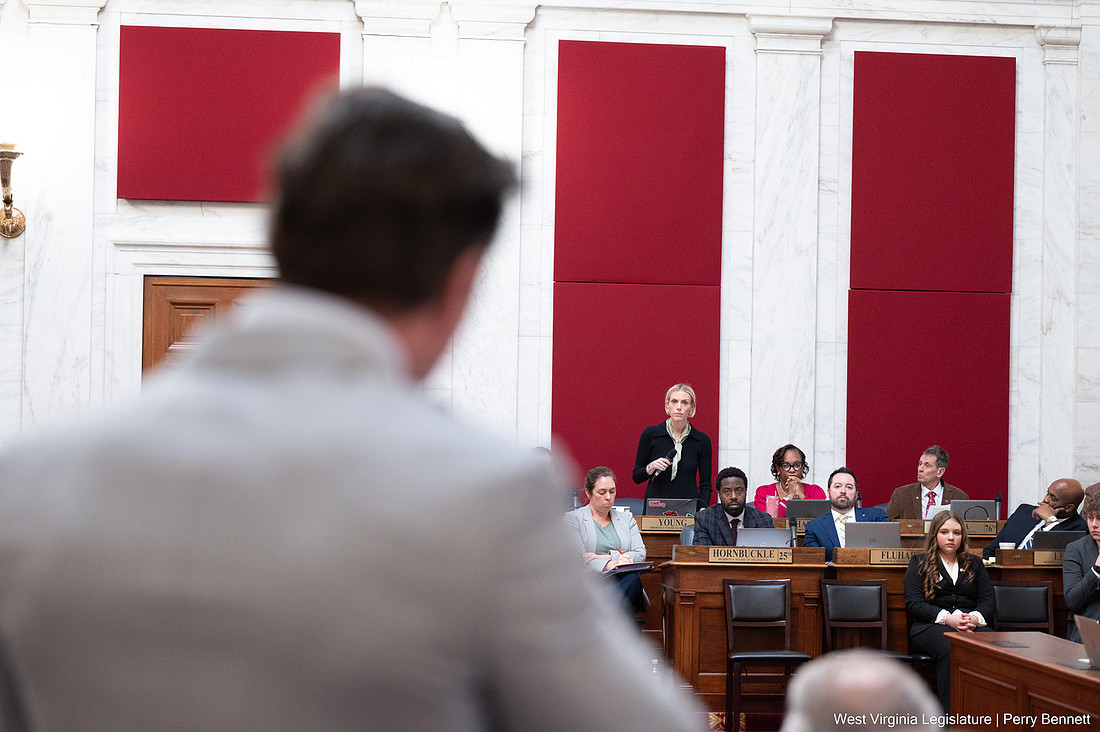
House Judiciary Committee Chairman JB Akers, foreground, debates with House Minority Leader Pro Tempore Kayla Young, background, Friday over an amendment to House Bill 4433, prohibiting human smuggling and trafficking. -- Photo Courtesy/WV Legislative Photography
CHARLESTON – Winter Storm Fern delayed action of several bills up on third reading in the West Virginia House of Delegates Monday, including a bill meant to criminalize the assistance of immigrants accused of being in the U.S. illegally.
But opponents say the bill is too broad and heavy-handed.
Both the House of Delegates and state Senate quickly gaveled in and out Monday afternoon, not having enough of a quorum for a regular floor session due to the weather, postponing action on bills until Tuesday. All committees scheduled for Monday were canceled.
While the Senate had no bills on third reading Monday, the House had six bills up for passage to the Senate, including House Bill 4433, prohibiting human smuggling and trafficking. HB 4433 creates a new crime of human smuggling, targeting individuals or groups who move or hide immigrants accused of being in the country illegally in order to evade legal detection by local, state or federal law enforcement.
Human smuggling is defined as “knowingly transporting, transferring, receiving, isolating, enticing, or harboring an illegal alien to avoid enforcement of the laws of this state, another state, or the United States.”
The bill creates separate felonies for the human smuggling of adults and minors, carrying sentences of up to 10 and 15 years, respectively. It also imposes much stricter sentences for existing criminal offenses – such as human trafficking, forced labor, debt bondage, and sexual servitude – with some sentences reaching a maximum of 50 years. The bill eliminates parole eligibility for any individual convicted of an offense under this article where the victim is a minor.
HB 4433 includes exemptions, such as when the alleged illegal alien is being voluntarily transported by family members, or individuals contracted by the state or federal government transporting illegal aliens through the state. The legislation carves out legal and medical exemptions for professionals providing essential services to individuals regardless of their immigration status.
The bill establishes felony penalties and parole restrictions, particularly when crimes involve minors or the use of lethal weapons. It expands the definitions for forced labor and sexual servitude while allowing for the seizure of property used in these criminal acts.
Supporters of the bill see it as a way to address what they see as an immigration crisis caused by the previous presidential administration of Joe Biden. While the number of people illegally crossing the southern border has greatly decreased under President Donald Trump, some delegates believe the bill will punish those exploiting young immigrants.
“Our compassion has been exploited for too long in the perpetual amnesty cries, and the facilitating of the invasion of this country by the previous presidential administration and exploiting every loophole. And it’s gone on for far too long,” said Del. Joe Funkhouser, R-Jefferson, during a House Judiciary Committee meeting last week where the committee recommended the bill for passage.
“These people are victims,” Funkhouser continued. “Their policies encourage violence, sexual trafficking, just brutal, brutal things in the name of compassion. And I strongly support this bill.”
But opponents believe HB 4433 could unfairly target religious organizations and nonprofits that are providing humanitarian aid to immigrants and chill the work of churches providing charity and aid.
“My concern is that these types of actions will subject people of faith to criminal penalties and time in jail,” said Del. Evan Hansen, D-Monongalia. “For a lot of people, religion is not just about going to church or synagogue. It’s not just about praying, it’s about action … We don’t subject people to criminal penalties, and we don’t chill that type of activity for fear of going to jail, even if it would be unlikely that they would be prosecuted.”
On Friday, the House adopted amendments to HB 4433 to clarify legal definitions and remove restrictions on court-ordered restitution for adult victims. These changes were approved to ensure that perpetrators are held liable for various damages regardless of the victim’s age or immigration status.
However, an amendment offered by House Minority Leader Pro Tempore Kayla Young, D-Kanawha, to require financial or material benefit as a motive for smuggling was defeated over concerns it might create legal loopholes for those assisting illegal entry.
“I want to make sure we’re targeting people that are profiting more off of exploiting other people,” Young said during Friday’s amendment debate. “All this amendment does is clarify that smuggling is when you are doing something for value. It doesn’t touch churches. It doesn’t touch nonprofits.”
“It would create exposure for volunteer groups, which doesn’t currently exist,” argued House Judiciary Committee Chairman JB Akers, R-Kanawha, opposing Young’s amendment. “It would also allow someone to simply, I’m doing air quotes here, ‘volunteer’ to avoid law enforcement as long as they don’t get paid for it, and they could help someone break the law and have no criminal liability.
“We don’t want church groups or nonprofits to have criminal liability if they’re just providing simple services,” Akers continued. “We also don’t want to incentivize people to break the law as a quote-unquote volunteer.”
Steven Allen Adams can be reached at sadams@newsandsentinel.com
Local News

Vote on human smuggling bill in W.Va. possible this week

Restoring service

Frozen Moments
Morrisey warns W.Va. of freezing temperatures following weekend snowstorm
CHARLESTON — With Winter Storm Fern dumping several inches to nearly a foot of snow in some parts of West ...
With snow behind, frigid temps to continue