
Ewing hopes to continue ‘fascinating’ role on W.Va. Supreme Court
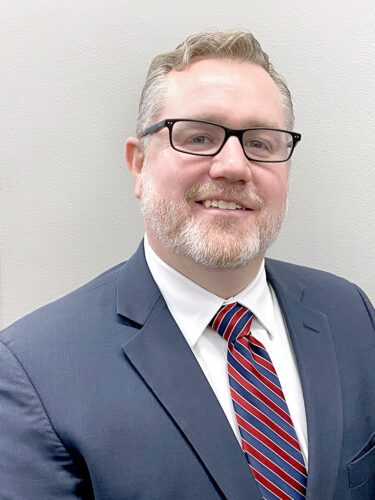
Thomas Ewing
When West Virginia Supreme Court Justice Thomas Ewing discusses the overarching philosophies that guide him on the bench, he hearkens back to his days as an athlete. There are many of those, first as a multisport star at Midland Trail High School and then as a four-year stalwart and ultimately a captain of the Glenville State men’s basketball team.
He likens his role to that of a game official.
“Whether it’s a basketball game or baseball game, football game, whatever it was, if you didn’t really see the referees, if you didn’t notice the referees, and they probably did their job well,” he said. “But if the referees make it about themselves, they’re influencing the game.
“As the court. I don’t want to be out here influencing the game, so to speak,” he added. “I want to do my job calling the balls and strikes, applying the rules and letting the players do what they need to do.”
Ewing, who was in Wheeling on Monday meeting constituents, admits that those who remember him from his playing days might be somewhat surprised he now sits on the highest appellate court in the Mountain State. Yet his willingness to step out of his comfort zone at several points in his life has led him to a position he considers very fulfilling and offers a wonderful opportunity to serve the people of West Virginia.
Ewing — who was appointed by Gov. Patrick Morrisey last August to fill the seat vacated by retiring former Justice Beth Walker – is running to fill the remainder of Walker’s 12-year term, which ends in 2028. Prior to being appointed to the state Supreme Court, Ewing spent seven years as a judge for the 15th Judicial Circuit in the state. Before that, he was an attorney for the Kay, Casto and Chaney law firm.
Yet the legal profession was not his first focus. Ewing has bachelor’s degrees in education and history from Glenville State, with designs on becoming a teacher and a coach. After some consideration, he decided the education field wasn’t for him, but a trip to the University of Pittsburgh School of Law got him intrigued about the subject. He was accepted into West Virginia University’s law school.
“I had no idea what I was really getting myself into, but I love the subject matter,” Ewing said. “I love learning and reading, researching and writing. That’s what I like doing.”
His move to the judiciary came from a suggestion from the man he ultimately would replace. Former Circuit Court Judge John Hatcher had told Ewing he was retiring and felt Ewing would be a good candidate for the seat. He was appointed to that seat in 2018 and elected twice in 2020 and 2024.
While Ewing did not become a teacher, his desire to help children and families never waned. As a circuit judge, he presided over the Fayette County Adult Treatment Court and started and presided over the Fayette County Family Treatment Court, the Fayette County Teen Court, and the Fayette County Truancy Diversion Program. He also served as a commissioner on West Virginia’s Juvenile Justice Commission and was recognized as a 2025 Champion of Children by Just for Kids, Inc.
That experience gave him the ability to offer informed guidance to members of the West Virginia Legislature on the subject of funding family treatment courts.
“Part of the reason why I think I’m in the position I’m in is I was able to go out during that time and tell legislators, tell other people what I had seen from the program,” Ewing said, “the results I had seen, how it worked in Fayette County, and why it was worth the Legislature appropriating funds to keep them, why it was worth really expanding other parts in the state.
“My experience as a family treatment court judge actually gave me the ability to talk to people and be in rooms to discuss these things,” he continued. “I wouldn’t have had that if I didn’t have that experience.”
The judicial branch has been in recent news at the federal level following the United States Supreme Court’s 6-3 decision to strike down the multiple tariffs President Donald Trump enacted through executive orders. The decision drew a scathing rebuke from Trump.
When asked if there was a worry that those sorts of reprimands could trickle down to the state level from members of the executive or legislative branches, Ewing said that criticism is part of the job. Yet the mission should always be to keep calling the balls and strikes without influence from outside parties.
“I hope we can continue to do that, but my focus has to be to ensure that the judiciary remains independent,” he said, “that our decisions aren’t impacted by public sentiment, and that we make the decisions based on the law and the facts.”
That, Ewing said, will always be his main goal as long as he is a West Virginia Supreme Court Justice. He finds the ability to guide the judicial profession in West Virginia with his fellow justices a captivating and exciting endeavor.
“To be able to look at all that and try to figure out what the answer should be, one of the most fascinating things is to sit in that room with the other four justices and debate those cases,” he said. “We’re actually debating what the law of the state of West Virginia is going to be or should be. It’s really been a part of the job that I like the most, being in the room, talking with the other justices about their view on the case and trying to make the decision.”
Local News
Sen. Helton, PSC Chairwoman Lane debate energy policy during committee meeting
Del. McCormick bill regulating vape shops moves in House Health Committee
RIF/Transfer process begins in Hancock County Schools
Paratransit program promotes independence
W.Va. House passes bill providing funding stream to EMS services
Ewing hopes to continue ‘fascinating’ role on W.Va. Supreme Court
When West Virginia Supreme Court Justice Thomas Ewing discusses the overarching philosophies that guide him ...