
Sen. Helton, PSC Chairwoman Lane debate energy policy during committee meeting
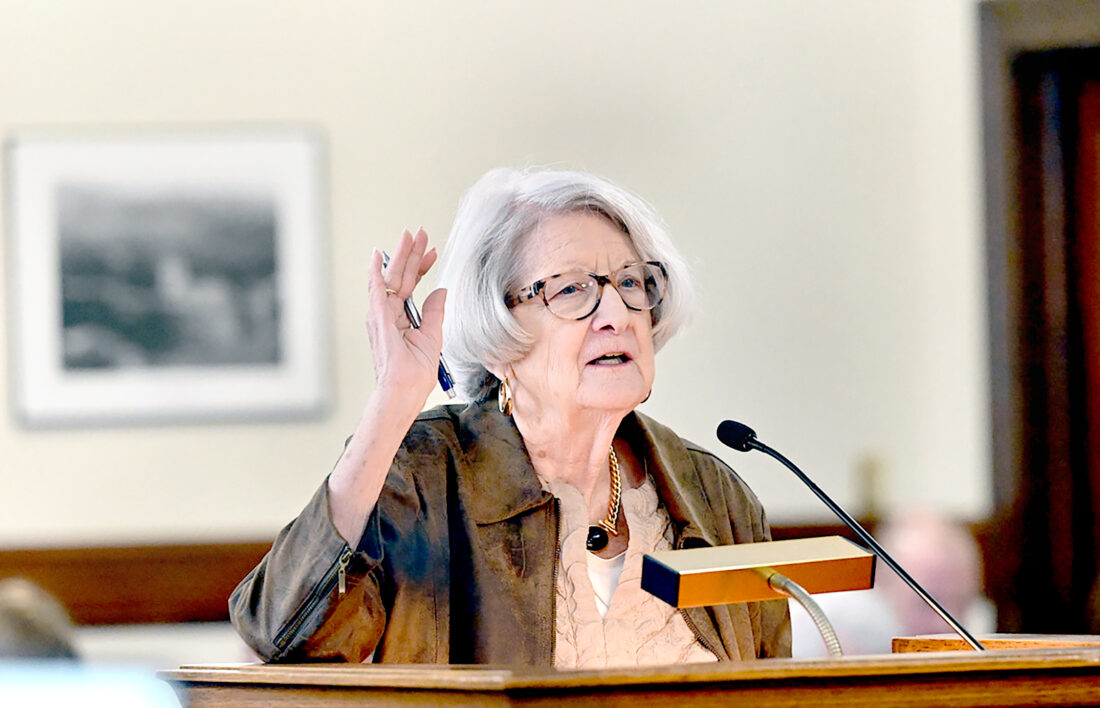
MAKING A POINT — PSC Chairwoman Charlotte Lane argued Monday that doing more to require coal-fired power plants to operate at a 69 percent capacity could also do more to raise electric rates for customers. -- Photo Courtesy/WV Legislative Photography
CHARLESTON — The matter of at what capacity West Virginia’s coal-fired power plants should be operating and whether those requirements would raise costs for ratepayers became a back-and-forth discussion between a state senator and the chairwoman of the Public Service Commission Monday.
The House Energy, Industry and Mining Committee recommended two bills for passage Monday afternoon to the full Senate: A committee substitute for Senate Bill 420, the West Virginia First Energy Act, and a strike-and-insert amendment for House Bill 4026, relating to expanding the requirements for integrated resource plans utility companies must file with the Public Service Commission.
Both bills would create the West Virginia First Energy Act, a legislative framework designed to restore electric rate stability through prioritized in-state coal-fired generation and the preservation of the state’s natural gas industry. State Sen. Brian Helton, R-Fayette, is the lead sponsor of SB 420 and led the subcommittee that amended HB 4026.
“Over the past 15 years, our state has given up our ability to control our own energy,” Helton said during remarks by members on the Senate floor earlier Monday. “We’re the second largest coal producer in the nation. We have abundance of natural gas. Yet we’re losing jobs. Our coal communities are getting devastated. And we’re seeing utility rates spiral up and up and up. And our people just can’t afford it, particularly with the loss of these jobs.”
The legislative package proposes a target utilization rate of 69% for coal-fired power plants, tied to tiered cost-recovery incentives. HB 4026 introduces requirements for utilities to analyze Advanced Transmission Technologies in their integrated resource plans.
Attainment of utilization goals is tied to cost-recovery incentives in a tiered structure, with cost recovery set at a specific level, increasing as the plant approaches the 69 percent target. Utilities supplying electricity for industrial or residential use must maintain a 30-day supply of base fuel.
A previous PSC order set an expectation that coal-fired power plants need to achieve at least a 69 percent capacity factor in order for in-state electric companies to self-generate power and reduce reliance on purchased power.
“That came out of a case that we had about three or four years ago in which we disallowed a ton of money for (Appalachian Power) because we felt that the plants hadn’t been utilized enough,” explained PSC Chairwoman Charlotte Lane to committee members Monday.
“We looked at the statistics of what it cost to run the plant, what it cost to buy power on the PJM market, and doing that analysis — it took a long time to do that analysis — we came up with a percentage that had they run at 69 percent, then they wouldn’t have been asking for this huge amount of money for their power (cost) recovery.”
Helton said incentivizing coal-fired power plants to operate at a 69 percent capacity rate would lower electric rates and result in more coal miners being employed.
“We want them to be utilized according to the PSC standard of 69 percent. And if we’ll do that, and we’ll get these utilities back in line with that 69 percent, we’re going to see an economic uptick like we’ve never seen before,” Helton said.
A 2024 report commissioned by the PSC showed that coal-fired power plants owned by Appalachian Power and Wheeling Power — subsidiaries of Columbus-based American Electric Power — often operated well below the 69 percent recommended capacity factor.
The Mitchell Power Plant in Moundsville remained at 6% capacity between September and December 2021, with the John Amos Power Plant in Winfield at 3 percent capacity and the Mountaineer Power Plant near New Haven at 0 percent capacity. Both of those companies purchased most of their power that year through PJM Interconnection, a wholesale energy transmission company — also called a regional transmission organization — serving West Virginia, 12 other states and Washington, D.C.
“We need our state to take back control of our energy. We’ve turned it over to an out-of-state PJM dispatch model that has … removed all this base load power,” Helton said. “We need to bring that back in state. We need to take control of our own energy. We need to look at West Virginia first when it comes to our power and how we’re going to run our state moving forward.”
During Monday’s committee meeting, Lane told committee members that leaving PJM would be difficult, given that both American Electric Power and Akron-based First Energy — with West Virginia subsidiaries MonPower and Potomac Edison — are tied in with the PJM region.
“We had proceedings two or three years ago, both with First Energy and (Appalachian Power), to look to see about getting out of PJM,” Lane said. “at the time we decided it was probably too much trouble.”
Lane said that while a 69 percent capacity factor was a good goal, putting pressure for coal-fired power plants to produce more power when PJM is demanding more power from less expensive sources, such as natural gas, would actually cause West Virginia electric customers to pay higher rates.
“Senator, let me just ask you a question … If it costs more to run the coal-fired plants than buying off the PJM market, do you want those plants to run and pass those costs to rate payers,” Lane asked Helton.
“I myself believe long-term reliability is better,” Helton said. “I think we can see that historically when we utilized long-term reliability with coal, our rates were steady. We’ve since went to minute-by-minute PJM dispatchable, and our rates are all over the board. And by the way, we’ve lost a whole lot of jobs in the process.
“My suggestion, senator, is that you tell us to run at 69 percent and just pass whatever cost that is onto the ratepayers, and I will do that,” Lane said.
Lane said she stood by the PSC recommendation for coal-fired power plants to operate at a 69 percent capacity if able to do so but argued that a new study may be needed, and that factor might need to be raised or lowered.
“I do believe in the 69 percent in the order that we issued, and it was looking back at that particular time,” Lane said. “Now, whether or not running at 69 percent now is economic, I don’t know.”
Speaking earlier on the Senate floor Monday, Senate Energy, Industry and Mining Chairman Chris Rose, R-Monongalia, encouraged members to support SB 420 and HB 4026 when they come to the floor later this week.
“I’m encouraging each and every one of you to join me and look at the Senate Energy agenda today,” Rose said. “I need you guys to join me and fight like hell to get that to the governor’s desk. Because if we lose these (coal) jobs, we’re going to lose our state.”
Local News
Sen. Helton, PSC Chairwoman Lane debate energy policy during committee meeting
Del. McCormick bill regulating vape shops moves in House Health Committee

RIF/Transfer process begins in Hancock County Schools

Paratransit program promotes independence

W.Va. House passes bill providing funding stream to EMS services
Ewing hopes to continue ‘fascinating’ role on W.Va. Supreme Court
When West Virginia Supreme Court Justice Thomas Ewing discusses the overarching philosophies that guide him ...