
Crossover Day: West Virginia Senate breezes through agenda focused on energy, firearms, and obscenity
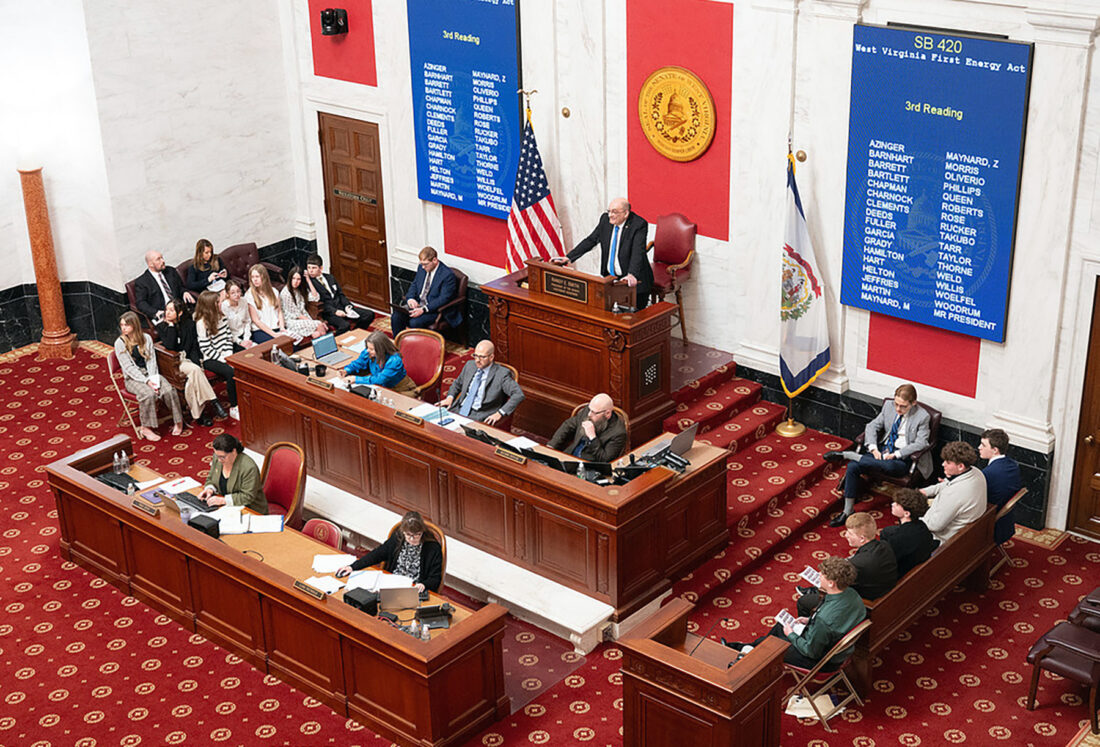
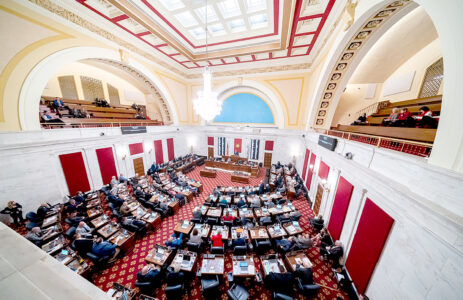
IN SESSSION — Senate President Randy Smith presides over the state Senate chamber Wednesday as the body considered Senate Bill 420, the West Virginia First Energy Act, on Crossover Day. -- Photo Courtesy/WV Legislative Photography
CHARLESTON — The West Virginia Senate had fewer bills to consider than the House of Delegates on Crossover Day, with debates breaking out over energy policy, obscenity, and firearms for accused domestic abusers.
The state Senate passed 30 bills Wednesday on Crossover Day, the 50th day of the 60-day legislative session when Senate bills must be passed and sent to the House in order to be considered in time for when the 2026 session ends at midnight Saturday, March 14.
The Senate passed Senate Bill 420, the West Virginia First Energy Act, on a 22-11 vote with one absent or not voting.
SB 420 sets a goal for coal-fired power plants to maintain a minimum of 69% operational utilization on a 12-month rolling average. The bill tiers a 9.2% additional rate of recovery over cost for utilities that meet the 69% attainment goals. It requires electric utilities supplying residential and industrial power to maintain a 30-day supply of base fuel.
The bill prohibits the premature termination of coal-fired or natural gas-powered plants without prior approval from both the PSC and the Public Energy Authority, something already established within State Code. It restricts utilities from recovering expenditures associated with investments in renewable energy, such as wind and solar.
“The act is designed to restore electric rate stability through in-state coal-fired generation, preserve employment and investment in the state’s coal and natural gas industries, sustain dependable base load and mid-load generation capacity statewide, and enhance the role of the public energy authority in maximizing in-state electric generation,” said Senate Energy, Industry and Mining Committee Chairman Chris Rose, R-Monongalia.
SB 420 is similar to House Bill 4026 passed by the Senate last week, which amended several of the provisions in SB 420 into the House bill.
But several senators raised concerns Wednesday that despite the bill not making the 69% capacity factor a mandate, other language in the bill clarifies that failure to maintain this level constitutes noncompliance and could cause coal-fired power plants to operate when it is not economical to do so, potentially raising electric rates.
“That’s a mandate. Looking back, if you were to apply the economics of this bill from January of 2025 through November 30 of 2025, those costs would have been pushed back onto rate payers at $80 million,” said state Sen. Eric Tarr, R-Putnam. “That’s an $80 million increase in rates that would come back to the rate payers of West Virginia.”
State Sen. Tom Takubo, R-Kanawha, argued that the bill’s definition of “dispatchable non-intermittent” sources is limited to coal and natural gas. He argued this “handcuffs” the state by preventing the use of nuclear energy or new renewable contracts.
“It really handcuffs us going into the future,” Takubo said. “If you look at the particulars of this bill, it would completely stop us from using nuclear.”
The Senate passed Senate Bill 590, relating to exhibition of obscene materials, in a 31-2 vote with one absent or not voting.
SB 590 would regulate the exhibition of what is classified as “obscene material” by criminalizing specific types of adult entertainment in public or semi-public settings. It would make it a criminal offense to engage in an adult cabaret performances if it can be viewed by a minor or occurs on public property, preempting local laws.
The bill defines an adult cabaret performance as entertainment featuring specific types of performers, such as topless dancers, go-go dancers, exotic dancers, and strippers; and male or female impersonators. First offense would be a misdemeanor charge and subsequent charges would be elevated to felonies.
“I urge passage of this bill on behalf of the children that should not be exposed to this type of adult entertainment,” said Senate Judiciary Committee Chairman Tom Willis, R-Berkeley.
Senate Assistant Minority Leader Joey Garcia, D-Marion, argued that the bill’s provisions could inadvertently make performances by dance teams subject to criminal charges or even how someone dresses in public.
“It seems like this is … portrayed as trying to protect children. In reality, I think it’s more about judgment,” Garcia said. “Do people have to worry now about what they wear in public about how it’s going to make somebody else feel, about whether it’s going to turn somebody else on? I think that’s a dangerous road to go down.”
The Senate passed Senate Bill 963, protecting due process in firearm confiscation, in a 22-11 vote with one absent or not voting.
SB 963 would modify the procedures for firearm surrender under personal safety and domestic violence protective orders. The bill would limit surrender of firearms to three specific circumstances: the accused party fails to appear at a hearing, the accused party agrees to the surrender, or a full adversarial hearing is held where a finding of violence or threatened violence is made by a preponderance of evidence.
State Sen. Ryan Weld, R-Brooke, opposed SB 963, arguing that the current system for domestic violence protective orders does not need changed.
“Studies show that time after time, the time frame in between the filing of an emergency protective order and then when that hearing is held … is the most lethal time,” Weld said. “Why we would increase the lethality during that time period when we’ve had this system in place for 14 years and there has never been an issue that has been brought to our attention as legislators?”
Local News
Crossover Day: West Virginia Senate breezes through agenda focused on energy, firearms, and obscenity

Lou Holtz dies at age 89
Senate Republicans vote down legislation to halt Iran war in Congress’ first vote on the conflict
Concern in Follansbee about loss of traffic signals remains
Crossover Day: House of Delegates works its way through long list of House bills
Jefferson County grand jury returns indictments
STEUBENVILLE — A Jefferson County grand jury returned eight indictments Wednesday, including one against a ...