
Plugged In: W.Va. works towards comprehensive energy plan
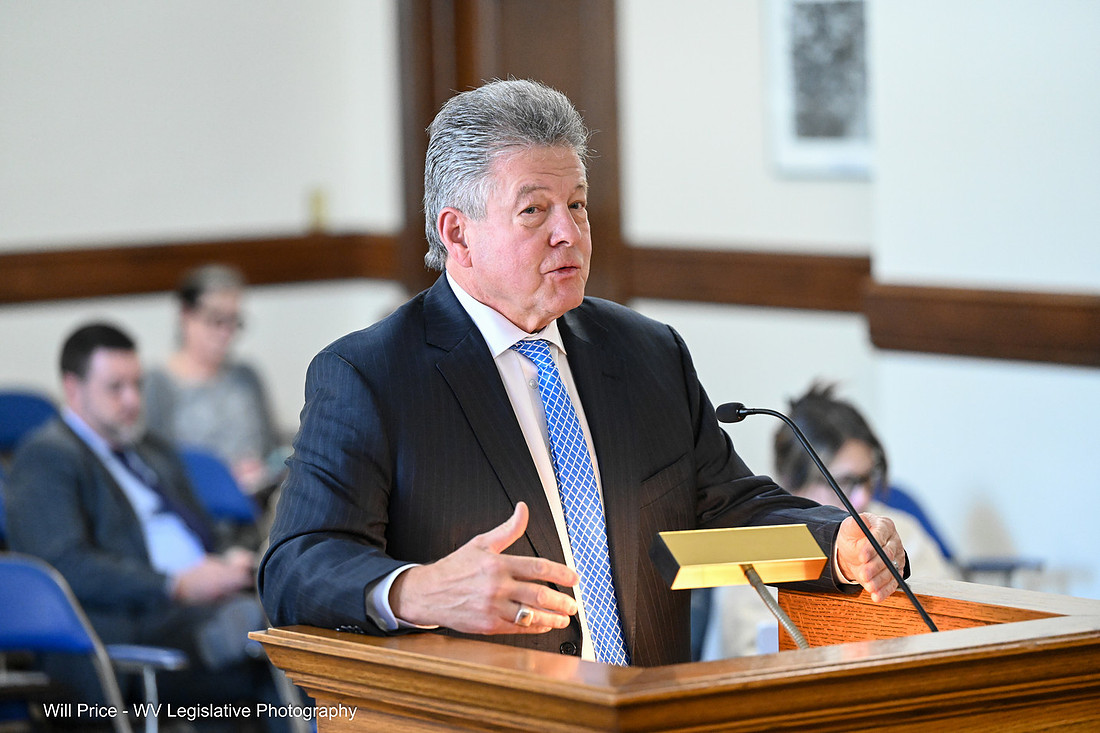
Photo courtesy of WV Legislative Photography West Virginia Coal Association President Chris Hamilton said West Virginia coal-fired power plants continue to be the best hope of meeting energy demands for data centers and AI.
CHARLESTON – Gov. Patrick Morrisey wants West Virginia to be the battery of the East Coast, and his Office of Energy is working on the state’s long-term energy plan that must find a balance between the state’s major fossil fuels, while critics say there is too much focus on base-load over renewables.
House Bill 5381 creates the Comprehensive Energy Policy and Development Plan Act of 2026, which tasks the Office of Energy with creating a long-term strategy to bolster electrical grid stability and energy security through 2050. The bill, introduced on behalf of Morrisey, made it through the legislative process on March 14, the last day of the 2026 session and less than an hour before the midnight deadline.
The legislation is the next step in codifying Morrisey’s 50 by 50 plan to increase the state’s electric-generating capacity from 16 gigawatts to at least 50 gigawatts by 2050. Since Morrisey unveiled the plan last summer, several companies, including Akron-based FirstEnergy, have announced plans for new natural gas-fired power generation that could add more than 2 gigawatts toward that goal.
“We’ve been really doing a lot of hard work on our 50 by 50 energy plan,” Morrisey said in a March 16 press conference. “It’s been one of the lynchpins for the successful economic development initiatives that we’ve had in recent months.
“Our 50 by 50 energy strategy is designed to send a message across the country that West Virginia is America’s energy state,” he continued. “We have a laser-like focus on continuing the reasonable useful life of coal, expanding natural gas opportunities and moving aggressively toward nuclear and other alternatives. We think that West Virginia is very well positioned to leverage our energy resources.”
HB 5381 calls for a diverse, “all-of-the-above” energy policy, including the use of coal, natural gas, nuclear and alternative energy. A last-minute change removed references in the bill to renewable energy, such as solar or wind, though the bill doesn’t prohibit consideration of renewable energy in the plan.
It includes a mandate to allow existing coal-fired power plants to remain fully operational through at least 2050, expanding international markets for West Virginia coal and developing non-generation uses for coal. It also calls for creating a robust in-state market for natural gas through increased manufacturing and electricity generation.
HB 5381 changes the core mission of the Office of Energy from a focus on energy savings to energy production and independence. The bill mandates a five-year Comprehensive Energy Plan, with the first version due by Dec. 1. The policy must include four pillars: reliability focused on stable baseload generation, efficiency driven by technological innovations, affordability focused on low-cost energy sources and independence focused on domestic energy production.
“I think it’s important from the perspective of us having a strategy that could then be taken down into a tactical implementation plan,” said Del. Bob Fehrenbacher, R-Wood, the chairman of the House Energy and Manufacturing Subcommittee within the House Energy and Public Works Committee.
“West Virginia has historically been an energy provider to the region. And with our coal and natural gas resources, we have abundant fossil fuel-based energy that can make a definite impact,” he continued. “It presents an opportunity for the state to be a player in not only generating the electricity, but also ideally having facilities and economic development and jobs where that electricity is the key input or driver of those developments.”
The power of planning
Work toward a comprehensive energy plan began with the Office of Energy soliciting public comments in November and December. On Wednesday, the Office of Energy announced it had contracted with Davis Energy and Infrastructure Strategy Group, fronted by former Virginia Department of Energy Director Glenn Davis, to help develop the comprehensive energy plan.
“While other states are turning their backs on the reliable power needed to support growth, West Virginia is stepping up,” Morrisey said in a statement. “We understand that if you want to create jobs, if you want to attract investment and if you want to compete, you have to have the energy to support it. We are building that here, and we are ready to lead.”
Nicholas Preservati is the deputy secretary of the state Department of Commerce and director of the Office of Energy. In an interview Thursday at the department’s offices on the grounds of the State Capitol Complex, Preservati said West Virginia has ranked fourth or fifth nationally in total energy production but only 31st in electricity generation. The new comprehensive energy plan seeks to stop the outflow of these resources and use them here to meet the nation’s electric demand.
“The main thought was, how do we stop that? How do we keep those resources in West Virginia so that we can mine the resources here? We can use the resources here to produce electricity so that we get that extra benefit in West Virginia,” Preservati said. “Then we use the electricity to fund businesses and data centers and stuff in West Virginia. We’re wanting to keep all that in state as much as we can.”
According to Preservati, West Virginia has the ability with existing coal-fired power and planned natural gas-fired power to be a major exporter of power to PJM Interconnection, the wholesale energy transmission company serving West Virginia, 12 other states and Washington, D.C.
Preservati said that by utilizing coal and gas in-state to produce electricity, the state gains multiple economic “touches” – mining/drilling, transportation, generation and ultimately powering in-state businesses. This shift is designed to increase individual wealth, improve the quality of life and provide high-paying jobs to retain and attract a skilled workforce.
The comprehensive energy plan is intended to position the state against regional competitors, like Virginia, by offering tax incentives and a stable energy supply. Preservati said the passage last year of House Bill 2014, creating incentives for data center and microgrid projects to locate in West Virginia, will provide the new load required to justify expanding energy infrastructure in the state without negatively impacting existing ratepayer costs.
“I think that this wedding of the energy policy with House Bill 2014 on the data centers creates a perfect circle for us to maximize one of the biggest revenue generators in the history of economics, with data centers, and pairing that with our unique position on energy,” Preservati said. “It’s a perfect storm for West Virginia to finally be on top, so we’re trying to take advantage of that.”
Preservati said the goal of the energy plan is to focus on aggressively increasing electric generation; targeting high-use electricity customers, such data centers, to make use of this generation; and partnering with higher education to train the workforce needed for these technology and energy sectors
High voltage
As West Virginia develops its comprehensive energy plan, the state’s two major fossil fuels – coal and natural gas – will play a major role.
According to 2023 data from the U.S. Energy Information Administration, the vast majority of electricity generated in West Virginia came from coal-fired power, accounting for 91%, followed by natural gas at 6.5%, renewable energy (wind, solar, hydroelectric) at 2.1%, and petroleum at 0.3%, with no nuclear power within the state.
“We’d like to think that coal is just a core component of this energy plan sponsored by the governor,” said Chris Hamilton, president of the West Virginia Coal Association. “The whole energy legislation bodes well for existing energy sources first and foremost.”
“I think we obviously think that the role of natural gas in helping to hit the governor’s 50 by 50 goal is critical, said Rebecca McPhail, the incoming president of the Gas and Oil Association of West Virginia. “We think it’s a huge opportunity for our industry. It’s a huge opportunity to create more jobs and support economic growth in West Virginia.”
West Virginia has nine active coal-fired power plants, four natural-gas-fired power plants, one petroleum plant and one biomass plant, 12 hydroelectric facilities and six wind power-generating projects with nearly 400 wind turbines spread across six counties. But neighboring Ohio and Pennsylvania have a combined 36 natural gas-fired power plants.
In 2024, natural gas supplied more than 44% of the electricity used by PJM. During last summer’s heat wave, natural gas use by the PJM grid reached as high as 47%. In February, FirstEnergy announced it would build a 1,200-megawatt natural gas-fired power plant next to its Fort Martin Power Station to provide power to its MonPower and Potomac Energy customers.
During the recent legislative session, several attempts were made by coal supporters to pass bills that would have incentivized the state’s existing coal-fired power plants to operate at a 69% capacity factor as recommended several years ago by the state Public Service Commission. Hamilton said the state’s coal-fired power could provide the needed energy without new generation construction.
“These plants are not running at their full capacity levels today. So, the easiest way to increase the overall energy output of the state in our gigawatts is to run these plants at a higher capacity factor,” Hamilton said. “We think that’s also the least cost option for consumers of West Virginia electricity, putting additional monies in these existing facilities so that they run much more efficient and for a much longer period of time as opposed to building out new generating facilities.”
Opponents of those plans, including the PSC, argued that operating the coal-fired power plants at a 69% capacity factor when PJM is primarily using natural gas and nuclear to meet base-load demand would cause ratepayers to bear the costs. According to a 2025 analysis by financial firm Lazard, coal-fired power costs consumers $122 per megawatt hour compared to $78 per megawatt power or natural gas.
“I think you’ve got to really be cautious about legislating winners and losers in any environment, but particularly in market-driven energy environments,” McPhail said. “I think the market should be allowed to dictate what the economics bear out. I believe, and I think that others would agree, that those capacity factors are probably heading in that direction without the need to legislate them because we see such a growth in demand.”
Preservati said the state’s comprehensive energy plan includes 25-year plans for coal and natural gas, with the goal of keeping coal-fired power generation going while being open to new generation from natural gas, but it’s not a zero-sum game where new natural gas generation would hurt coal-fired power.
“PJM needs 120 gigawatts regardless of whether you build new generation or you don’t build new generation,” Preservati said. “There’s no need for the gas and coal to compete … It’s not either/or – it’s an ‘and.’ And I think the way that we’ve structured this, we basically cement that. So, they’re not competing with each other at all.”
It’s not easy being green
House Energy and Public Works Minority Chairman Evan Hansen, D-Monongalia, said he thinks the plan focused too much on base-load energy production though coal and natural gas at the expense of renewables.
“I think it’s a big mistake,” Hansen said. “I think it’s picking and choosing winners and losers rather than embracing the true all-of-the-above energy strategy. And what this means is that the state’s going to be focused on an energy strategy that’s not necessarily the best for ratepayers. Because wind and solar are not only cost competitive with basic generation with fossil fuels, but in many cases cheaper.”
According to that same 2025 Lazard report, for the $122-per-megawatt-hour cost of coal, wind power can produce the same amount for $61 per megawatt hour and solar can produce the same amount for $58 per megawatt hour at utility scale.
“I think we want a reliable grid. I think we want innovation. We want low-cost energy and energy dependence. That’s all good,” Hansen said. “But I think by excluding new technologies that can be the cheapest and are the most innovative technologies around and provide energy security to the state, you’re hamstrung. You’ve got one hand tied behind your back because the plan is not even allowed to consider those technologies that are most likely to allow you to achieve your goals.”
While now no longer listed within HB 5381, Preservati said the comprehensive energy plan does factor in growth in renewable energy – specifically solar and wind – over the next 25 years. But he said supporters of wind and solar need to be understanding of West Virginia’s physical limitations.
“If you look at it, solar is a pretty big part of this, but … West Virginia has some of the worst solar radiance in the country,” Preservati said. “Then the other issue is when we look at our development for data centers and other things, we have land use issues. We have limited flat land. … There’s a lot more complex issues that go into this than people realize than just saying, ‘Well, we need more solar.'”
The first draft of the state’s comprehensive energy plan could be ready in the next two to three months. The Office of Energy will then seek feedback from stakeholders, then put the document out for a 90-day public comment period, allowing for any changes to meet the Dec. 1 deadline.
“I want people to understand when they read this, they may not agree with us, but they’re not going to be able to say we ignored voices,” Preservati said. “They’re not going to be able to say we ignored data, or we didn’t address certain issues. Our goal is to do an actual energy policy void of rhetoric, void of any … politics and saying, this is what’s best for West Virginia.”
Local News

Wellsburg coffee shop opens with community spirit
Grant sought for major Wellsburg water project
Daily Happenings
Police Beat Jefferson County Drug Task Force Man charged after search – A Mingo Junction man was booked into ...
The greatest mission need ever
Emotional and mental health needs have never been higher. Depression and anxiety, loneliness and social isolation, ...
Plugged In: W.Va. works towards comprehensive energy plan
Church sermon topics
• Bell Chapel United Methodist Church: "You Are" • Cadiz Presbyterian Church: "A Path is Chosen" • Cove ...