Rates hiked for Jefferson County water, sewer customers
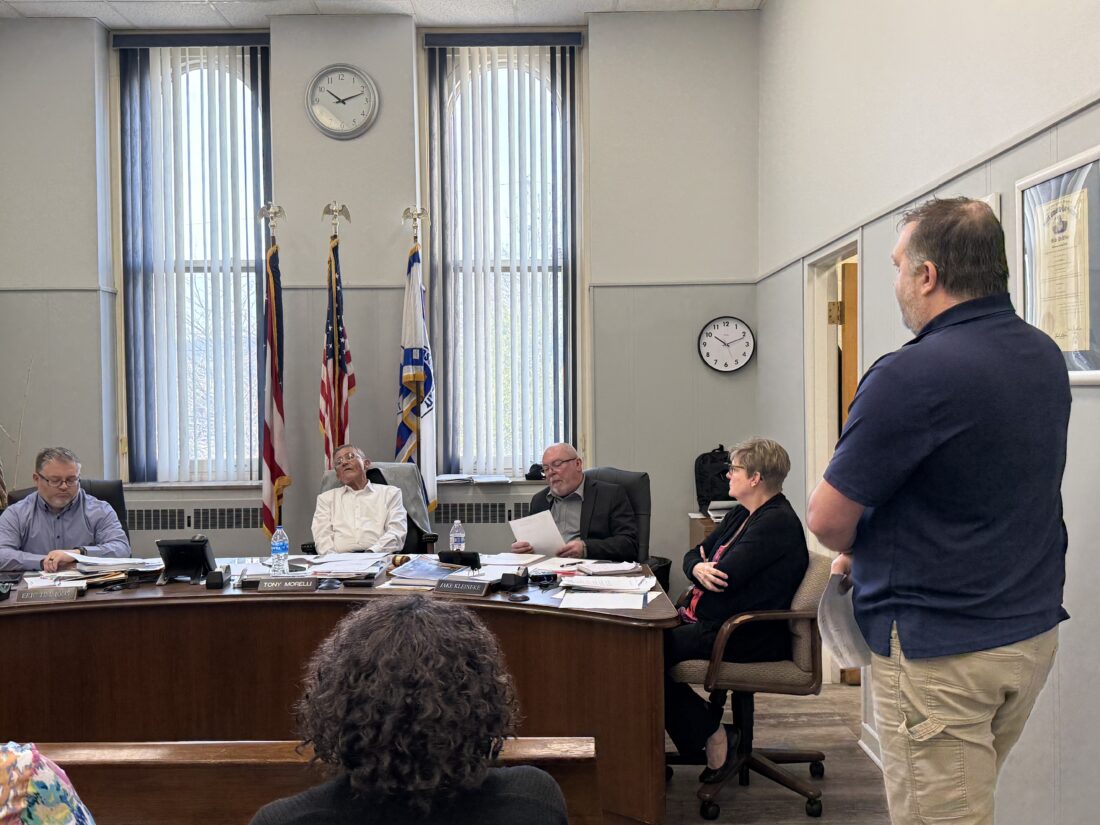
STEUBENVILLE — Minutes after approving rate hikes for their cash-strapped Water & Sewer District, Jefferson County Commissioners had to front the department nearly $252,000 to cover an upcoming bond payment for the sewer service.
Commissioner Jake Kleineke said that bailouts like that are one of the reasons they had to order rate hikes, pointing out it’s not the first time they’ve been forced to use the county’s “permissive debt” money to pay a bill that the two enterprise funds are supposed to be able to pay out of their own accounts but can’t.
“It’s ironic that the day we had to raise rates we also had to bail the sewer department out with permissive tax funds,” Kleineke said. “That’s the magnitude of the problem we’re having with all of this. We have these debt service (payments) coming due and debt service has to be paid before payroll–that’s the law in Ohio.”
During Thursday’s meeting commissioners increased minimum billings for all residential, commercial and industrial customers.
*On the water side, the minimum bill for residential customers with three-quarter inch meters will go up $10 per month to $44.80 for the first 2,000 gallons of water used; Customers with one-inch meters will pay $76.01 for the first 5,000 gallons consumed (a $17.54 increase); two-inch meters, $190.93 for the first 12,000 gallons consumed (a $44.06 increase); four-inch meters, $384.59 for the first 24,000 gallons consumed (an $88.75 increase); and six-inch meters, $772.77 for the first 48,000 gallons of water consumed (a $178.33 increase).
All water customers will pay $12 for every 1,000 gallons they use in excess of the minimum billing amount, a $2 increase.
*On the sewer side, the minimum bill for residential customers with three-quarter inch meters be $73.48 for the first 2,000 gallons of waste produced (a $26 increase); one-inch meters, $80 for the first 4,500 gallons of waste produced (an $18.46 increase); two-inch meters, $148.29 for the first 9,600 gallons of waste produced (a $34.22 increase); four-inch meters, $638,37 for the first 46,200 gallons produced; and six-inch meters, $947.67 for the first 69,300 gallons of waste produced (a $218.69 increase).
Sewer customers also will pay $12 for every 1,000 gallons they use in excess of their minimum billing amount, a $2 increase.
In requesting the increase, Director Jonathan Sgalla said a “significant effort was spent analyzing” expenses for both water and sewer “to keep the necessary rate increase(s) to a minimum.”
Sgalla said budgets for both departments are barebones: For water, he said that means “only purchased water system maintenance and repair and existing debt payments.” On the sewer side, they stripped it down to “sewage pumping and treatment, purchased sewage treatment, system maintenance and repair, failed pump replacements and existing debt payments.” He said the increase “accounts for funds needed to make it through the year without any significant” system catastrophes or equipment failure.
On the water side, Sgalla points out the county is responsible for “300 miles of waterline, 18 water tanks, nine booster stations, countless system valves and thousands of fire hydrants, all exceptionally expensive to maintain.”
“Our water loss across our five water systems is at an all-time high,” he said. “With each passing day, more and more water is purchased from our suppliers and lost into the ground. This loss will not stop until the aging waterlines are replaced.”
He said it’s just as dire on the sewer side, which oversees 20-plus wastewater lift stations and 11 collection systems as well as eight wastewater treatment plants–three of them failed subdivision treatment plants Ohio EPA turned over to JCWSD. He said the system is well “past (its) useful life” with cracks and seal failures that lead to intensive storm and rainwater infiltration and inflow into the sewer system that can’t be stopped without expensive sewer replacement or lining projects.
“The vast majority of our (sewer) assets are well past their useful life,” Sgalla said. “Both federal and state environmental protection agencies’ rules and regulations have become increasingly stringent over the years. These regulatory changes are designed to protect public health and the environment from harmful waste discharges but, unfortunately, put further strain on system finances.”
Arcadis Engineering’s Andrew Dawson, the district consultant, pointed out employees were routinely “working 20-plus hour shifts” over the past few months.
“That’s not 20 hours straight of working at a desk with a nice cup of coffee next to you,” he said. “It’s 20 straight hours of being out in the elements in the freezing cold at 1 a.m. doing physical labor, with water spraying from gaskets and smelling sewage and getting fecal matter on their clothes…and there’s still not enough of them to do what needs to be done.”
Before the vote, commissioners said they had no other option.
“We’ve got to stop the bleeding, that’s how I feel,” said Commissioner Tony Morelli. “Talk about the can getting kicked down the road all these years…well, here it is.
“A lot of this mess were in, in my opinion, is because no action was taken in the past,” Morelli said. “Now, why did that happen? There might have been some good reasons for it…But everything goes up, everyone knows that–but if their water rate goes up $10, people flip out but they still want water to come out of the faucet.”
Commissioner Eric Timmons said it’s “the right thing to do. If not, we’re going to be in trouble.”
“I want this place to be better for my kids than it is for us,” Timmons added. “You’ve got to make the hard decisions sometimes.”
Kleineke agreed, saying without the rate hike, painful though it is, “Our customers are going to walk up to faucet and not only will water not come out of the faucet, there’s not going to be employees or fire hydrants.”
Likewise, commissioners said they didn’t want to use permissive tax money to get the sewer district over the looming debt service hump. They said the department could theoretically cover the debt service payment with its existing funds but if they did, they wouldn’t have enough for payroll
“We’ve all said it more than once, ‘We don’t want to do that again, we’ve said it over and over again. But we had to do it today, and the only way we can do it lawfully is because we have designated some of that permissive money for debt purposes.:
Commissioners, meanwhile, said OEPA is still pushing them to take on the aged, failing Warren water system but they’ve made it clear that won’t happen without “significant” financial assistance with a major water improvement project in the Amsterdam. Residents in those communities face almost daily line breaks–sometimes two or three breaks in the same day.
“The only reason that we might have a possibility of getting some money for Amsterdam is because we took that stand,” Morelli said.
Local News

Earth Day event planned in Weirton April 25
Rates hiked for Jefferson County water, sewer customers
Briefs
Drawing to benefit beautification WINTERSVILLE — The Wintersville Beautification Committee is holding a ...

Preliminary hearing set in Belmont County bomb threat case
Hancock commissioners disagree on opioid fund request