Raylee’s Law gets attention as Crossover Day deadline looms
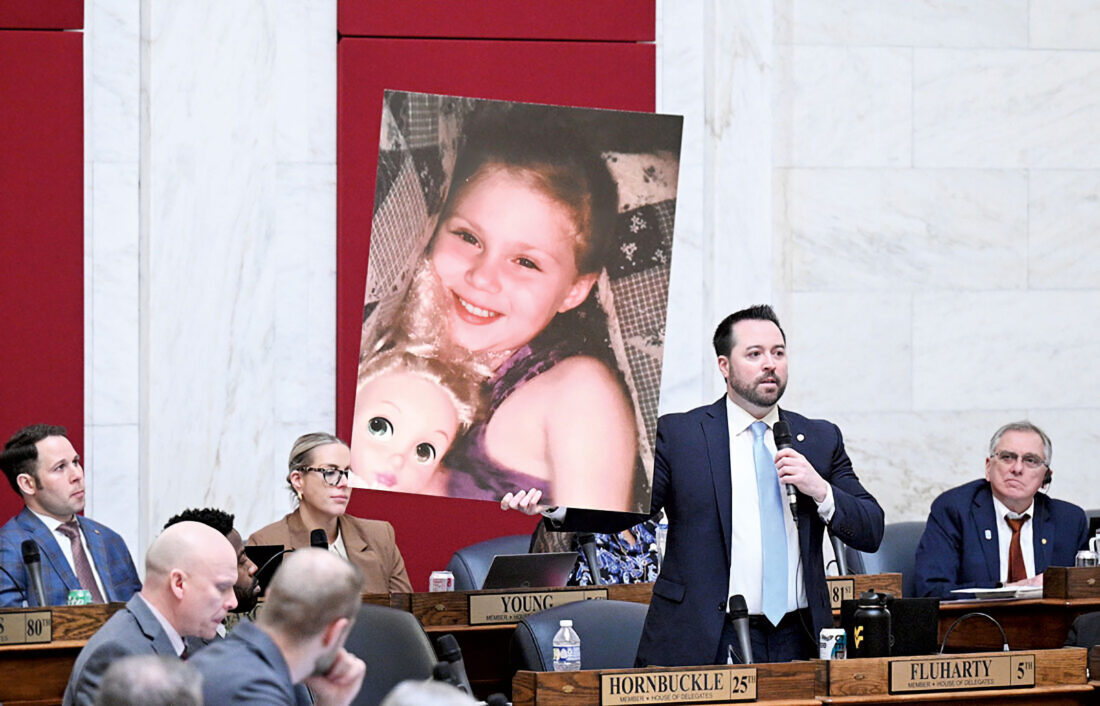
SPEAKING OUT — House Minority Whip Shawn Fluharty holds a photo of 8-year-old Raylee Browning, the namesake of a bill meant to prevent children from being pulled out of public school during active CPS investigations during a debate on an amendment in the House of Delegates in 2024. -- Photo Courtesy/WV Legislative Photography
CHARLESTON — With Wednesday’s legislative Crossover Day deadline around the corner, lawmakers in both the West Virginia House of Delegates and state Senate tried to get out bills aimed at protecting children from being pulled from school during child welfare investigations.
The House Education Committee held a hearing Monday afternoon on a committee substitute for House Bill 5669, prohibiting the home schooling of children in certain circumstances. The committee voted to suspend its rules to allow the bill to be considered and recommended in one day.
HB 5669 is the latest version of Raylee’s Law: named for Raylee Jolynn Browning, a child in Oak Hill who died in 2018 due to child abuse by her father, Marty Browning.
According to press reports, Raylee had been pulled from public school by Marty Browning. He, along with his girlfriend and girlfriend’s sister, were sentenced in 2022 after being convicted of child neglect causing death. The lead sponsor of Raylee’s Law — House Minority Whip Shawn Fluharty, D-Ohio — has been advocating for the law for years.
Under HB 5669, custodial parents or guardians accused of abuse or neglect would be prohibited from withdrawing a child from a school setting to begin homeschooling while the Child Protective Service (CPS) conducts its inquiry. The ban would remain in effect until the state determines the allegations are unfounded or a court intervenes.
The bill requires the department to provide official notice of these restrictions to both the relevant educational institutions and the child’s caretakers. Under the committee substitute for HB 5669, reports by mandatory reporters – those legally required to report suspected child abuse within 24 hours – are what would trigger the provisions of the bill.
“It only is initiated in a very strict circumstance if a report is made by a mandatory reporter, by a school teacher … or school personnel,” Fluharty explained. “That confirmation must be made within 48 hours, and it has to be substantiated within 14 days, meaning there’s a backstop here.”
“It does not apply to current homeschoolers, and it does not apply to all CPS reports. It only applies to those within the school setting,” Fluharty continued. “We have narrowly tailored this to those individuals only, not just any report that is made under the sun. There were concerns and there were some accusations made that this was very broadly tailored, and it would be people calling up and making false accusations. That’s not what this is about. This is narrowly tailored for mandatory reporters within this public school setting.”
A successful amendment from Del. Mike Hornby, R-Berkeley, narrowed the 14-day time frame to seven days. Another successful Hornby amendment would require the state Department of Education to establish specific guidance for county school systems for Raylee’s Law. A successful amendment from House Educational Choice Subcommittee Chairwoman Kathie Hess Crouse, R-Putnam, made a technical change.
Bills in the House and the Senate need to make it to third reading by the 50th day of the 60-day legislative session – also known as Crossover Day – when bills must be passed by the body or origin and be sent to the opposite body.
In order for HB 5669 to make it to third reading and the session’s Crossover Day deadline, the second committee reference to the House Judiciary Committee will need to be dispensed with. The House would need to take up the committee message during its floor session and rules would need suspended to have the bill read a first and second time in order for the bill to make it to third reading and passed out Wednesday.
Similar bills have passed the House the last couple of years only to not be taken up in the Senate. But this year, the Senate’s version of Raylee’s Law remains stuck in the Senate Health and Human Resources Committee.
Senate Education Committee Chairwoman Amy Grady, R-Mason, and Senate Assistant Minority Leader Joey Garcia, D-Marion, are the sponsors of Senate Bill 972, relating to education placements during child abuse and neglect investigations.
Speaking during a break in the floor session, Garcia said SB 972 differed from
“This is a version that Senator Grady and I worked really closely to try to narrow the scope, to make it very focused on children who are in public school, a public charter school, or a private school,” Garcia said. “This is not just a CPS complaint, but there is an actual investigation that begins. During that investigation, the child cannot be removed from those schools to be homeschooled, but there’s a 10 day limit on it, based on the committee substitute that we worked through.”
“This wouldn’t necessarily have fixed the situation with Raylee Browning; this is about the next situation,” Garcia continued. “This is about the next child … We want to make sure that they are protected and that we don’t have another senseless death that occurs.”
The bill was first introduced on Feb. 17 and was briefly on a committee agenda last week for the Senate Health Committee but removed from consideration.
During Monday’s floor session, Garcia made a motion to discharge SB 972 from the Senate Health Committee for consideration on the Senate floor. However, a motion to table Garcia’s motion was adopted in a 20-11 vote with three members absent or not voting. Nine Republicans voted with Garcia and Senate Minority Leader Mike Woelfel, D-Cabell, in opposing the motion to table.
Following the tabling of Garcia’s motion to discharge, Garcia made motions to have all bills on the Senate’s third reading agenda read in full instead of explained, a move used as a form of protest and a way to slow down the legislative process. Garcia said many in the Senate Republican majority are reluctant to do anything that advocates believe will harm the state’s home school system.
“I think there are some senators that if you say anything against homeschool, if there’s any regulation or impediment to someone being able to homeschool their kids or even how they do so, then there’s a lobbying group that is really working hard up here, and there are people that are sensitive to that,” Garcia said.
Roy Ramey, the president of the West Virginia Home Educators Association, told House Education Committee members Monday that those wishing to take their children out of the public school system should not be punished if there is a pending CPS investigation.
“If there’s truly harm that’s been done and justification for an investigation, by all means investigate,” Ramey said. “Just don’t stop that child from going to another educational system that they might be better suited to go to.”
“If we accuse somebody of some heinous crime, are they guilty already, or do we give them the leniency that they’re innocent until proven guilty,” Ramey asked. “This bill professes to say somebody is guilty and stops them from moving on to a better opportunity without even the presumption of guilt.”
“I don’t see anything in here that would hurt home schoolers,” Hornby said. “This is about publicly enrolled students who a report has been made on that we’re trying to protect them from being used by their parents if they were being neglected, right? So, I’m having a hard time understanding where in this bill you have such opposition.”
Local News
Raylee’s Law gets attention as Crossover Day deadline looms
Garbage rates discussed in Follansbee

As Mideast conflict widens, U.S. says attacks on Iran will last weeks and intensify
Senate panel advances bills allowing for State Police machine gun sales, eased domestic violence gun prohibitions
CHARLESTON — The Senate Judiciary Committee pushed out two bills Monday afternoon: one that could sidestep ...
New Cumberland approached about partnership to address unsafe structures