
A century of faith and fellowship: Wheeling cathedral marks historic milestone
Apostolic nuncio to the United States leads centennial mass
Trending
WHEELING -- Beneath vaulted ceilings that have carried a century of prayer, the Cathedral of St. Joseph marked its 100th anniversary Tuesday, celebrating the generations who built, preserved and filled it with faith.
The milestone was observed with an evening Centennial Mass, drawing clergy, religious leaders and parishioners from across the Diocese of Wheeling-Charleston. The gathering honored not only the cathedral's history, but its continuing role as a spiritual home in West Virginia.
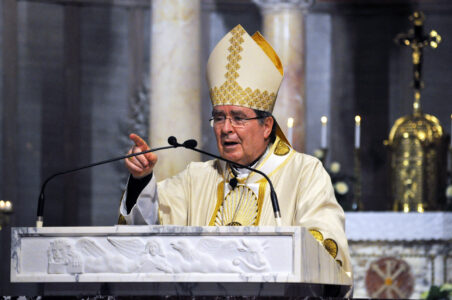
"It is a joy to be with you as we celebrate the 100th of this cathedral," said Cardinal Christophe Pierre. "We give thanks for the faith of those who built this church."
Pierre, the apostolic nuncio to the United States -- representing both Pope Francis and later Pope Leo XIV and who early this year participated in high-level meetings with the Pentagon amid tensions surrounding Pope Leo XIV's criticisms of U.S. policies -- was the principal celebrant and homilist.
Bishop Mark Brennan concelebrated alongside visiting bishops, with priests, deacons, religious and lay faithful filling the cathedral.
The present Cathedral of St. Joseph, consecrated April 21, 1926, is the second church to occupy the site. The original structure, St. James Church, was built in 1847 under Bishop Richard Vincent Whelan and became the cathedral when the Diocese of Wheeling was established in 1850. In 1872, Whelan dedicated the diocese to St. Joseph, Guardian of the Redeemer, a patronage that continues today.
After a devastating fire in 1923 left the original cathedral in disrepair, what followed was not only rebuilding but a renewed vision for the diocese. Designed by architect Edward J. Weber in the Lombard-Romanesque style, the new cathedral rose from the ashes and was intended to reflect both artistic craftsmanship and deep theological meaning.
At its consecration in 1926, Bishop John J. Swint described the cathedral as "symbolic of all the Catholic Church stands for" in West Virginia. A century later, it remains a visible sign of faith -- a testament to generations shaped by sacrifice, perseverance and an abiding trust in God.
Chad Carter, chancellor for the Diocese of Wheeling-Charleston, reflected extensively on the cathedral's history, pointing to both its construction and later preservation efforts.
"What a glorious evening as we gather from around the Mountain State to celebrate the centenary of our magnificent cathedral," Carter said. "Almost 20 years ago, when the cathedral was only 70 years old, a major restoration and renovation breathed new life into this building. It included many upgrades, but also uncovered some of the beautiful architectural and painted elements that had been hidden over the years."
Carter recalled how past church leaders recognized the cathedral's significance, including during that re-dedication.
"Bishop Bernard Schmitt, during the re-dedication Mass homily, recalled the children's rhyme 'The House That Jack Built,'" Carter said. "He emphatically stated that this was the house that John built -- Bishop John J. Swint -- and what a magnificent house of prayer this cathedral is and has been for 100 years."
He added that the cathedral's creation was the result of both vision and craftsmanship.
"Truly inspired by God, dreamed and guided into being by our beloved Bishop Swint -- a native West Virginia son and a very young bishop at that time -- and meticulously designed and executed by the master architect Edward J. Weber and many skilled artists and craftsmen," Carter said.
Carter emphasized that the building's history is inseparable from the people who sustained it.
"These sacred walls could tell many stories, not only from its time of construction to dedication, but of the outpouring of love, faith and tireless work by so many bishops, priests, deacons, religious and lay faithful over these past 100 years," he said. "Tonight, we give thanks to all those who have gone before us -- those whose faith, sacrifice and generosity built and sustained this cathedral."
Brennan welcomed parishioners and local religious leaders, including Rabbi Joshua Lief of Temple Shalom, the Rev. Joshua Saxe of St. Matthew’s Episcopal Church and Bishop Darrell Cummings of Bethlehem Apostolic Temple, while speaking of both gratitude and renewal.
"We acknowledge with gratitude those who have served in this cathedral parish in years past and helped shape its life and mission," Brennan said. "As we mark 100 years of faith in this cathedral, we pray this sacred time renews our love for Christ and inspires us to carry forward the Gospel with hope for generations to come."
Brennan also offered special recognition to the descendants of architect Edward J. Weber in attendance.
"We are mightily indebted to your grandfather and great-grandfather," Brennan said. "He designed a magnificent place in which we can gather to worship God."
Pierre, weaving both humor and reflection into his homily, greeted the congregation warmly.
"Greetings to all of you from Pope Leo XIII," he said. "You know him? You like him? He's a good one, isn't he? Greetings in his name."
He, too, acknowledged the descendants of architect Edward J. Weber seated in the front pews.
"The family of the builder," Pierre said, gesturing toward them before pointing up. "But we are all family of the builder, by the way."
While honoring the past, Pierre urged those gathered not to remain focused solely on it.
"For those who have worshiped here and for all that God has done in this diocese, the word of God today invites us to do more than to look backward," he said.
"God does not merely gather us in a building. He builds us up as his people. He does not only desire to bring us to a holy place -- he desires to make us holy."
Pierre reflected on the cathedral itself with a lighthearted remark before turning to its deeper meaning.
"This cathedral -- by the way, it's quite a nice one, isn't it? -- has been built and rebuilt," he said. "A church like this lifts your heart and reminds us that we are made for more."
Pierre's words underscored that the true legacy of the cathedral lies not in its structure, but in its people.
"So yes, today we give thanks for this cathedral of stone -- of stone and marble," Pierre said. "But even more, we give thanks for what God has done and continues to do through it."