
A day in court for Steubenville students
Judge Michelle Miller gives civics lesson
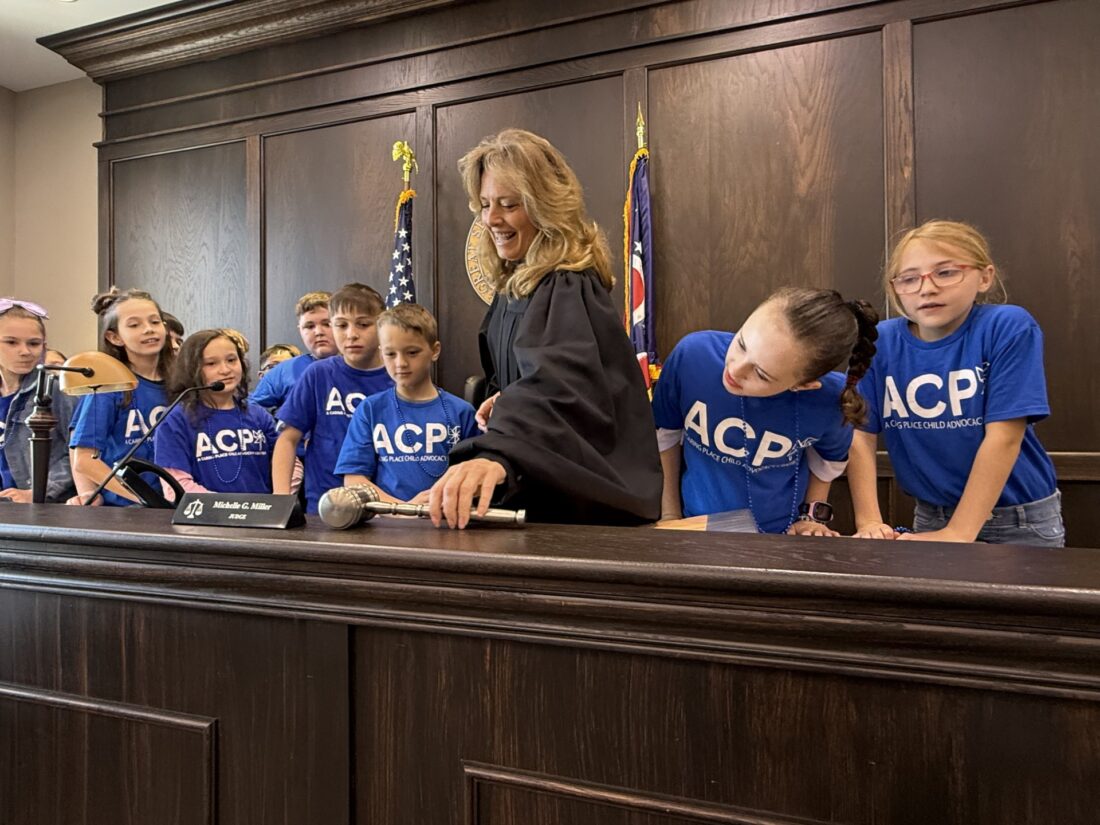
Linda Harris CLOSER LOOK — Students from Steubenville City Schools take a closer look at Jefferson County Common Pleas Judge Michelle Miller's gavel.
STEUBENVILLE — Jefferson County Common Pleas Judge Michelle Miller may have faced her toughest crowd this week — two dozen second-, third- and fourth-graders from Steubenville City Schools who piled into her courtroom to learn about the justice system.
The kids, students at Wells Academy and McKinley STEM Academy, had planted blue pinwheels earlier in front of the courthouse minutes earlier to draw attention to child abuse, then made their way up two flights of steps to a third-floor courtroom where Miller talked with them about the court and how it functions, asking them questions and answering theirs.
The idea, she said, is “to build a foundation of trust for those in authority.”
“That starts by introducing them to the courtroom and court personnel and the people involved with it,” Miller said. “Familiarity can, I think, breed trust. And not only that, but it’s also an opportunity to talk about civic duty and responsibility, introduce them to government and discuss the role of the judiciary — and instill in them how important it is to follow the rules.”
She reminded the kids there are always going to be consequences for breaking rules, whether it’s at home, at school or when they’re out in public.
“Crimes are just people not following the rules,” Miller explained. “It’s kind of like coming to the principal’s office if you do something wrong at school or at home, if you don’t do what your parents say there are consequences — (you may be) grounded or get time out. When adults come into my courtroom, you know what I tell them? If you follow the rules we all learn as children, as students — don’t take things that don’t belong to you … get your own coat, your own pencils or your own backpack … keep your hands to yourself — that solves a lot of the problems, right?”
She told the kids that consequences are what happens when you break the rules.
“In our country we listen to the evidence,” she said. “We just don’t take people and put them in time out … When you go to the principal’s office, the principal doesn’t just say, ‘Hey, you’re in trouble’ and that’s it. The principal wants to know what happened, your teachers want to know. It’s the same here — we try to find out what happened and if something did happen, somebody needs to be held accountable.”
That was a concept the kids understood.
“I have to clean my room and do a lot of stuff or I get in trouble,” one boy offered. His classmates admitted their parents tell them to “take care of the cat,” “clean the toy room” or “do your homework,” and if they don’t do it, it’s trouble.
“Laws exist so people don’t have to fight and throw punches and yell and scream at each other,” Miller said. “They don’t have to do that.”
The visit ended with the kids taking turns sitting at the bench and asking the judge questions. Miller said it’s an annual event, though this year’s crowd was smaller than normal due to so many schools being on spring break.
“This year I was pleasantly surprised,” she said. “These were second-, third- and fourth-graders and they were able to answer almost all of my questions about the three branches of government and what each branch is responsible for. I was really impressed that kids that age were able to grasp the concepts of self-government and were able to identify the three branches, the roles of each.”
She said it’s a chance for the kids to talk to and learn about all the people involved in the justice system, from law enforcement, prosecutors and defense attorneys to court reporters, court administrators, support staff and judges who keep things on track.
“I think it encourages them when you share your story, when you tell them ‘I’m a graduate of Buckeye North (now Buckeye Local) and I grew up here,’ you can grow up here, go to college and on to law school, work hard at your career and become a judge … those are real aspirations to have,” she said. “And it’s important that they meet a judge directly and meet our support staff — it fosters respect, I think. It fosters an understanding of what the legal system is and that we can resolve any differences fairly. It fosters a great foundation for citizen participation in our democracy, not to be too corny, but it’s true.”
Local News
One dead following incident at Marshall County mine
A miner was killed after suffering head and neck injuries in an incident at a Marshall County mine Friday ...
W.Va. Citizens Action Group files intervenor motion against DOJ effort to obtain voter records
CHARLESTON - An advocacy group is seeking to intervene against efforts by the U.S. Department of Justice (DOJ) to ...
Health center hits milestone

Work begins Monday on Veterans Memorial Bridge, U.S. 22
Church sermon topics
• Bell Chapel UMC: "It Doesn't Matter" • Cadiz Presbyterian Church: "He Set Me Free!" • Cove Presbyterian ...
Daily Happenings
Steubenville Police Pointing fingers: A woman in the 500 block of S. 4th Street wanted a male roommate removed ...