Judicial Order: Voters have choices in races for W.Va. Supreme Court, Intermediate Court of Appeals
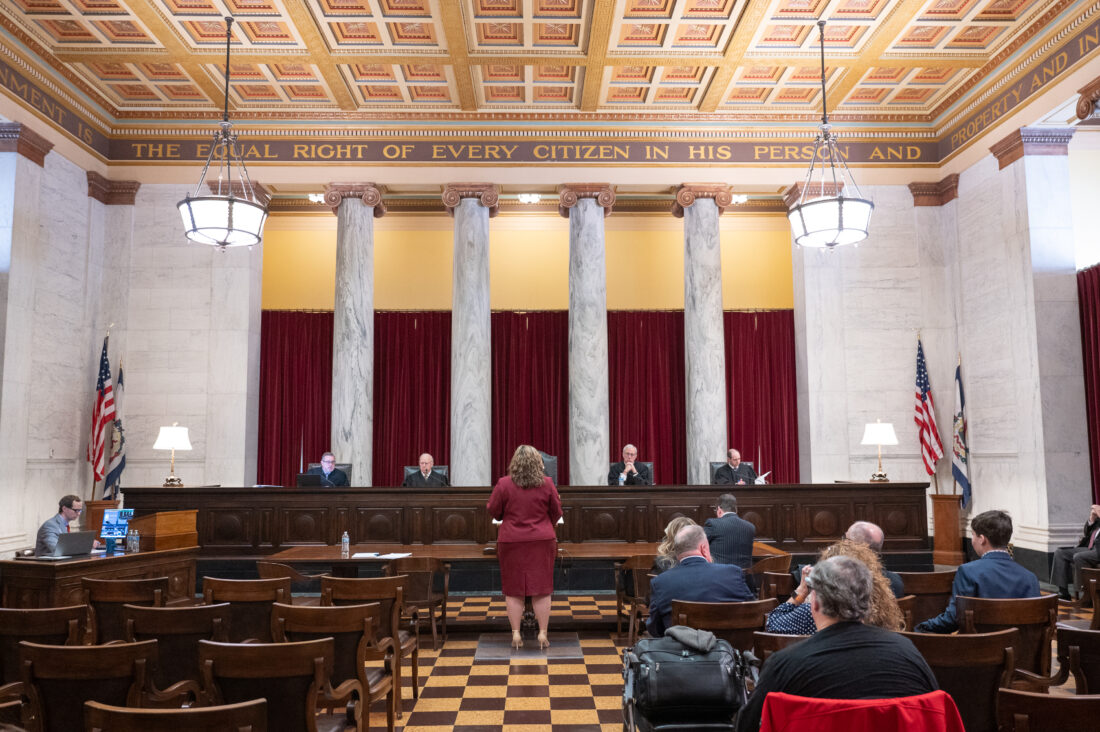
Photo courtesy of WV Supreme Court of Appeals The West Virginia Supreme Court of Appeals heard arguments on the first day of its Spring 2026 term in January.
CHARLESTON – This year’s May primary serves as the general election for two races for the West Virginia Supreme Court of Appeals, while voters will get their chance to elect a second judge to the state’s new Intermediate Court of Appeals.
Both state Supreme Court races feature a justice appointed by Gov. Patrick Morrisey, with other candidates in those contested races including current and former circuit court judges, an attorney, and a member of the West Virginia House of Delegates. The one race for Intermediate Court of Appeals features the court’s first chief judge being challenged by a long-time family court judge.
Supreme Court Division 1
Voters will decide whether Morrisey’s appointed justice remains on the bench or if a new candidate will follow in the footsteps of the late Justice Tim Armstead.
Armstead, 60, died in August due to complications from cancer. A 20-year member of the West Virginia House of Delegates and former House speaker, Armstead was appointed to the state Supreme Court by then-Gov. Jim Justice in 2018, re-elected to serve the remainder of former Justice Menis Ketchum’s term later that year, and elected in 2020 to a full 12-year term.
Morrisey announced last November the appointment of Charleston attorney Gerald M. Titus III to serve on the state’s highest court and succeed Armstead until the May special election.
Titus is in a five-way race to determine who will serve the remainder of Armstead’s term, which runs through 2032.
“As a Supreme Court Justice, my job is to apply the law as written and to faithfully adhere to the United States and West Virginia Constitutions,” Titus said. “It is imperative that the judiciary stay in its constitutional lane and not attempt to make policy or legislate.
“Cases should be decided based upon the law, not politics, social status or anything other than the law,” Titus continued. “This approach produces the clarity, predictability and stability necessary to move our state forward economically while also protecting our communities from those who would break the law. This can be accomplished while treating all parties before the Court with dignity and respect.”
Titus was an attorney with the Spilman Thomas and Battle law firm based in Charleston and a former assistant U.S. Attorney for the Southern District of West Virginia working in the Violent Crime Division. He began his legal career at Allen Guthrie McHugh and Thomas PLLC. He is a graduate of Washington and Lee University, where he earned a bachelor’s degree in politics and American history, and later his law degree.
Twenty-Seventh Judicial Circuit Court Judge Laura V. Faircloth was first elected to the new 23rd circuit in 2016, which then also served Berkeley, Jefferson and Morgan counties. Voters returned her to the bench in 2024 to serve in the new 27th circuit, which serves Berkeley and Morgan counties.
“My judicial philosophy is quite simple, as personified by Lady Justice, who carries a sword and a balanced set of scales and is blindfolded,” Faircloth said. “Her blindfold symbolizes the absence of bias or prejudice; hence, ‘justice is blind.’ The balanced scales represent a fair and balanced regard for truth and fairness. Finally, the sword symbolizes the power of the judiciary, which must be exercised with measured and tempered authority.
“In summary, then, Judicial officers must preside without bias or prejudice, balance truth and fairness, and responsibly exercise the power of the judiciary – which sometimes requires punishment, accountability, and restitution,” she continued. “The public must have confidence in the judiciary to exercise all of these functions, and my judicial philosophy includes my duty to be transparent and exercise these functions to the best of my ability.”
Faircloth led her own six-person law firm in Martinsburg. Prior to that, she was a partner at Preiser, Tabor, Lindsay and Coltelli (now Tabor Lindsay and Associates), which focuses on medical malpractice lawsuits. Her law career saw her work at Askin, Pill, Scales and Burke; Martin and Seibert; and Lewis, Ciccarello, Masinter and Friedberg. Faircloth has a bachelor’s degree in political science from Shepherd University and earned her law degree from West Virginia University.
Fourteenth Judicial Circuit Judge Todd Kirby is in the middle if his first four-year term serving from the bench in Raleigh County. He was appointed by Justice to the remainder of a term in 2024, winning election to the seat that same year.
Kirby was previously a Republican member of the West Virginia House of Delegates, serving part of one two-year term beginning in 2023 in the 44th House District in Raleigh County.
“I see my role as a judge to be one of interpreting law and not legislating from the bench,” he said. “The Constitution and our laws mean what they say, and it is not the role of judges to revise, transform or bend them to fit personal preferences or political outcomes. I believe that respect for the law, precedent and our Constitution is what preserves our Republic and ensures liberty for the people.”
Kirby opened up his own law practice in Beckley in 2011 after earning his law degree from Liberty University. He also has several degrees from Marshall University. He has experience as an assistant prosecuting attorney in Raleigh County, where he handled child abuse and neglect cases.
“I serve and will continue to serve with humility and fairness,” Kirby said. “Coming from a working-class background, my courtroom is a place where every litigant receives the same respect and the same application of the law. Justice is not about who has the most resources or power, but about applying the law evenly and without favoritism.”
Senior Status Judge H.L. “Kirk” Kirkpatrick retired in 2024 after serving as a long-time circuit court judge in Raleigh County. A senior status judge is a former judge that can be recalled for temporary assignment by the state Supreme Court.
Kirkpatrick has more than 30 years of judicial experience, having served as the chief judge of the Raleigh County circuit. He administered the circuit’s juvenile drug court for 10 years and served as a member of the state Judicial Investigation Commission which enforces the Code of Judicial Conduct for sitting judges and justices.
“My judicial philosophy, shaped by three decades of judicial experience, is grounded in a commitment to the rule of law, judicial restraint, and the implementation of the plain wording of the Constitution,” Kirkpatrick said. “I believe that voters should judge a candidate based on their record, not vague promises of change or judicial activism.”
Kirkpatrick was first appointed to the bench in the then-10th Judicial Circuit by former Gov. Gaston Caperton in 1995, winning election to the bench in 1996. Prior to his judicial career, was an attorney with the law firm of Bailey, Worrell and Viars in Pineville, beginning in 1976; in a solo practice in Pineville from 1979 to 1985; and at Ashworth and Kirkpatrick from 1985 to 1995. Kirkpatrick is a graduate of the University of Kentucky with a law degree from WVU.
“I stand on my record of achievement, which I invite all to examine,” he said. “I have presided over thousands of cases and have treated every lawyer and litigant in my courtroom with respect and common human decency. Everyone who comes to court deserves to have their cases decided impartially, based on the facts and the law. I am committed to ensuring that our courts remain fair, transparent and worthy of the public trust.”
Wheeling attorney Martin “Red Hat” Sheehan – who previously went by the nickname “Red Shoes” due to his flamboyant footwear – has been an attorney in private practice since 1990. He also has experience as a former assistant U.S. attorney and was an adjunct lecturer at the WVU College of Law. An email to Sheehan seeking comment was not returned.
Supreme Court Division 2
The winner of the Division 2 contest for state Supreme Court will serve the remaining term of Justice Elizabeth “Beth” D. Walker, who retired effective last June.
Walker was first elected to the Supreme Court in 2016, beginning her 12-year term in 2017. During her tenure, she served in the rotating position of chief justice in 2019 and 2023.
Morrisey appointed former 15th Judicial Circuit Court Judge Thomas H. Ewing to succeed Walker until the May special election.
Ewing faces state Del. Bill Flanigan, R-Ohio, in the race to complete the term until 2028.
Ewing was appointed to the 15th Circuit serving Fayette County at the end of 2018 by former Gov. Justice. He was elected for his first four-year term in 2020 and re-elected in 2024.
“My judicial philosophy is grounded in three core principles: upholding the rule of law, getting the decision right, and treating every person with dignity and respect,” Ewing said. “I believe the independence and integrity of the judiciary must be protected at all times, which means making decisions based on the law and the Constitution – not political pressure, public opinion, or special interests.”
Prior to his appointment, Ewing worked for the Kay, Casto and Chaney law firm in its Fayetteville office. He has two bachelor’s degrees from Glenville State University and a law degree from WVU.
During his tenure in the 15th Judicial Circuit, Ewing presided over the Fayette County Family Treatment Court, Teen Court, and the Truancy Diversion Program. He served as a commissioner on West Virginia’s Juvenile Justice Commission.
“For the individuals who come before the Court, their case is often one of the most important matters in their lives, and they deserve a Justice who is prepared, thorough, and committed to doing the hard work necessary to reach the correct outcome,” Ewing said. “Just as important, judges and justices set the tone for the entire judicial system, and every person who enters the courtroom should be treated with dignity and respect. Throughout my career as a lawyer, judge, and now a Justice, I have demonstrated a consistent commitment to these principles, and my record reflects the kind of Justice I am and will continue to be.”
Flanigan is finishing out his second two-year term in the House of Delegates representing the 4th District, where he served on the House Judiciary Committee and Courts and Legal Services subcommittees. He also served on legislative interim committees for Children and Families, Judiciary and West Virginia Fusion Center Oversight.
“I bring both legislative experience and a strong commitment to constitutional principles to this race,” Flanigan said. “As an attorney and current member of the state Legislature, I’ve dedicated my career to upholding the rule of law, protecting judicial integrity, and ensuring that every West Virginian’s voice is heard.”
Flanigan was first appointed to the House in the former 51st District, which included Morgantown, in 2016, but was unable to serve the remainder of the term due to complications from a 2007 testicular cancer diagnosis.
He manages his own law firm in Wheeling after moving back to West Virginia in 2021. He has a bachelor’s degree from Salem-Teikyo University, a master’s degree from the University of San Francisco and a law degree from WVU.
“I believe the role of the court is to interpret the law as written,” Flanigan said. “I will not legislate from the bench. I will remain free from political influence. I am running on principles of transparency, accountability, and fairness. My experience in both crafting and applying the law has given me a well-rounded perspective, and I will serve the people of West Virginia with honesty, respect and an unwavering commitment to justice.”
Intermediate Court of Appeals
Voters have the opportunity in May to elect the second of three positions on the West Virginia Intermediate Court of Appeals since the court’s creation by the Legislature in 2021.
The new three-judge court, which began hearing cases in 2023, is meant to help take the load off of the state Supreme Court and allow the justices to focus on precedent-setting legal cases.
The first three ICA judges were appointed by former Gov. Justice. In 2024, voters got to choose the first ICA judge for a 10-year term with the election of ICA Judge Ryan White.
Dan Greear is one of the ICA’s original judges and is serving a second time as the court’s chief justice. He is a former Kanawha County Circuit Court judge, was a Republican candidate for attorney general in 2008 and was a chief of staff and legal counsel for the House of Delegates.
“My judicial philosophy is that of judicial restraint,” Greear said. “A judge should respect and follow the policy decisions as announced in the text of legislative enactments. The judge must ensure that the legislation fits within the guidelines of the Constitution. When interpreting a statute or the Constitution, the meaning of the text when enacted is paramount. A judge should refrain from forcing his own beliefs, opinions, or experiences in place of the actual intent of the Constitution or legislation.”
Greear served in the House representing Kanawha County for one two-year term beginning in 1995. He served as chief counsel for the former then-attorney general, now-Gov. Morrisey from 2013 to 2014. Greear was also a managing member of KKB, LLC, focusing on civil litigation.
Greear’s lone opponent is 11th Family Circuit Court Judge Jim Douglas, who was first elected to the circuit serving Kanawha County in 2016 and re-elected in 2024. Prior to that, Douglas operated his own law practice since 1977 focused on divorce proceedings and family law. He also served as prosecuting attorney in Braxton County for one term beginning in 1985.
“My entire career has been dedicated to Family Law. Nothing, nothing, is more important to a continuing civilized society than families and children,” Douglas said. “I believe my kids and my grandkids, and your kids and grandkids, are entitled to have the most qualified Judge sitting on their cases.
“Would you want a veterinarian to treat your daughter for an abscessed tooth? Would you want your son to get the oil in his truck changed by a spa masseuse? Would you want your granddaughter to have a divorce lawyer just out of law school who has just watched two episodes of ‘Judge Judy?’ Qualification and experience are the watchwords,” he continued. “West Virginia families want me on the ICA; they need me on that ICA; the children have to have me on the ICA.”
Local News
Steubenville income tax levy renewals on primary ballot

Sunnyside Dispensary Opens In Bridgeport

JVS Transition To Work students gain on-the-job experience
Police Reports
Steubenville Police Creepy men: A juvenile jogging in the 1000 block of Lincoln Avenue Wednesday said she felt two ...
Judicial Order: Voters have choices in races for W.Va. Supreme Court, Intermediate Court of Appeals